All species › Passerines › Thornbills, scrubwrens, gerygones and allies › White-throated Gerygone
White-throated Gerygone | Gerygone olivacea
Witkeelmangrovezanger | Gerigón de garganta blanca
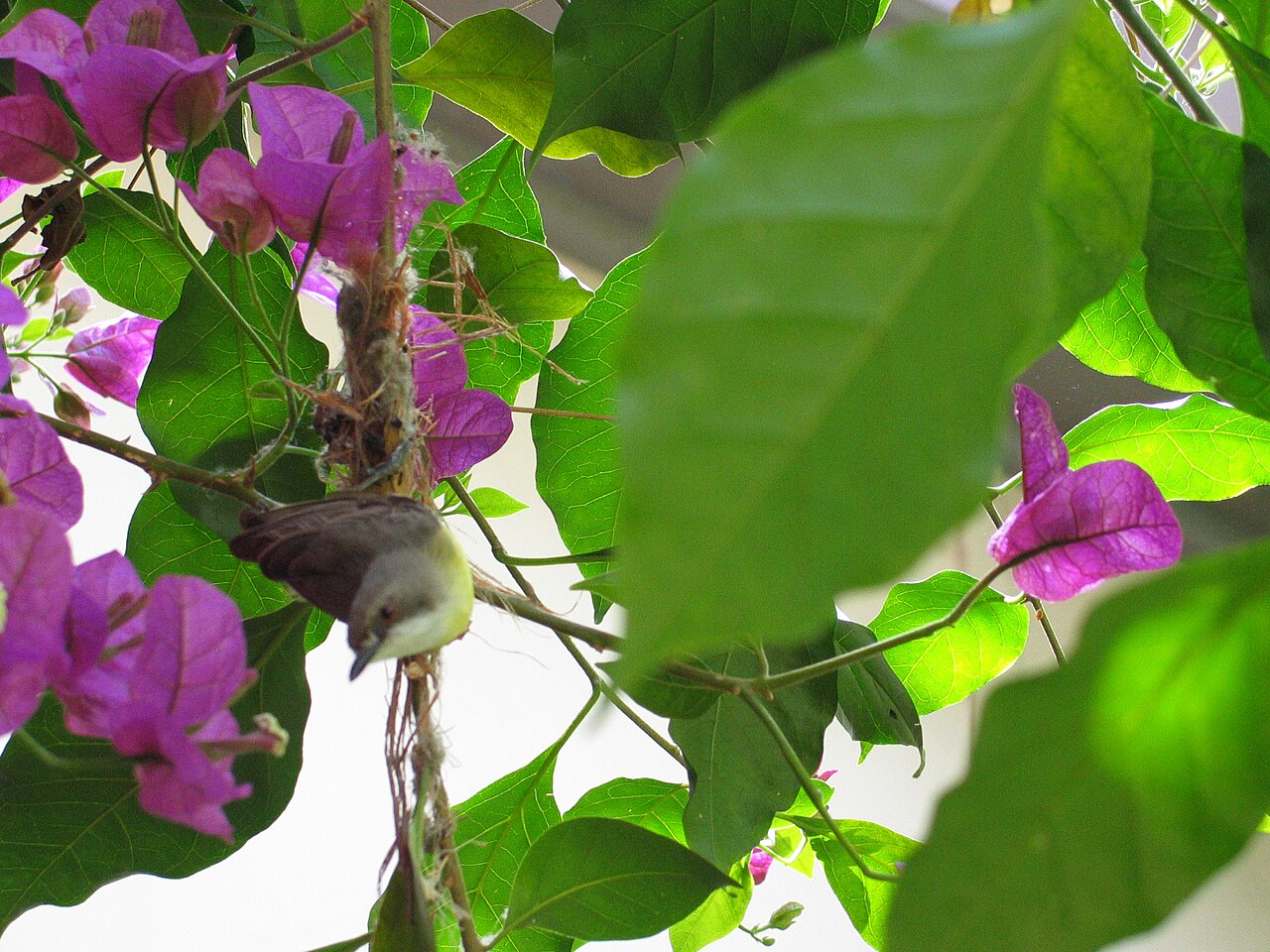
The White-throated Gerygone is the most striking of all the gerygones, and at the same time the one species that does not belong in mangroves at all: it lives in open eucalypt woodland and along creeks. Eleven centimetres, grey-brown above, with a bright yellow belly, a white throat, a small white spot on the forehead and a red eye. In southeastern Australia it is a summer bird that returns in spring and makes itself heard at once.
Voice
A descending trill, sweet and silvery, which slides down like a falling leaf and fades away on the last note. It is one of the most recognisable sounds of Australian woodland and it is usually the first sign that the species is back in the south. In the breeding season it sings all day, including through the middle of the day when the rest of the bush falls quiet.
Recording: Zebedee Muller — CC BY-NC-SA 4.0 · Paddy's River (near Paddys River), Australian Capital Territory, Australia · xeno-canto
Identification
Small and slim, grey-brown on head and back and bright lemon-yellow on breast and belly. The throat is white and sharply set off against the yellow, and a small white spot sits on the forehead. The eye is red. The tail is dark with white tips to the outer feathers, best seen as the bird turns. Young birds are duller, with a brown eye and a less sharply marked throat.
Confusion species
Fairy Gerygone (Gerygone palpebrosa) is the only real pitfall and overlaps only in Queensland: it lacks the white tail tips, and in the male the throat is dark rather than white. Young birds resemble the Weebill (Smicrornis brevirostris), but that bird has a pale eye with no red, no white throat or forehead spot, is paler above and has a shorter, paler bill. Western Gerygone (Gerygone fusca) shares the woodland locally but is grey and off-white with no trace of yellow. The remaining members of the genus — Brown Gerygone (Gerygone mouki), Large-billed Gerygone (Gerygone magnirostris), Mangrove Gerygone (Gerygone levigaster), Dusky Gerygone (Gerygone tenebrosa), Grey Gerygone (Gerygone igata), Norfolk Gerygone (Gerygone modesta) and Chatham Islands Gerygone (Gerygone albofrontata) — are all plain and yellowless, or live outside the range.
Habitat
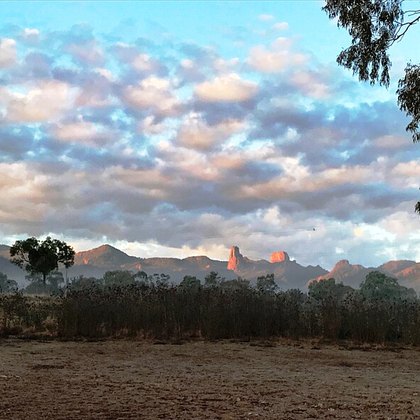
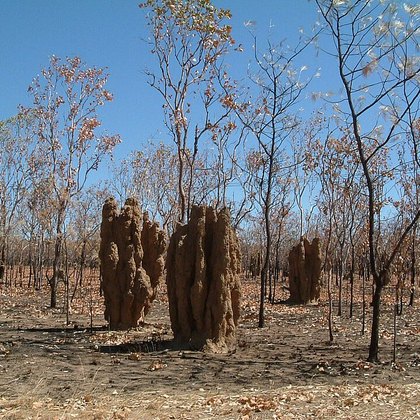
Open eucalypt forest and woodland, the tree belts along creeks and floodplains, and in the north eucalypt savanna. It hunts high in the canopy and among the outer leaves, gleaning insects and other arthropods from the foliage or fluttering out after them. In well-planted gardens and parks close to bush it turns up regularly.
Where the bird is most often found, arranged by main group and formation.


Range and movements
From southeastern Australia through Queensland and right across northern Australia to the Kimberley in Western Australia. Southern birds are partly migratory: they breed in the south and move north in winter, so there the species is a pronounced summer visitor. In the north it stays all year. Pairs mate for life.
- Resident
- Breeding (summer)
- dark = core range, pale = thinly spread
Where and when to look
Learn the descending trill and the rest follows: it sings higher in the tree than you are looking, and it is small enough to read as a silhouette against the sky. Then look for the yellow belly and the white tail tips. In September and October it is suddenly everywhere in the southeast; by May it has gone from there.
Conservation
Least Concern (LC) and common over most of its range. It wants open forest with an intact canopy and goes where woodland is thinned to scattered paddock trees. In the closely farmed country of the southeast it has therefore declined locally, while in the north it remains undisturbed. As a long-distance migrant it also depends on woodland at both ends of the journey.
Scientific name
Gerygone olivacea | (Gould, 1838)
Gould described the species in 1838 as Psilopus olivaceus, from a bird taken in New South Wales; because the name later moved to Gerygone, author and year stand in parentheses. Gould himself replaced Psilopus with Gerygone in 1841, from Greek gērugonos, born of sound. olivacea means olive-coloured, after the upperparts. For a long time the species was called Gerygone albogularis, white-throated, and that name still stands on older factsheets; the Dutch name Witkeelmangrovezanger points at the same feature, even though the bird does not live in mangroves.