All species › Passerines › Thornbills, scrubwrens, gerygones and allies › Brown Gerygone
Brown Gerygone | Gerygone mouki
Bruine mangrovezanger | Gerigón pardo
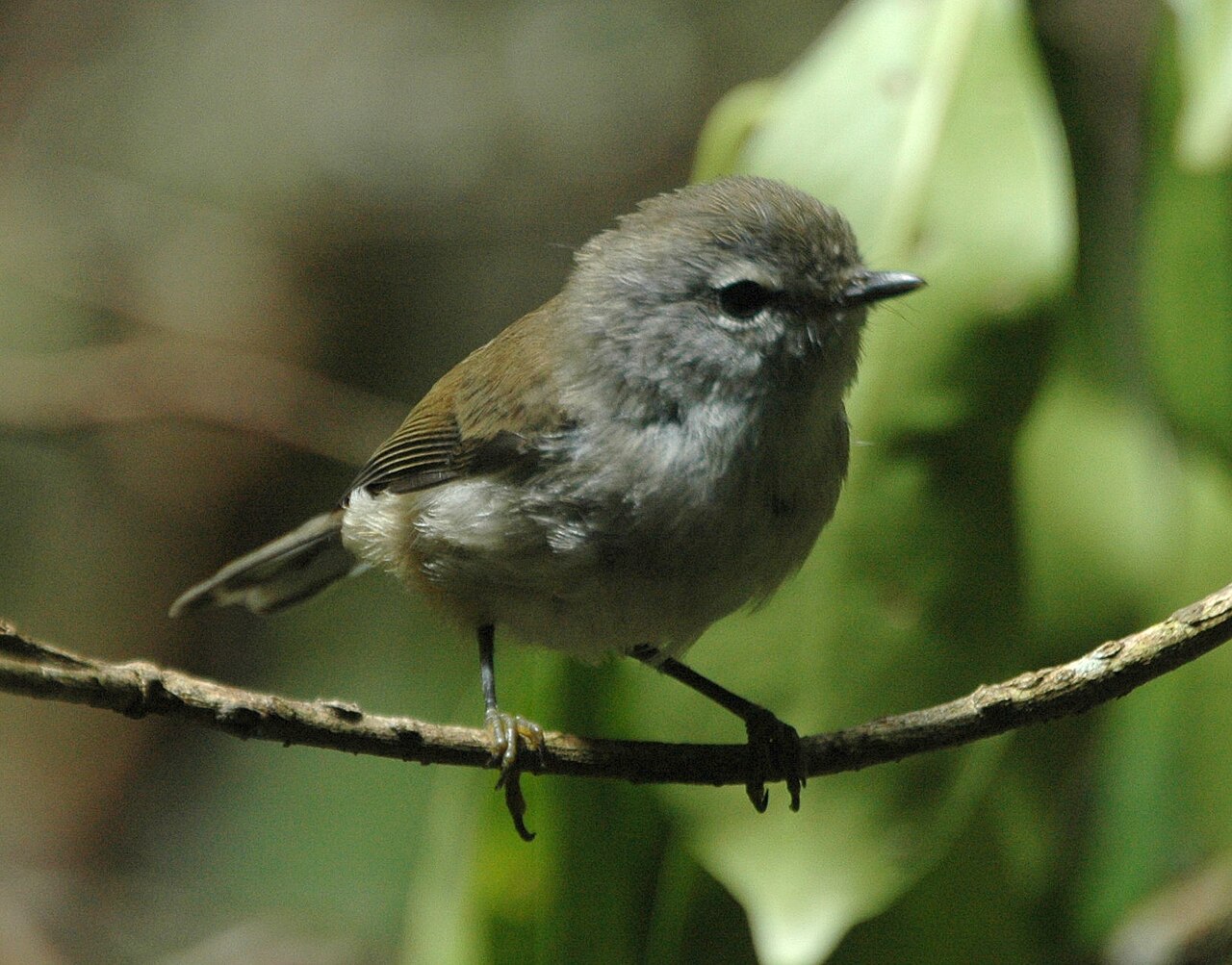
Despite the Dutch name the Brown Gerygone is above all a rainforest bird: a tiny, plain brown-grey warbler that flutters ceaselessly through the foliage of the eastern coastal forests in pairs and parties of three or four. It is one of the few members of its difficult genus that can be named without hearing it, thanks to one character most of its relatives lack: a long, sharply drawn white eyebrow above a grey-washed face.
Voice
The voice is busy, incessant and surprisingly loud for so small a bird. The most quoted motif is a soft repeated phrase written in English as what-is-it — two short notes and a higher third — repeated almost all day from high in the canopy. Alongside it runs a series of brisk rattling and chirping contact notes by which the members of a party keep track of one another in dense leaves. Once the phrase is known, the species can be heard in any patch of coastal rainforest that holds it.
No freely licensed recording has been found for this species yet; what to listen for is described below.
Identification
Nine to eleven centimetres, so smaller than almost any other bird of the forest. The upperparts are olive-grey in the southern race richmondi and buffier brown in the northern mouki; face and underparts are pale grey, with a brown wash along the flanks. Three things together decide it: the long white eyebrow, the grey-tinged face and the red-brown eye. The tail carries a dark band and white tips, most visible as the bird turns in the air. The sexes are alike.
Confusion species
This is the easiest of the group, but the confusion is real. Large-billed Gerygone (Gerygone magnirostris) lacks exactly that eyebrow — at most it shows a narrow broken eye-ring — and has a heavier bill; where the two meet in northern Queensland that is the deciding point. Mangrove Gerygone (Gerygone levigaster) does have the eyebrow, but lacks the grey face, is whiter on the flanks, has a redder eye and sits in mangrove rather than rainforest. White-throated Gerygone (Gerygone olivacea) is yellow below and thereby ruled out at once; Fairy Gerygone (Gerygone palpebrosa) is likewise yellow below and the male has a black throat. For completeness: Green-backed Gerygone (Gerygone chloronota) and Dusky Gerygone (Gerygone tenebrosa) stay in the tropical north and west and do not occur here, and Western Gerygone (Gerygone fusca) is paler and belongs to dry woodland.
Habitat
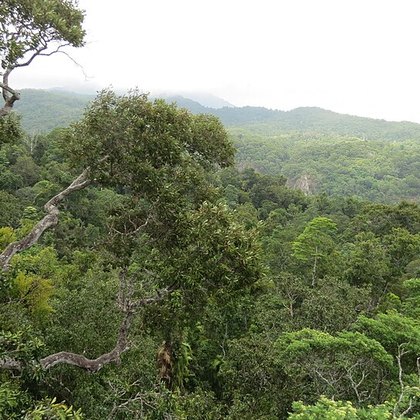
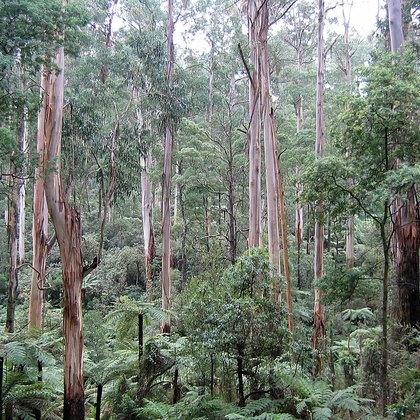
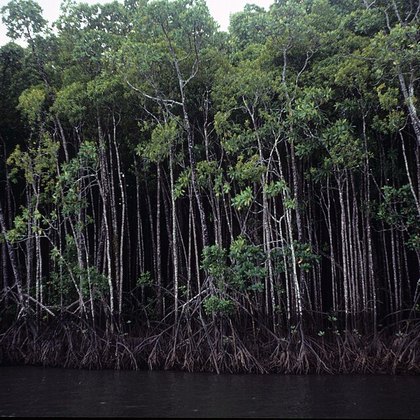
Coastal and mountain rainforest, wet eucalypt gullies and, locally, mangrove — the Dutch name rests on that last and smaller part of the story. It forages at all heights of the forest but most in the canopy, hanging and fluttering around the leaves and snatching flying insects out of the air. Planted suburbs with enough closed canopy are occupied too; the Royal Botanic Gardens in Sydney are a well-known site. The nest is a rounded dome with a tapering ‘tail’ below it, slung from a branch or vine, holding two to four eggs; the season runs from August to February, eggs hatch after eighteen days and the young fledge after about fifteen.
Where the bird is most often found, arranged by main group and formation.

Range and movements
The east coast of Australia in two disjunct sections: the northern race mouki north of Tully in Queensland and there only above about two hundred and fifty metres, and the southern race richmondi from Cooktown south to Sale in Victoria. In Victoria the species is expanding westward; records from the Dandenong Ranges east of Melbourne are confirmed. It is sedentary and does not migrate.
- Resident
- dark = core range, pale = thinly spread
Where and when to look
Stand still on a rainforest track and look up rather than into the understorey. You are looking for motion, not colour: a couple of very small birds fluttering endlessly around the leaf tips and talking softly and constantly while they do it. The moment one sits, find the white eyebrow against the grey face — that takes two seconds and separates it at once from Large-billed. Early morning and the track edges work best, because the canopy comes low enough there.
Conservation
Least Concern (LC) and common throughout its range. The species is tied to closed forest and therefore to the remnants of coastal rainforest, which are themselves poorly represented in the Australian landscape; within those remnants, though, it holds up well, including in fairly small patches and in planted suburbs. The westward expansion in Victoria points to gain rather than loss. What matters most is keeping the canopy continuous: where the forest opens out, the layer it forages in disappears.
Scientific name
Gerygone mouki | Mathews, 1912
Gregory Mathews described this form in 1912. The genus name Gerygone goes back to Greek and is usually read as ‘born of song’, fitting for a group that can be told apart almost solely by ear. The meaning of the epithet mouki is not clearly documented and is therefore left open here. The English name Brown Gerygone and the older Brown Warbler take the colour, as does Spanish gerigón pardo. The Dutch name mangrovezanger is misleading for this species: mangrove is a fringe habitat, rainforest is its real home. That is a quirk of the Dutch naming of the whole genus rather than of this bird.