All species › Passerines › Thornbills, scrubwrens, gerygones and allies › Norfolk Gerygone
Norfolk Gerygone | Gerygone modesta
Norfolkmangrovezanger | Gerigón de la Norfolk
The Norfolk Gerygone lives only on Norfolk Island, a thirty-five square kilometre island in the Tasman Sea, and nowhere else. That is among the smallest ranges of any species in this guide. At the same time it is the commonest native bird on that island — a combination that states exactly what island endemism amounts to: numerous and yet vulnerable, because everything that goes wrong goes wrong in one place at once.

Voice
A melodious, loud trill, strikingly powerful for the island's smallest bird, and the easiest way to find it. Parks Australia explicitly advises visitors to Norfolk Island National Park to go by ear first and only then search the trees, because seeing it is harder than hearing it. The song has the quality of that of its sister species on the New Zealand mainland, which given the close relationship is no surprise.
No freely licensed recording has been found for this species yet; what to listen for is described below.
Identification
About eleven centimetres with a sixteen-centimetre wingspan and a weight of some nine grams. The head is olive-brown, the face grey and the throat greyish, turning whitish on breast and belly; the upperparts are dull grey-brown. The eye is red to red-brown, the bill black. Young birds carry a yellow wash over face and underparts, a duller eye and a paler bill. It moves fast and restlessly through the canopy, catching insects on the wing and gleaning them from leaves and branches.
Confusion species
On Norfolk Island there is nothing to confuse it with: it is the only Gerygone on the island and the smallest bird occurring there. The comparison that matters is taxonomic. Grey Gerygone (Gerygone igata) of New Zealand is its sister species and was formerly treated, together with the extinct Lord Howe Gerygone (Gerygone insularis), as one species with it; genetic work confirms that igata and modesta are sister species, though some authorities still lump them. In the field the sea separates them completely. Chatham Islands Gerygone (Gerygone albofrontata) is larger, the male has a white forehead, and it too has an archipelago of its own. None of the white-browed Australian species — Mangrove Gerygone (Gerygone levigaster), Brown Gerygone (Gerygone mouki) — reaches Norfolk; anyone hesitating there is hesitating over a bird that is not present.
Habitat
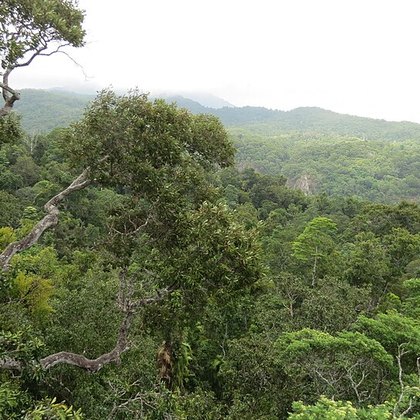
Subtropical moist lowland forest, and beyond it gardens and pasture with standing vegetation: the species has adapted well to the island's human-altered landscape, which for an island endemic is by no means a given. It hunts mainly in the canopy, catching insects in the air or gleaning them from leaves and branches. The breeding season runs from November to February, that is through the southern summer.
Where the bird is most often found, arranged by main group and formation.

Range and movements
Endemic to Norfolk Island and spread over virtually the whole of it, concentrated in the forest remnants of the national park and in the vegetated parts of the farmed country. Its world range is thus smaller than that of almost any other species in this guide. The population is put at about ten thousand mature birds, making it the island's most numerous native bird. It is sedentary; there is no movement across the sea.
- Resident
- dark = core range, pale = thinly spread
Where and when to look
Take a track in Norfolk Island National Park and listen: the loud trill gives it away long before you see it. Then search the midstorey and canopy for something very small moving fast and restlessly from branch to branch. Because there is no other gerygone on the island, there is nothing to rule out — this is the rare occasion on which a Gerygone can be named without further doubt. Gardens and pasture edges produce sightings too.
Conservation
The IUCN has held it at Least Concern (LC) since 2012; before that it was listed as Vulnerable, and the downlisting followed evidence that the population was stable. Its success in gardens and farmland was decisive there. The category says little about risk, however: a population of ten thousand birds on thirty-five square kilometres can be in trouble quickly through one introduced predator, one disease or one severe cyclone. Control of introduced rats and cats, and the retention and expansion of forest in the national park, therefore remain important.
Scientific name
Gerygone modesta | Pelzeln, 1860
August von Pelzeln described the species in 1860. The epithet modesta is Latin for ‘modest, unassuming’ and suits a plain grey-brown bird with no striking feature at all. The genus name Gerygone is usually read as ‘born of song’. The English name varies: AviList carries it as Norfolk Gerygone, while Parks Australia calls it grey gerygone on Norfolk itself — the same name used elsewhere for Gerygone igata, reflecting the older view that the two were one species. That is worth bearing in mind when searching the literature. The Dutch norfolkmangrovezanger and the Spanish gerigón de la Norfolk both take the island; no mangrove grows there.