All species › Passerines › Thornbills, scrubwrens, gerygones and allies › Large-billed Gerygone
Large-billed Gerygone | Gerygone magnirostris
Dikbekmangrovezanger | Gerigón picudo
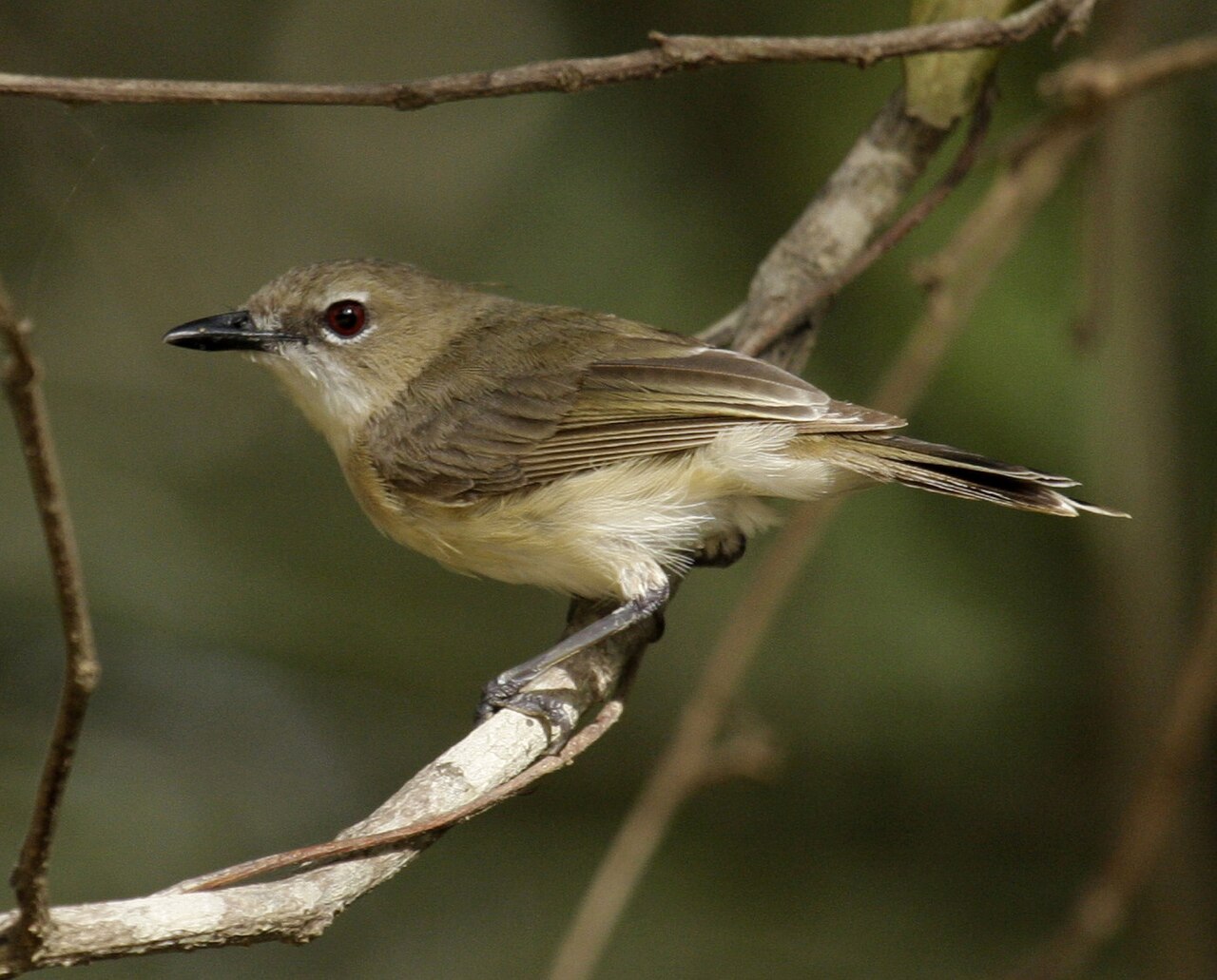
The Large-billed Gerygone is the gerygone that earns its Dutch name: it hangs its long, untidy nest over the water of the tropical mangroves, and that is where it stays all year. It carries the heaviest bill of the genus and, unusually for this group, no eyebrow at all — and in northern Australia that absence is the most useful character it has to offer. Beyond that it is best known for a battle fought inside its own nest: it is one of the few birds in the world known to recognise a cuckoo chick and throw it out.
Voice
A fine, high, melodious series built from several separate phrases and kept up for long stretches, often from a fixed song post in the mangrove. The sound carries far over still tidal water and in the early morning is close to the only thing to be heard in the mangroves. Because almost all gerygones are plain and look alike at close range, identification in practice often runs through this voice — though the difference from Mangrove Gerygone is not always easy to nail down in the field.
No freely licensed recording has been found for this species yet; what to listen for is described below.
Identification
A small, plain bird of about eleven centimetres with olive-brown to grey-brown upperparts and pale, off-white underparts. Two things help: the bill is distinctly long and heavy for a gerygone, and there is no white eyebrow above the eye, at most a narrow broken pale eye-ring. The sexes are alike; juveniles are duller with a less developed bill. Six subspecies are recognised across Australia and New Guinea; the Australian birds are magnirostris and cairnsensis.
Confusion species
Mangrove Gerygone (Gerygone levigaster) is the species it constantly shares the mangroves with: that one has a conspicuous long white eyebrow, is greyer and whiter below, has a redder eye and a finer bill. In good light that is all you need. Brown Gerygone (Gerygone mouki) also has the white eyebrow, plus a grey-washed face, and in the Queensland overlap keeps to rainforest at altitude. Green-backed Gerygone (Gerygone chloronota) is greener above and darker-headed, Dusky Gerygone (Gerygone tenebrosa) is darker and confined to west-coast mangrove, Fairy Gerygone (Gerygone palpebrosa) and White-throated Gerygone (Gerygone olivacea) are yellow below, and Western Gerygone (Gerygone fusca) is paler and belongs to dry woodland. Anyone who gets no view of bill or brow is, honestly, thrown back on the voice.
Habitat
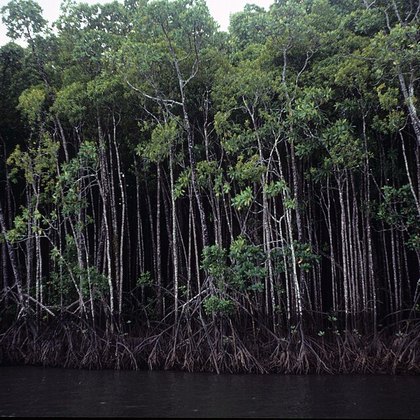
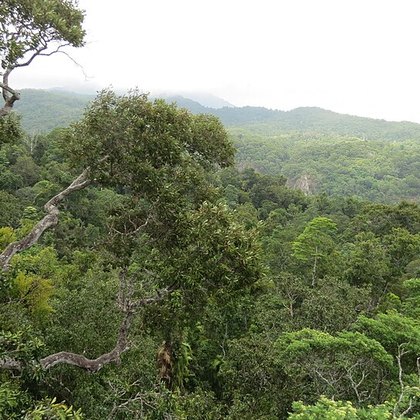
Mangrove first of all, and beyond it riverine forest along tropical creeks, swampy woodland and the edges of monsoon forest and rainforest — nearly always close to water. It forages in the foliage and along the branches, on small insects. The nest is the most distinctive structure in the genus: a long, straggling dome of plant fibre and spider web with a trailing tail, slung from a thin branch over open water. Two or three eggs are usual. That nest is the setting for the story the species owes its scientific fame to: the Little Bronze Cuckoo Chalcites minutillus lays in it, and although the host does not recognise the egg, it does remove the hatched cuckoo chick — one of the few documented cases of discrimination at the nestling stage rather than the egg stage.
Where the bird is most often found, arranged by main group and formation.

Range and movements
The coasts of tropical northern Australia, from the Kimberley in Western Australia east through the Northern Territory and Cape York and down the Queensland coast, plus southern New Guinea and nearby islands. The range is a narrow line: it follows the mangrove belt and the lower reaches of the rivers and rarely penetrates far inland. It is sedentary and holds the same territory year-round.
- Resident
- dark = core range, pale = thinly spread
Where and when to look
Take a mangrove boardwalk at low tide in Darwin, Cairns or Broome, early in the morning, and wait for the song. Look for the bird at eye level along the outer edge of the mangrove, where the light is better than inside. Then check two things against Mangrove Gerygone at once: the eyebrow (absent versus present) and the bill (heavy versus fine). A second clue hangs literally over the water: the long nest with its trailing tail belongs to this species and stays visible for months after breeding.
Conservation
Least Concern (LC) according to AviList and BirdLife International, with a stable population over a very large range. The species benefits from the fact that mangrove in northern Australia is still largely intact and in many places protected. Where mangrove is cleared for ports, aquaculture or urban expansion it disappears immediately, and in the longer term sea-level rise is a genuine concern for a bird that breeds only in the tidal zone. On a continental scale those are local losses for now.
Scientific name
Gerygone magnirostris | Gould, 1843
John Gould described the species in 1843. The epithet magnirostris is Latin for ‘large-billed’, from magnus and rostrum; the English Large-billed Gerygone, the Dutch dikbekmangrovezanger and the Spanish gerigón picudo all translate the same character. The genus name Gerygone is usually read as ‘born of song’ — a reference to the voice that in this genus is generally the only workable character. Unlike most of its relatives, the Dutch element mangrovezanger is genuinely accurate for this species.