All species › Passerines › Thornbills, scrubwrens, gerygones and allies › Mangrove Gerygone
Mangrove Gerygone | Gerygone levigaster
Witbrauwmangrovezanger | Gerigón de manglar
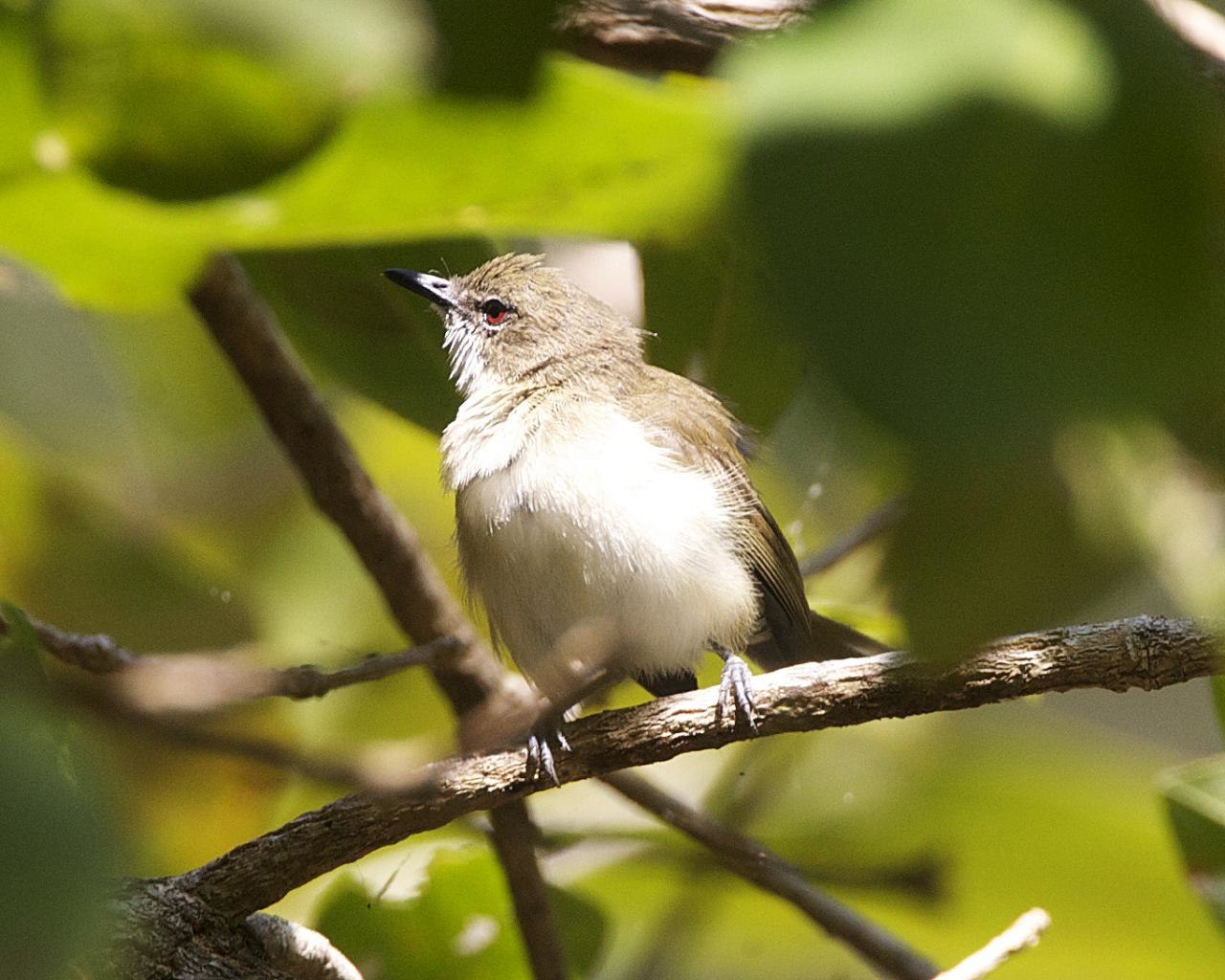
The Mangrove Gerygone is the gerygone of the mangroves themselves: it follows the tidal forests along virtually the whole northern and eastern coast of Australia and scarcely steps outside them. In a genus where the distinctions usually have to be made by ear, it is one of the few that gives itself away at a glance — that long, sharply drawn white eyebrow above a red eye — provided the light inside the mangroves cooperates, which it rarely does.
Voice
A sweet, rich, tuneful phrase often compared to that of the Western Gerygone: a series of thin, falling notes with something wistful about them, repeated over and over from the foliage. Individual birds' songs differ in length, from long elaborate strophes to sharply abbreviated versions. In the mangroves the sound carries far over still water and is in practice the first sign of presence, well before the bird itself appears.
No freely licensed recording has been found for this species yet; what to listen for is described below.
Identification
Nine to eleven centimetres, one of the smallest birds of the mangrove. The upperparts are grey-brown, the underparts white to light grey across throat, belly and flanks, with a white rump. The decisive character is the long, clearly drawn white eyebrow running from the base of the bill to behind the eye; the iris is red, bill and legs black to dark grey. Three subspecies are recognised: levigaster from Western Australia to coastal Queensland, cantator from coastal Queensland to New South Wales — slightly larger and heavier — and pallida in southern New Guinea, slightly browner above.
Confusion species
Large-billed Gerygone (Gerygone magnirostris) shares the mangroves with it along almost the whole north coast and is the only real confusion species: it has no eyebrow, at most a narrow broken eye-ring, and a noticeably heavier bill. That difference is the whole story. Brown Gerygone (Gerygone mouki) also has the eyebrow, but with a grey-washed face, less white on the flanks and a less red eye, and along the east coast keeps mainly to rainforest. Dusky Gerygone (Gerygone tenebrosa) is the mangrove species of the west coast and is darker and plainer. Western Gerygone (Gerygone fusca) sounds confusingly similar but lives in dry woodland inland. Green-backed Gerygone (Gerygone chloronota) is greener above, and White-throated Gerygone (Gerygone olivacea) and Fairy Gerygone (Gerygone palpebrosa) are yellow below and thereby excluded.
Habitat
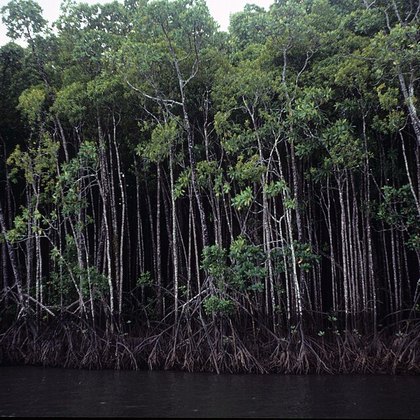
Mangrove, in the main: the tidal forest itself and the forest and woodland immediately behind it, into which it moves to feed during the breeding season. In the Kimberley it shifts locally into paperbark and acacia scrub, where it then occurs alongside the Large-billed Gerygone. Intertidal wetlands and, exceptionally, coastal gardens are used as well. The nest is an oval dome of rootlets, grass, spider web, moss, seaweed and bark, slung in the mangroves, holding two or three eggs. Like its neighbour it is a host of the Little Bronze Cuckoo (Chalcites minutillus) and is among the few birds shown to remove the hatched cuckoo chick from the nest while failing to recognise the egg itself.
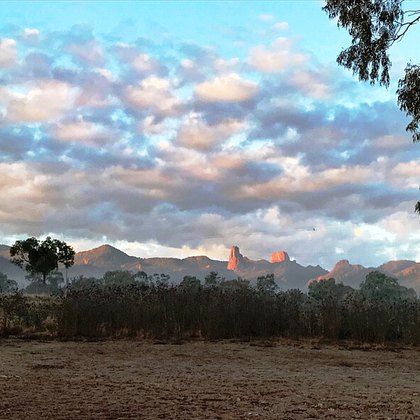
Where the bird is most often found, arranged by main group and formation.

Range and movements
The tropical and subtropical coasts of Australia, from the Western Australian coast around Broome east through the Northern Territory and Cape York and then south along the Queensland coast into New South Wales, where the subspecies cantator reaches the Hunter estuary. It also occurs locally in southern New Guinea, where it is uncommon. The range is a long, very narrow line following the tidal zone. It is sedentary.
- Resident
- dark = core range, pale = thinly spread
Where and when to look
Enter the mangroves at low tide, by boardwalk or along a creek bank, and search the outermost row of trees where the light falls. Wait for the song, find the bird, and go straight to the head: a clear long white eyebrow means this species; only a broken eye-ring and a solid bill means Large-billed. Against the light, which in mangroves is the rule rather than the exception, voice is the more reliable route — and it is worth being honest about that in your notes.
Conservation
Least Concern (LC), with a large range and a stable population. Its fate is nonetheless bound entirely to that of the mangroves: where tidal forest is cleared for ports, industry, urban expansion or aquaculture it goes with it, and that happens above all around the growing coastal towns of Queensland and New South Wales. In the longer term sea-level rise is the concern: mangrove can migrate landward, but only where no seawall, road or town stands in the way.
Scientific name
Gerygone levigaster | Gould, 1843
John Gould described the species in 1843. The epithet levigaster is read as ‘smooth-bellied’, from Latin levis, ‘smooth’, and Greek gaster, ‘belly’ — a reference to the plain white underparts. The genus name Gerygone is usually read as ‘born of song’. The English Mangrove Gerygone and Spanish gerigón de manglar take the habitat and are entirely apt for this species; the Dutch witbrauwmangrovezanger adds the best field character on top of that and is the most useful of the three. When searching the literature, watch for the older spelling Gerygone laevigaster, which appears in earlier works.