All species › Gamebirds › Partridges, pheasants, grouse and allies › Wild Turkey
Wild Turkey | Meleagris gallopavo
Kalkoen | Bimbo
Here the Wild Turkey is no farmyard animal but a feral bird of rough pasture, above all on the New Zealand North Island. It is the largest gamebird in the region: dark, broad and long-legged, with a bare blue and red head. The birds descend from stock released or strayed from the 1860s onwards.

Voice
The male gobbles in the breeding season: a loud, fast-rolling run of gurgling notes, gobble-obble-obble, audible a kilometre off, and set going by any sudden noise — a car door is enough. In display he also produces a deep, vibrating drumming that is felt as much as heard. The hen calls a soft, sustained tuk-tuk, and a sharp cackle in alarm.
Recording: Jonathon Jongsma — CC BY-SA 3.0 · Richardson Nature Center, Hennepin, Minnesota, United States · xeno-canto
Identification
Ninety to a hundred and twenty centimetres, a heavy, long-legged bird with a long neck and a broad tail that can be fanned. The plumage is dull brown-black with a metallic gloss, finely barred, with a pale tail edge. Head and upper neck are bare and warty, blue-grey with red wattles; in the male these swell in display to bright blue and red, and a stiff tuft of bristles hangs from the breast. The hen is smaller, duller and more feathered about the head. It walks rather than flies, but when surprised goes off heavily and fast into the trees.
Confusion species
Helmeted Guineafowl (Numida meleagris) is half the size, slate-grey and spangled all over with white pearls. Australian Brushturkey (Alectura lathami) of eastern Australian forest is smaller and jet black, with a yellow wattle and a tail carried upright and flattened sideways — never fanned. Indian Peafowl (Pavo cristatus), feral in places, is unmistakable once the tail is in view. A party of turkeys on a paddock is known at range mainly by sheer size and by the long legs.
Habitat
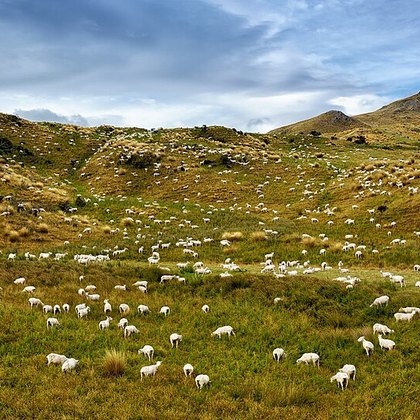
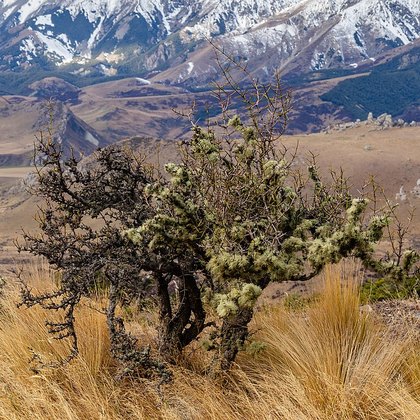
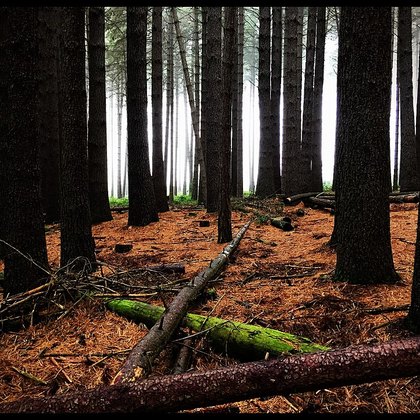
Rough, neglected pasture with scattered trees and with scrub or a forest edge alongside: that is its ground. By day it works the grass and crop margins for seed, fruit and insects, and by night it roosts on fence posts and in trees, which makes it visible at dusk. Young pine plantings and manuka regrowth belong to the picture too. Closed native forest and bare, heavily grazed grassland it hardly uses.
Where the bird is most often found, arranged by main group and formation.

Range and movements
At home in North America, from Mexico north into Canada. In New Zealand birds were released and escaped from the 1860s — the earliest known release was on Kawau — and it now occurs across lowland North Island, in the Marlborough Sounds, locally in the eastern South Island and on islands such as Waiheke and Great Barrier. In Australia the picture is thinner: small feral flocks on a few islands off the southern coast, Kangaroo Island among them, and scattered through southeastern farmland, nowhere numerous.
- Resident
- dark = core range, pale = thinly spread
Where and when to look
Watch the open paddocks and the fence lines along a country road in North Island hill country in the late afternoon; the flocks then come out of cover and stand in the sun. They are wary and keep well clear of a car that stops, so stay in it and look through the side window. From August to November the male displays on an open patch with feathers raised and tail spread, and then the gobbling carries a long way.
Conservation
Not threatened globally (LC); in North America the species was brought back by releases after a collapse around 1900. In New Zealand the population has not been counted, but the bird is widespread and certainly not rare; it is hunted and in places treated as an agricultural pest. No damage to native birds or vegetation has been demonstrated, though it feeds partly on the same ground as the Weka.
Scientific name
Meleagris gallopavo | Linnaeus, 1758
Linnaeus described the species in 1758 as Meleagris Gallopavo and the genus has never changed, so author and year carry no parentheses. Meleagris is the classical Greek name for the guineafowl; early authors confused the African and American birds, and the name stayed with the wrong one. gallopavo is Latin gallus, 'cock', with pavo, 'peacock', after the fanned tail. The type locality is taken as Mexico, because the domestic bird reached Europe from there.