All species › Passerines › Finches, euphonias and allies › American Goldfinch
American Goldfinch | Spinus tristis
Goudsijs | Jilguero yanqui
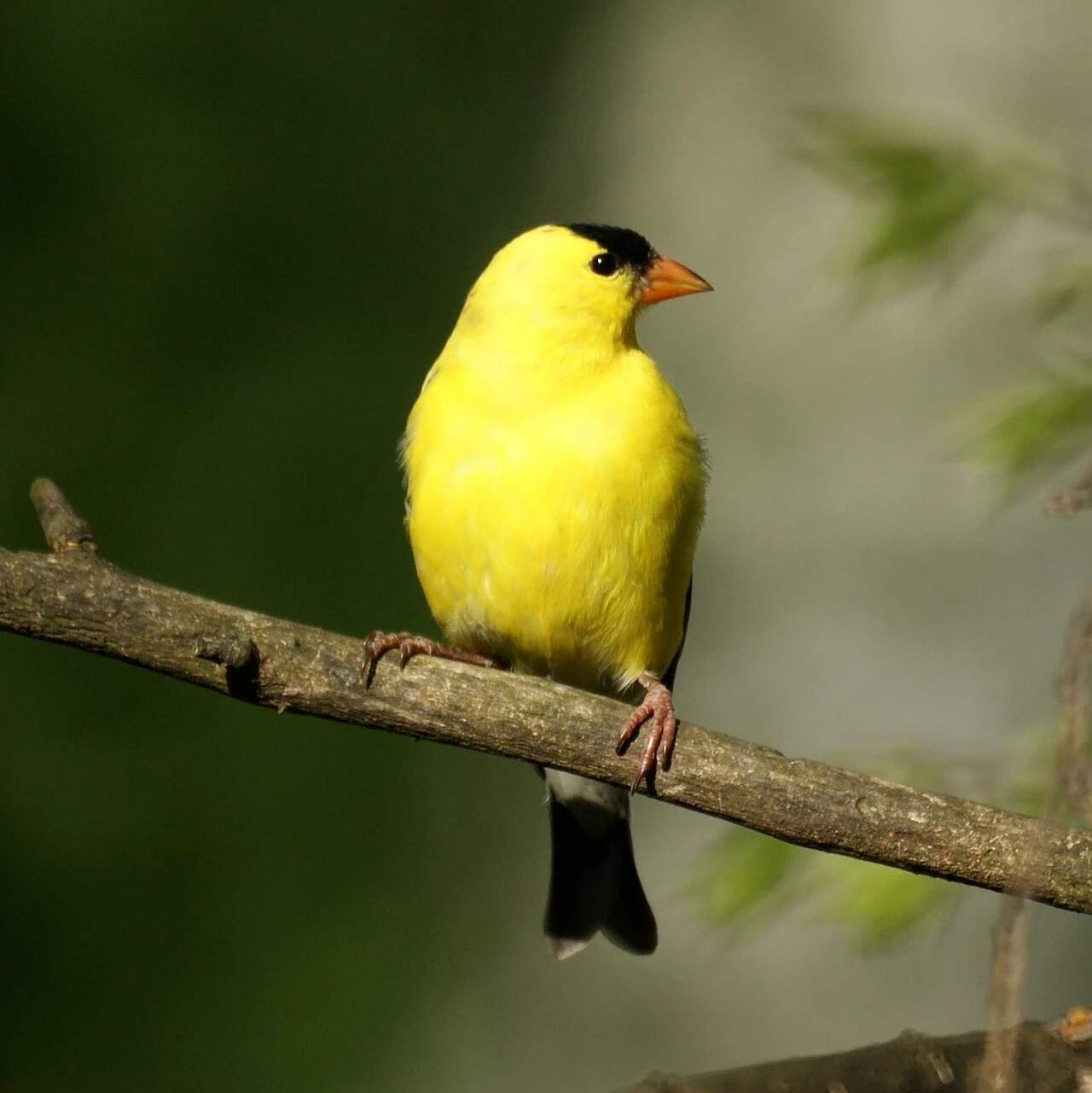
The American Goldfinch is the only North American finch whose male is wholly lemon yellow in summer, with a black cap and black wings. It eats almost nothing but seed, and so breeds later than nearly any other songbird on the continent: the nest comes only in July or August, when thistle and milkweed stand in seed and down.
Voice
The flight call is a four-note po-ta-to-chip, which in the undulating flight coincides with each upward arc — one call per bounce. Alongside it comes a long, rising sweeee from a perched bird. The song is a long, continuous series of twittering, buzzing and rapidly repeated notes, often kept up for minutes from a high branch or during the display flight. Imitations are regularly included.
Recording: Don Profota — CC BY-NC-SA 4.0 · South Bozeman, Gallatin County, Montana, United States · xeno-canto
Identification
Small, with a short conical bill, a small head and a short notched tail. In summer the male is bright yellow with a black forehead patch, black wings with a white bar, a white rump and an orange bill. The female is then olive-yellow without the black cap. In winter both are plain greyish brown, unstreaked, with black wings, two pale wingbars, a pale bill and usually a yellow wash on chin and shoulder. The flight is strongly undulating.
Confusion species
Lesser Goldfinch is smaller, has olive green upperparts in every plumage and shows a sharp white rectangle in the primaries that the American lacks. Pine Siskin is densely streaked on head, breast and flanks and has a thin, sharp bill. Female Wilson's Warbler and Northern Yellow Warbler are also yellow, but have a fine insect-eater's bill and no black wings with white bars. In winter the unstreaked, plain brown plumage with the black wing and pale rump is decisive.
Habitat
Open country with herbs and scattered shrubs: weedy fields, floodplains, woodland edges, field margins, roadsides and odd corners. It nests in shrubs and young broadleaved trees, often along water. Gardens and parks with sunflower, nyjer seed and unmown verges provide food year-round. It eats seed of thistle, sunflower, dandelion, alder and birch; insects play almost no part in the diet, not even in feeding the young.
Where the bird is most often found, arranged by the USNVC — the vegetation classification of the United States and Canada — and CMECS for sea and coast.






Range and movements
It breeds from central Alberta and southern Canada to North Carolina and from the Pacific coast to the Atlantic. Across the central and northern United States it is present all year, though the individuals change from season to season; the Canadian breeders leave in winter. From October to April the range extends into the southern United States and northern Mexico, from Baja California and Sonora to Nuevo León and Tamaulipas. As the one cardueline finch that moults twice a year, it changes from brown to yellow in March and April.
- Resident
- Breeding (summer)
- Winter
- Passage
- dark = core range, pale = thinly spread
Where and when to look
In a winter flock at the feeder it stands out by the plain brown, unstreaked underside among the streaked Pine Siskins. Away from the garden the call is the handiest: if you hear po-ta-to-chip timed to an undulating flight, it is an American Goldfinch. For the full yellow plumage, June to August is the best time, when the birds are also still in full song.
Conservation
The world population is estimated at 42 to 47 million mature birds and the species is widespread throughout its range; the IUCN rates it as Least Concern (LC). The long-term trend is slightly downward, with the picture differing by region. Because it eats almost only seed and feeds that to its young, Brown-headed Cowbird chicks rarely survive in its nest — brood parasitism therefore costs it little. Weedy field margins and unmown verges add breeding habitat, while salmonella at busy feeders causes local mortality.
Scientific name
Spinus tristis | (Linnaeus, 1758)
Linnaeus described the species in 1758 as Fringilla tristis, with 'northern America' as the type region, later restricted to South Carolina; since it now stands in another genus, author and year go in parentheses. The genus Spinus goes back to Greek spinos, an ancient name for a small finch. The species name tristis is Latin for 'sad' or 'sombre', probably after the plaintive tone of the call — a name that contrasts with the plumage. The Dutch and English names both point to the yellow summer plumage.