All species › Passerines › Longspurs and snow buntings › Thick-billed Longspur
Thick-billed Longspur | Rhynchophanes mccownii
McCowns ijsgors | Escribano de McCown
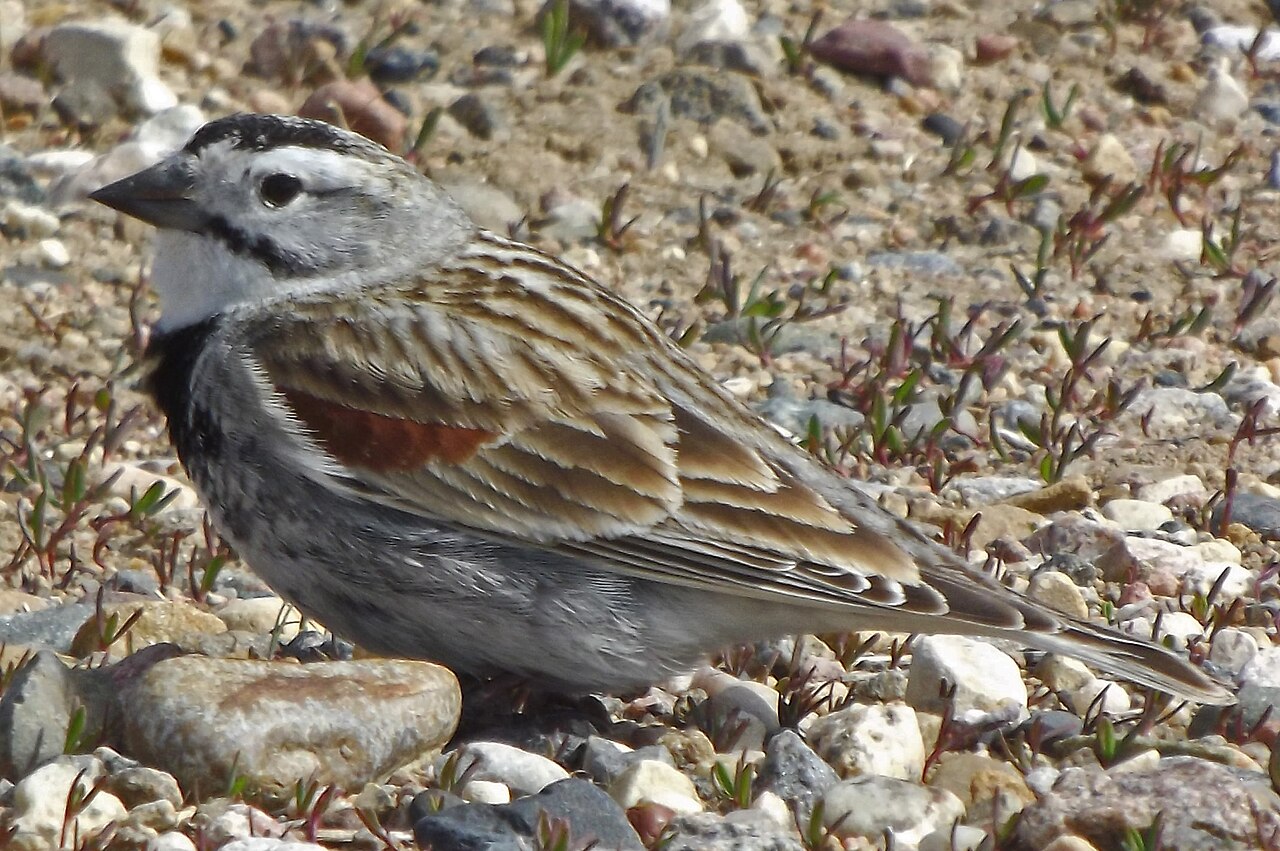
The Thick-billed Longspur is the longspur of the shortgrass prairie: a compact ground bird with a heavy, thick-based bill and, in every plumage, a white tail with a black T. It breeds on the driest, barest stretches of the northern Great Plains and has undergone one of the sharpest declines of any prairie bird.
Voice
The song is a series of clear, ringing whistles that tumble down and up again over a few seconds; the male delivers it almost only in display flight. He climbs to more than ten metres, spreads wings and tail and parachutes back to the ground on raised wings while singing. The call is a dry, short rattle, often heard as a winter flock takes off, along with a soft tsew.
Recording: Paul Marvin — CC BY-NC-SA 3.0 · Van Tassel Rd by Nebraska state line, Torrington, Wyoming, United States · xeno-canto
Identification
The breeding male has a black crown, a white face with a black malar stripe, a grey back and flanks and a black crescent on the breast. A rufous panel sits on the shoulder. The bill is stout and conical with a broad base, dark in summer. Females and winter birds are sandy brown and faintly marked, with a pink bill and at most a trace of rufous on the shoulder. The tail pattern is the same in all plumages: white with a black inverted T formed by the terminal band and the central tail feathers.
Confusion species
Chestnut-collared Longspur has a wholly black belly in breeding plumage and, in all plumages, a black triangle on a white tail rather than a T. Lapland Longspur is longer, with a slim bill, a rufous nape and far less white in the tail. Horned Lark, with which it often shares a flock, has a thin pointed bill, black cheek stripes and a dark tail with white outer edges. In winter, therefore, the heavy bill plus the T pattern decide it, not the faint head and breast markings.
Habitat
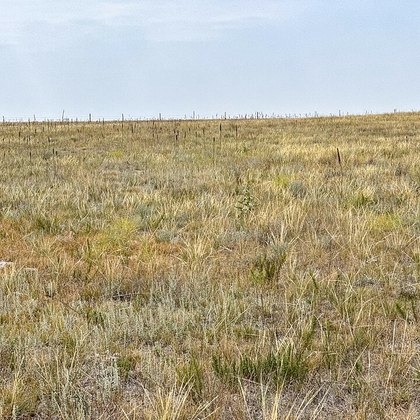
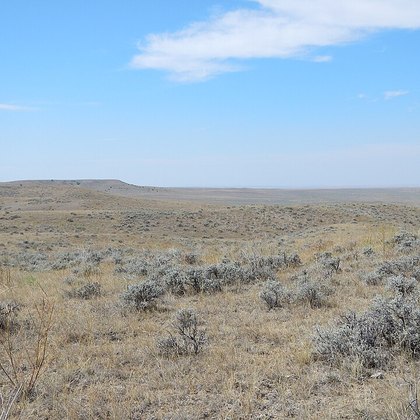
Shortgrass prairie with blue grama and buffalo grass, on the driest and most closely cropped patches, with open sand or bare ground between the grass tufts and scattered cacti or low shrubs. Bison grazing once kept the sward short; today heavily grazed pasture and the surroundings of prairie dog colonies are suitable. In winter it occupies shortgrass plains, dry lake beds, alkali flats and ploughed fields, in flocks mixed with other longspurs.
Where the bird is most often found, arranged by the USNVC — the vegetation classification of the United States and Canada — and CMECS for sea and coast.


Range and movements
The breeding range lies in southern Alberta and southern Saskatchewan, Montana, Wyoming, the western Dakotas and northeastern Colorado. That is a fraction of the historical range: around 1900 it still bred into Manitoba, Minnesota and Oklahoma. In winter it moves to southeastern Colorado, Oklahoma, New Mexico, southeastern Arizona and the Texas high plains, and on into northern Mexico. For Mexico the precise distribution among states is hard to pin down; Chihuahua is certainly the core, with smaller numbers in Sonora, Coahuila and Durango.
- Resident
- Breeding (summer)
- Winter
- Passage
- dark = core range, pale = thinly spread
Where and when to look
In May or June, drive a gravel road through heavily grazed shortgrass prairie in northeastern Colorado or southeastern Wyoming and look for a male parachuting down in song; that silhouette is recognisable at a distance. In winter it pays to flush a flock off a bare field: the tail pattern in flight is more reliable than the plumage of a perched bird.
Conservation
The species is listed as Least Concern (LC) on the Red List, but the 2025 State of the Birds report ranks it as a red-alert tipping point species: more than half the population has gone in fifty years. The cause lies in the loss of shortgrass prairie to arable farming and energy development, the absence of grazing on the remaining patches, and prairie dog control, since those colonies supply exactly the bare ground it needs. The present breeding range covers only part of the historical one.
Scientific name
Rhynchophanes mccownii | (Lawrence, 1851)
George Newbold Lawrence described the species in 1851 as Plectrophanes mccownii, from a specimen taken on the high prairies of western Texas; because it was later moved to another genus, author and year stand in parentheses. The species name honours John Porter McCown, a captain in the United States army, who collected the type. The genus Rhynchophanes comes from Greek rhynchos 'bill' and phainein 'to show', after the notably heavy bill. Because McCown later served as a Confederate general, the American Ornithological Society replaced the English name McCown's Longspur in 2020 with Thick-billed Longspur, after the heavy bill; the Dutch name keeps the older form.