All species › Waterfowl › Ducks, swans and geese › Barnacle Goose
Barnacle Goose | Branta leucopsis
Brandgans | Barnacla cariblanca
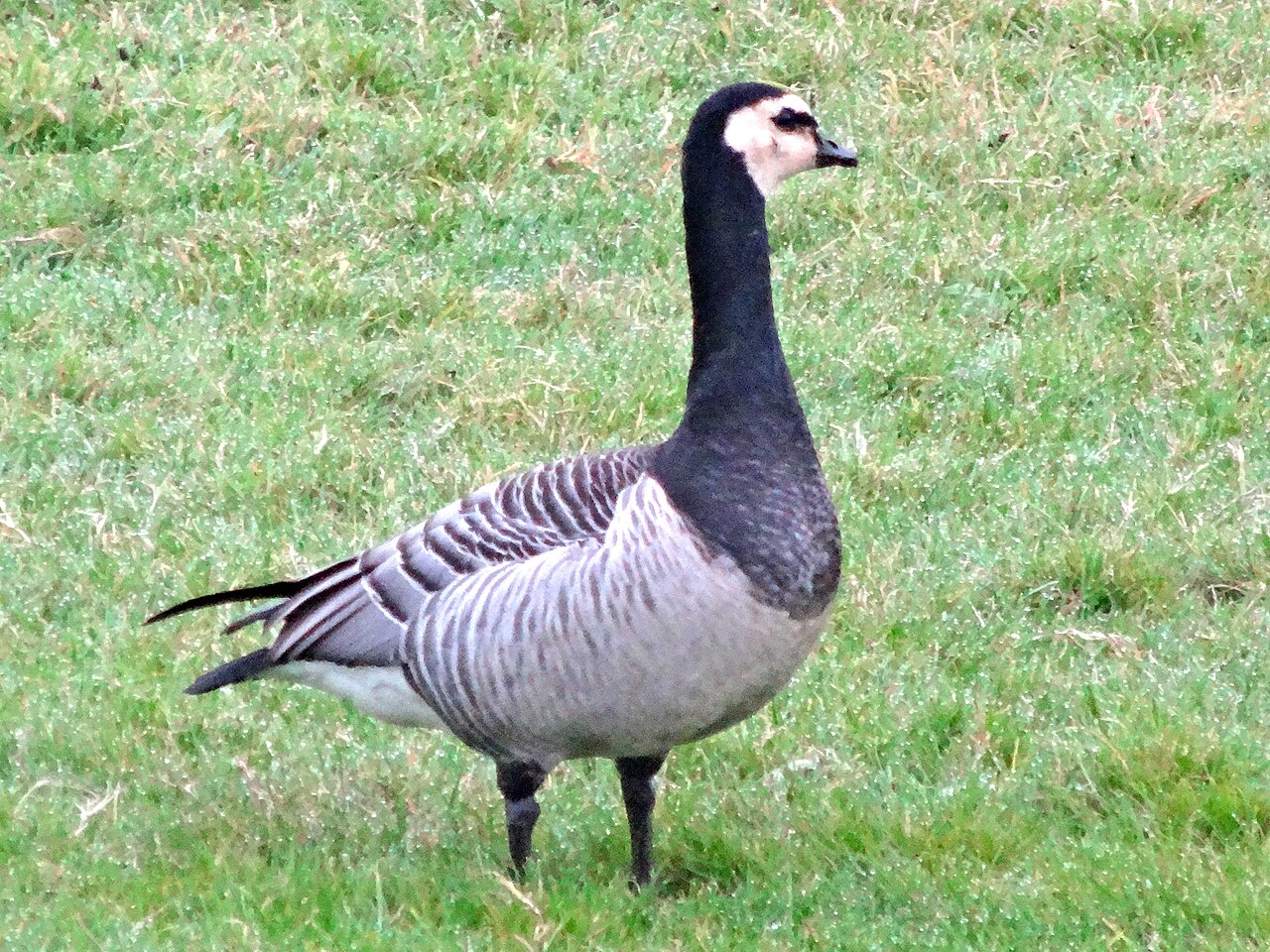
The Barnacle Goose has the sharpest contrast of any Arctic goose: an entirely white face against a black head, neck and chest, above a silver-grey plumage finely barred black and white. It nests on sheer cliff faces, sometimes more than a hundred metres above the tundra, and the goslings must jump from that rock within days of hatching to reach their parents' food below.
Voice
The call is a series of short, barking notes, kaw-kaw-kaw, higher and sharper than the clamour of the Canada geese and with something of a small dog's yapping. A grazing flock keeps up a steady, low chatter that switches, at the least alarm, to a short burst of sharp warning calls. In flight the call is more urgent and repeats faster. On the breeding cliff the parents call the jumping goslings from below.
Recording: Gil Lissens — CC BY-NC-SA 4.0 · Arrondissement Sint-Niklaas (near Beveren), Oost-Vlaanderen, Vlaams Gewest, Belgium · xeno-canto
Identification
Smaller and more compact than a Canada Goose, with a small black bill and an entirely white face running from forehead to chin without the dark lores some related species show. Head, neck, breast and the top of the back are black, sharply set off against silver-grey, finely black-barred flanks and upperparts. The legs are black, as are the outer tail feathers; the belly is white. Male and female are marked alike. In flight the clean contrast between the black front and the pale body stands out, with a quick, compact wingbeat.
Confusion species
Brant is the opposite: dark from face to breast, with no white beyond a small neck patch. Cackling Goose and Canada Goose have a brown, not silver-grey, back and a white cheek patch that does not cover the whole face but is bounded by a black crown. At greater range, among a flock of Canada Geese on mown grass, it is the combination of the wholly white face and the pale back that makes a Barnacle Goose stand out at once.
Habitat
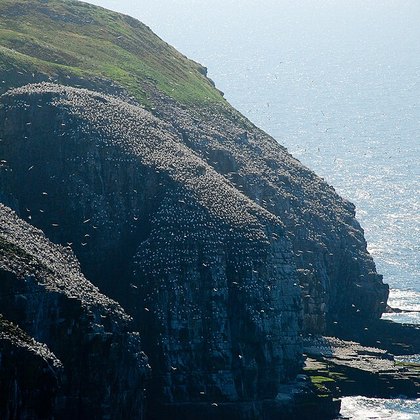
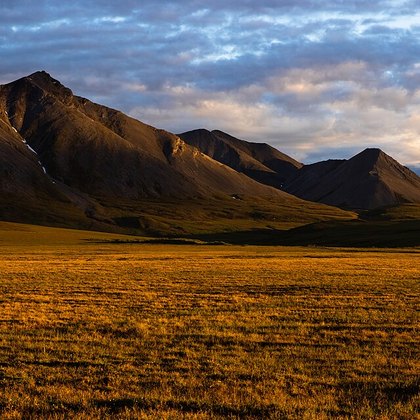
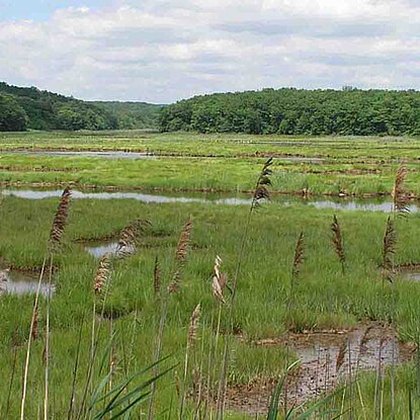
It nests on narrow ledges of coastal cliffs and on steep rock islets, often tens of metres up — a site most predators cannot reach, but one that forces the newly hatched goslings to jump down to reach the grassy tundra below the rock. Outside the breeding season it seeks short, nutritious grass: coastal pasture, salt marsh and farmland in northwestern Europe. Where it turns up in North America, it almost always joins groups of Canada Geese on mown turf, golf courses and cropland stubble.
Where the bird is most often found, arranged by the USNVC — the vegetation classification of the United States and Canada — and CMECS for sea and coast.


Range and movements
Three separate populations each breed on their own Arctic coast: Svalbard, Novaya Zemlya and East Greenland. Only the Greenland birds fall within the area of this guide; they do not winter in North America but cross the Atlantic to Ireland and western Scotland. In the twenty-first century single birds increasingly turn up along the Atlantic coast from Newfoundland to Virginia, almost always among flocks of Canada Geese — a pattern that is growing but does not yet amount to a fixed, annual presence in any one state. Escaped or released birds from waterfowl collections make the origin of some records uncertain.
- Breeding (summer)
- Winter
- Passage
- dark = core range, pale = thinly spread
Where and when to look
In autumn and winter work through flocks of Canada Geese along the Atlantic coast, from Newfoundland to Virginia: a single Barnacle Goose stands out at once by its white face among the brown mass. Anyone in East Greenland in June can, with patience, watch the goslings jump from the cliffs — one of the most-watched moments of the goose year.
Conservation
Not threatened worldwide and strongly increasing in recent decades, helped by protection on the breeding grounds and by many birds switching to farmland and pasture as winter food. In North America it does not breed and plays no part in hunting-quota management; the rising number of sightings is tracked mainly to separate wild birds from escapees.
Scientific name
Branta leucopsis | (Bechstein, 1803)
Bechstein described the species in 1803 as Anas leucopsis, among the ducks; because it was later moved to another genus, author and year stand in parentheses. The genus Branta was introduced by Scopoli in 1769, a Latinised form of Old Norse brandgás, 'burnt goose'. The species name leucopsis is Greek for 'white face', from leukos and opsis, and describes its chief mark. The English name 'Barnacle Goose' shares its origin with the Brant's species name, bernicla: because no one had ever seen this Arctic breeder nest, it was thought for centuries to grow from goose barnacles on driftwood. The type locality is Germany, where Bechstein knew only wintering birds.