All species › Tubenoses › Albatrosses › Black-footed Albatross
Black-footed Albatross | Phoebastria nigripes
Zwartvoetalbatros | Albatros patas negras
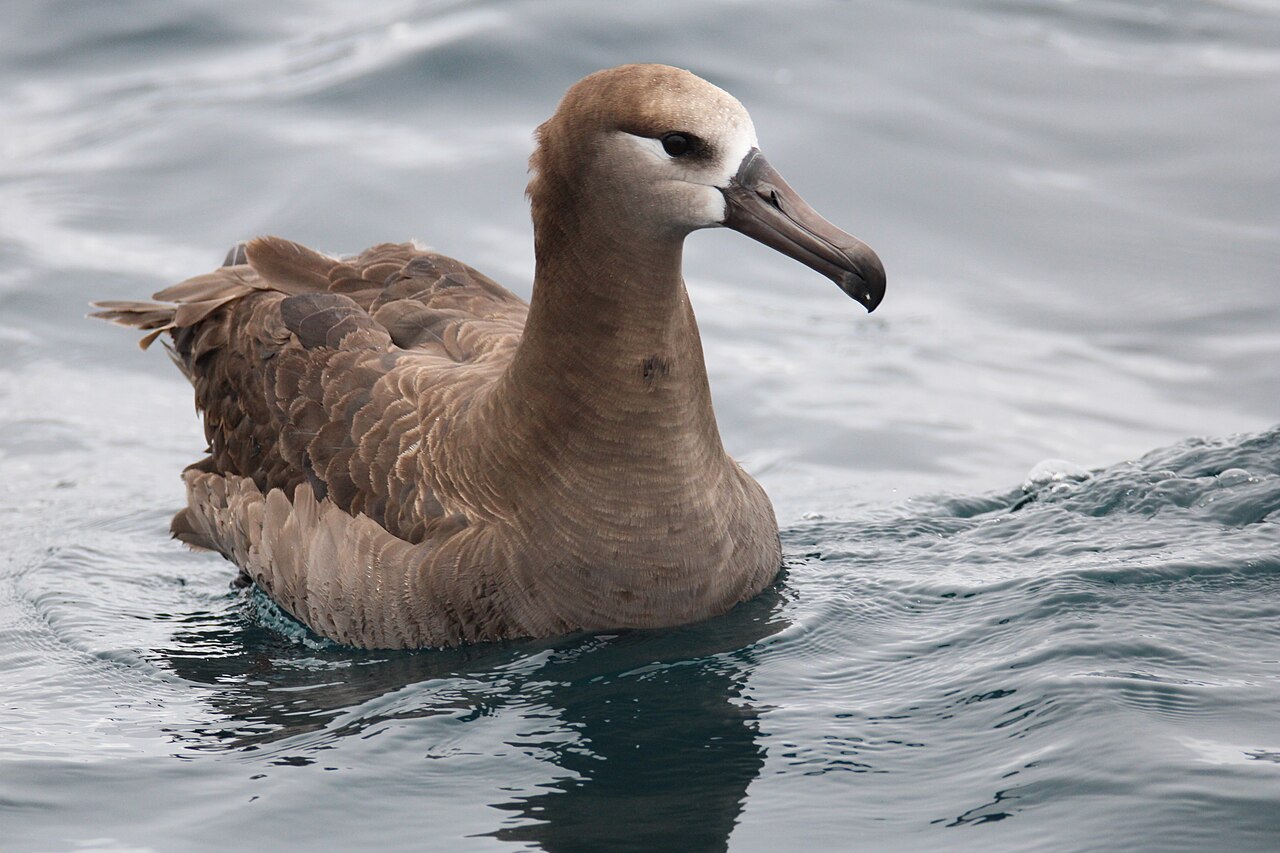
The Black-footed Albatross is the dark albatross of the North Pacific: sooty brown from head to tail, with a wingspan of two metres. It breeds on a handful of flat sand islands in the north-west of the Hawaiian chain and ranges from there to the coast of California and into the Gulf of Alaska. For anyone in North America taking a boat out to deep water, this is the albatross you may meet.
Voice
At sea it is not silent: as soon as several birds dive for the same piece of food there is a nasal, complaining groan that turns into a shrill, whinnying squeal. At the colony the sound carries across the whole island day and night — a drawn-out eee-yaah like a donkey's bray, alternating with a dull moaning and the dry clatter of bill against bill. Chicks beg with a thin, piping whistle that almost disappears beside the noise of the adults. On board a ship it gives itself away more often by that groaning behind the boat than by anything you see.
Recording: Elias Aristides Elias — CC BY-NC-SA 4.0 · Fort Bragg, Mendocino County, California, United States · xeno-canto
Identification
An all-dark, sooty brown albatross with long, narrow wings blunt at the tip and a heavy, dark bill. Around the base of the bill and below the eye is a pale, dirty-white border that widens with age and gives old birds a grey mask; old birds also have white undertail coverts and a pale rump. The feet are black, which the name records, and they do not project beyond the tail in flight. Young birds are more evenly dark, with less white in the face and a wholly dark rump. The flight is an albatross's: stiff wings, long arcs across the wave troughs, and only in a flat calm the occasional slow beat.
Confusion species
Laysan Albatross (Phoebastria immutabilis), which flies in the same waters, separates at any range: white body and white head against dark upperwings, with a dark smudge around the eye. More similar is the young Short-tailed Albatross (Phoebastria albatrus), which is also wholly dark; it is bigger, has a heavy pink bill with a bluish tip and pale legs, and is so rare that every sighting is checked. Large dark shearwaters such as Sooty Shearwater are taken for it at a distance, but are scarcely half the size and beat their wings far faster. In doubt the bill is the best character: dark and heavy in this species, pink in Short-tailed.
Habitat
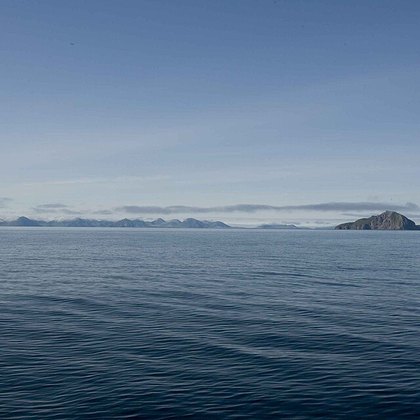
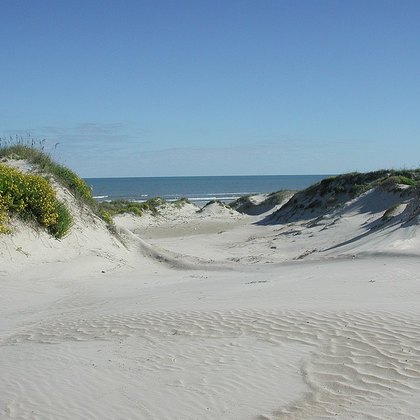
Outside the breeding season it lives over deep water and along the edge of the continental shelf, where upwelling brings squid and fish to the surface; there it also follows fishing vessels. To breed it needs a flat, low sand island with open ground between low herbs and bushes, where the nest is no more than a scrape in the coral sand. It uses neither cliffs nor steep rocky islands, and no fresh water. Almost all its breeding places lie on islands that rise only a few metres above the sea — which makes the colony easy to reach and, at the same time, fragile.
Where the bird is most often found, arranged by the USNVC — the vegetation classification of the United States and Canada — and CMECS for sea and coast.
Range and movements
The colonies lie in the north-western Hawaiian Islands, above all on Midway, Laysan and French Frigate Shoals; beyond those, small numbers breed on islands south of Japan and on Isla Guadalupe off Baja California. Outside the breeding season the species ranges over the whole North Pacific, from the Bering Sea to the tropics. On the North American side it can be found offshore all year, with most birds in summer and early autumn, when the adults move after breeding to the cold, food-rich water from California to Alaska. The map therefore shows the sea areas where it occurs regularly and the state its colonies belong to; the breeding islands themselves lie far to the north-west of the eight main Hawaiian islands.
- Resident
- Breeding (summer)
- Winter
- Passage
- dark = core range, pale = thinly spread
Where and when to look
Book a summer boat trip out to the shelf edge off Monterey, Half Moon Bay or Westport and watch behind the boat: when chum goes over the side it often comes sailing in within minutes. From the beach there is little point; the species stays well offshore. An all-dark albatross off the west coast of North America is nearly always this one — still, check the bill, because the rare Short-tailed Albatross is the exception.
Conservation
The species stands as Near Threatened (NT) on the Red List. There are about a hundred and thirty thousand adult birds and some sixty-five thousand breeding pairs, the great majority on three island groups — few places for a whole world population. The largest mortality comes from longline fishing, where birds go for the baited hooks and drown: estimates run into the thousands a year. To that are added plastic, fed to the chicks with the stomach oil, and sea level: the breeding islands lie so low that a heavy storm floods them, and in October 2018 East Island at French Frigate Shoals all but disappeared beneath the water in a hurricane.
Scientific name
Phoebastria nigripes | (Audubon, 1839)
John James Audubon described the species in 1839 as Diomedea nigripes, among the great albatrosses; because it was later moved to another genus, author and year stand in parentheses. The genus Phoebastria was introduced by Reichenbach in 1853, after Greek phoibastria 'prophetess' — a name with the ring of foretelling, which is how sailors long read the albatross. The specific name is formed from Latin niger 'black' and pes 'foot'. The type locality is not a coast or an island but a position on the open sea, 30° 44' north and 146° west, where the described specimen was collected.