All species › Tubenoses › Albatrosses › Short-tailed Albatross
Short-tailed Albatross | Phoebastria albatrus
Stellers albatros | Albatros colicorto
Short-tailed Albatross is the largest albatross of the North Pacific and, at the same time, the rarest of the three species reaching the American west coast. Around 1900 it was nearly wiped out by feather hunting on its breeding islands near Japan, a disaster it has still not recovered from.
Voice
At the breeding colony the species performs loud bill-clapping during courtship, like other albatrosses, along with deep, mooing and groaning calls. At sea, far from the colonies, it is, like all albatrosses, essentially silent.
No recording with a suitable Creative Commons licence has been found for this species yet; what to listen for is described below.
Identification
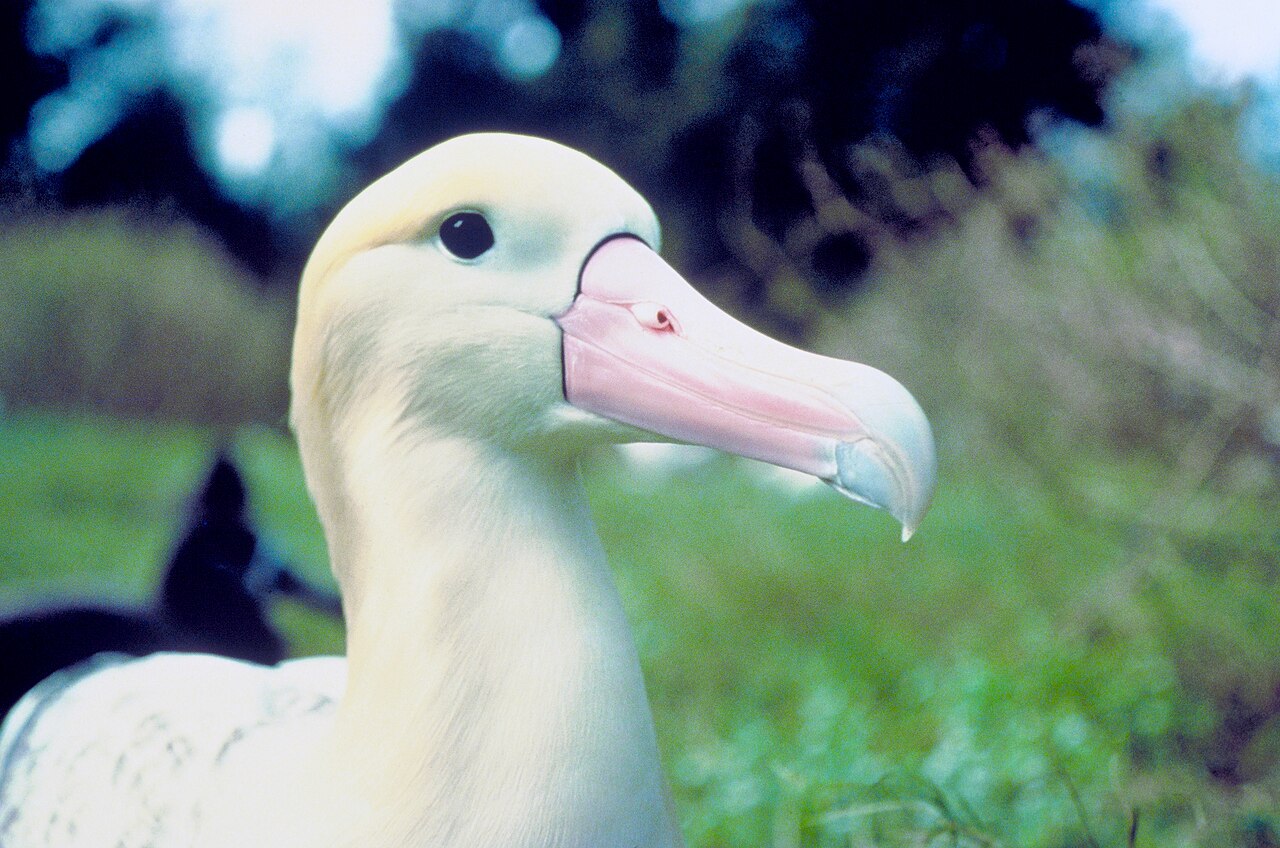
Adults are mostly white with a yellowish wash on the head and neck, a black tail, and a thick, pink bill tipped with blue. The upperwing is roughly half white and half black, unlike the almost entirely dark upperwing of Laysan Albatross. Young birds are entirely chocolate-brown, with only the thick pink bill hinting at the species; white does not appear on the face, underparts and underwing until three to four years of age, and the adult plumage is not complete until eight to ten years.
Confusion species
Young Short-tailed Albatrosses are often confused with Black-footed Albatross and with young Laysan Albatrosses, both of which are considerably smaller and have a thinner, dark bill. The thick, pink, blue-tipped bill is the best mark at any age. Adults, given their size and the yellow wash on the head, are hardly ever mistaken for anything else.
Habitat
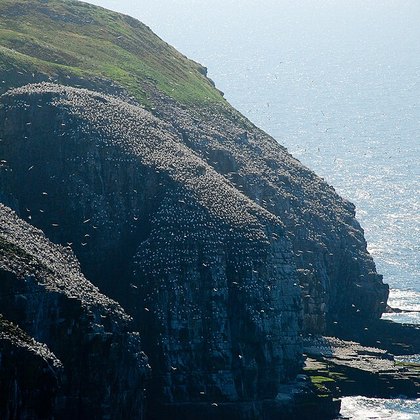
It breeds on steep, vegetated volcanic slopes on a handful of islands near Japan, far outside the guide area. Outside the breeding season it lives on the open ocean and over the edge of the continental shelf, snatching squid, fish and crustaceans from the surface, often in the wake of fishing boats.
Where the bird is most often found, arranged by the USNVC — the vegetation classification of the United States and Canada — and CMECS for sea and coast.

Range and movements
Almost the entire world population breeds on Torishima and the Senkaku Islands near Japan. Non-breeding and young birds move in summer in small numbers to the Bering Sea and the waters around the Aleutians, with scattered records further south off California. Before the hunting around 1900 the species was a common sight along the entire west coast of North America; only a fraction of that abundance remains today.
Where and when to look
Look for it in summer on a pelagic boat trip in the Aleutians or the Bering Sea, where it turns up in small numbers among other tubenoses; further south, off California, any sighting is a rarity worth reporting.
Conservation
The world population has grown back to a few thousand birds and is increasing by nearly ten per cent a year, but remains a fraction of the millions that existed before feather hunting. The species is listed as Vulnerable (VU); bycatch in longline fisheries and the risk of a volcanic eruption on its main breeding island remain the greatest threats.
Scientific name
Phoebastria albatrus | (Pallas, 1769)
German naturalist Peter Simon Pallas described the species in 1769 as Diomedea albatrus; it has since been placed in the genus Phoebastria, hence the parentheses around author and year. The type locality lies at sea off Kamchatka, where Pallas obtained the first specimen. In Dutch the species is named after explorer Georg Wilhelm Steller, the first European to observe and record it, during Vitus Bering's second Kamchatka expedition.