All species › Tubenoses › Albatrosses › Atlantic Yellow-nosed Albatross
Atlantic Yellow-nosed Albatross | Thalassarche chlororhynchos
Atlantische geelneusalbatros | Albatros clororrinco atlántico
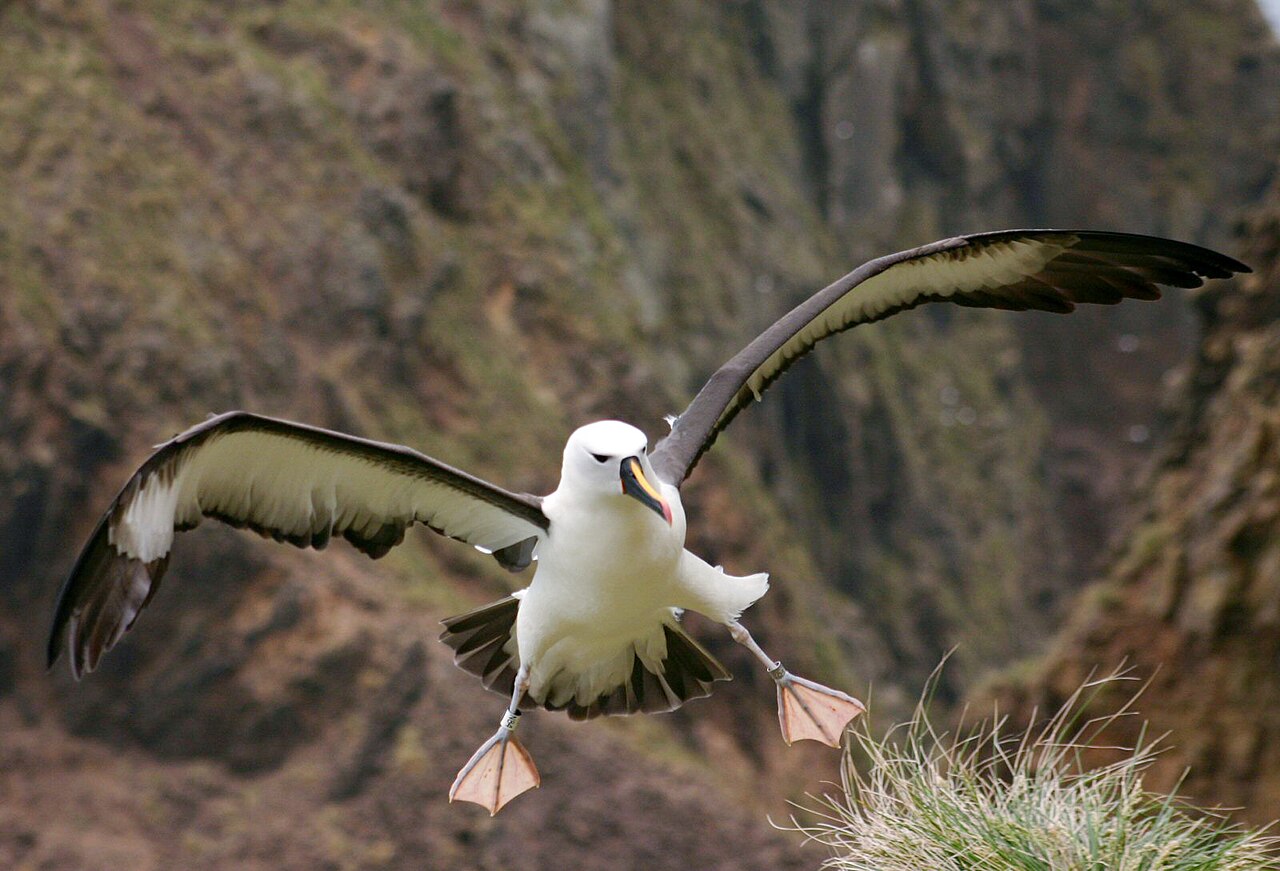
The Atlantic Yellow-nosed Albatross is the smallest albatross to appear from time to time in North American waters: a slim seabird with a dark back, white underparts and a black bill carrying a thin yellow stripe along the ridge. It breeds only on a handful of islands deep in the South Atlantic, and in North America it is a vagrant that rarely comes close to shore.
Voice
At sea, where almost every North American record occurs, the Atlantic Yellow-nosed Albatross is essentially silent. On its southern breeding islands, courtship brings a hoarse groaning call, alternating with a dry clattering as pairs tap their bills together. Near a boat or floating offal it may add no more than a low grunt. A vagrant drifting among shearwaters off the American east coast is therefore recognised by its silhouette long before it is heard.
Recording: Guilherme Melo — CC BY-NC-SA 4.0 · Penha - 12 - 20 km da costa, Brazil · xeno-canto
Identification
Adults are grey-black above with a sharp line to the white underparts and a white head washed grey on the cheeks. The bill is black with a thin yellow stripe along the upper ridge that turns pink toward the tip, and a narrow dark line in front of the eye gives the face a slightly frowning look. Juveniles have an entirely black bill and a vaguer head pattern, which invites confusion with other albatrosses. In flight the long, narrow wing profile stands out: stiff, barely bent wings on which it can glide for minutes above the swell without a beat.
Confusion species
Black-browed Albatross (Thalassarche melanophris) is the species it is most often confused with in North American waters: it is noticeably heavier-built, has a pink bill with a dark tip rather than a black bill with a yellow stripe, and a broad black leading and trailing edge under the wing against the narrow one of the Yellow-nosed Albatross. Young Black-browed Albatrosses also show a greyish collar the Yellow-nosed lacks. At long range, when bill colour cannot be judged, the underwing pattern is the more reliable clue.
Habitat
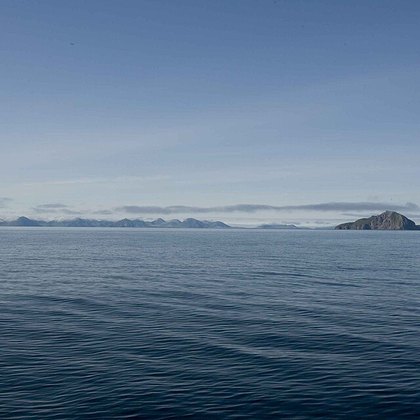
It spends nearly its entire life on the open ocean, far from land, foraging on squid, fish and crustaceans picked from the surface. Fishing vessels attract it for the offal and bycatch thrown overboard. It avoids shallow inshore water and the surf zone; only after severe storms does a vagrant occasionally end up close inshore or even on a beach.
Where the bird is most often found, arranged by the USNVC — the vegetation classification of the United States and Canada — and CMECS for sea and coast.

Range and movements
It breeds on Gough Island and the islands of the Tristan da Cunha group, deep in the South Atlantic, and ranges beyond them across much of the South Atlantic and southern Indian Ocean. Individuals occasionally reach the North Atlantic; since the first records it has been reported more than twenty times off the Atlantic and Gulf coasts of the United States, almost always in summer and without any fixed site. The number of reports has risen in recent decades, partly reflecting that observers now search further offshore, more often, than before.
Where and when to look
The best chance is a pelagic boat trip well offshore of North Carolina or in the Gulf of Mexico, in summer, scanning among the Black-browed Albatrosses and shearwaters drawn to fishing offal. Check the bill colour first: an entirely black bill with a thin yellow line points straight to this species.
Conservation
The IUCN lists the species as Endangered (EN): the world population is estimated at 55,000 to just over 83,000 mature birds, concentrated on a few islands. Numbers are falling on Nightingale and Inaccessible, while Gough Island holds the largest colony. The chief threats are bycatch in longline fisheries and, on Gough, introduced house mice that attack eggs and chicks.
Scientific name
Thalassarche chlororhynchos | (Gmelin, 1789)
Gmelin described the species in 1789 as Diomedea chlororhynchos, with the Cape of Good Hope as the type locality; because it has since been moved to another genus, author and year stand in parentheses. The genus Thalassarche was introduced by Reichenbach in 1853. The species name is Greek for 'yellow-billed', after the yellow stripe on the bill. Until the late twentieth century it was treated as one species with the Indian Yellow-nosed Albatross (T. carteri) under the name Yellow-nosed Albatross; the two are now considered separate species.