All species › Waders, gulls and terns › Auks, puffins and murres › Black Guillemot
Black Guillemot | Cepphus grylle
Zwarte zeekoet | Arao aliblanco
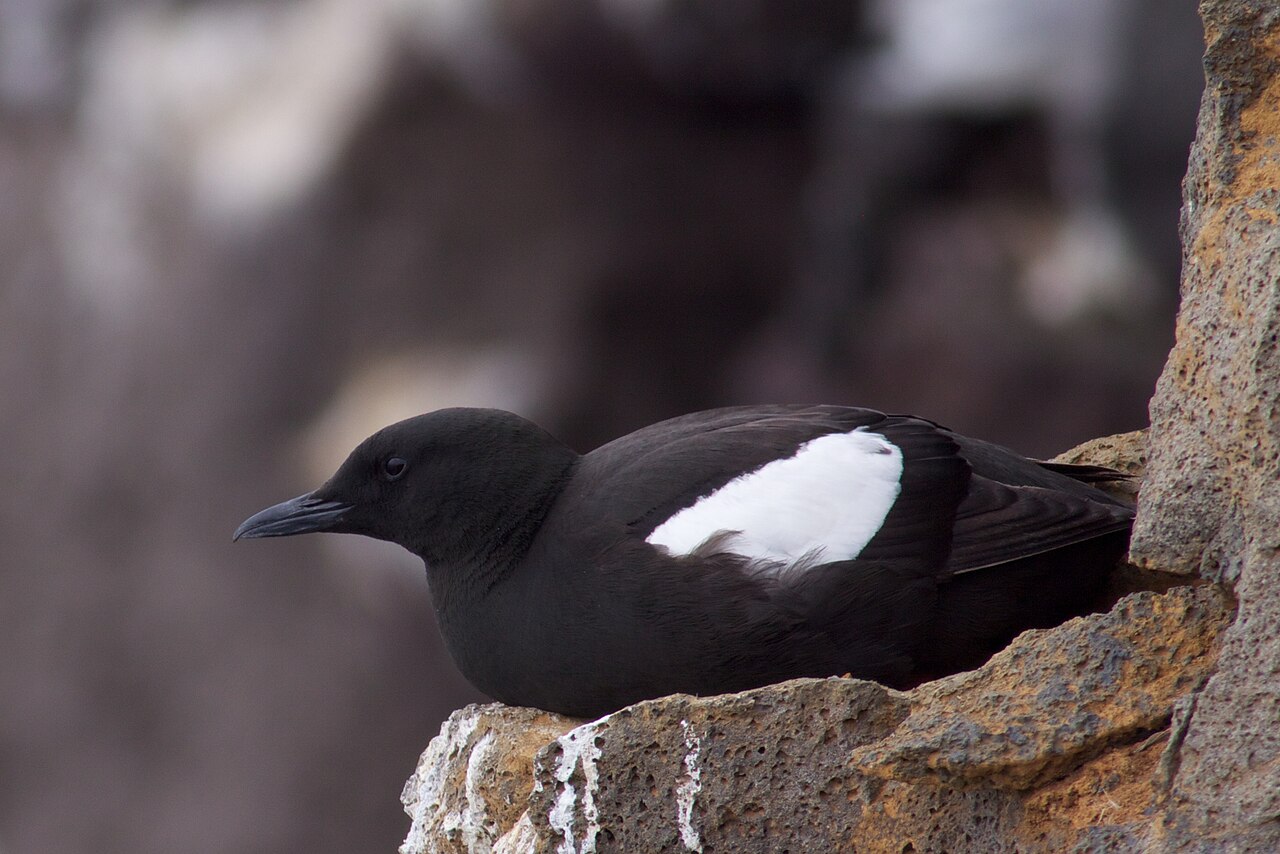
The Black Guillemot is the one auk that stays within sight of the shore all year: jet black, with a large oval white panel on the wing and two vivid red feet that it shows off pointedly in display. It breeds not in dense cliff colonies but a few pairs at a time among boulders, from the Gulf of Maine to the ice-bound coast of Alaska. In winter plumage it turns almost white, and at first glance becomes another bird altogether.
Voice
Its voice is a thin, very high whistle that carries remarkably far over still water: a sustained peeeee like a squeaking hinge, usually in series and often from several birds at once. In display on the water this becomes a hissing, trilling whistle, the birds gaping wide to show the fiery red inside of the mouth. At the nest crevice the call is shorter and sharper, sometimes with a soft growl audible only at close range. Away from the colony, on open water, it is almost always silent.
Recording: Doug Hynes — CC BY-SA 4.0 · Country Island, Nova Scotia, Canada · xeno-canto
Identification
In breeding plumage it is entirely sooty black but for one thing: a large, sharply outlined white oval in the middle of the upperwing, which slides back and forth like a white flag in flight. The legs and webs are coral red, the bill black and pointed, and the gape as red as the feet when the bill is open. Male and female cannot be told apart. Winter plumage inverts the picture: head, neck and underparts turn white, the upperparts grey with a fine black-and-white marbling, and only the white wing panel remains. Juveniles resemble winter adults but have the white panel shot through with dark feathers, so that it looks dirty and blotched. The flight is low, fast and whirring, with the red feet visible beyond the short tail.
Confusion species
No other auk in the Atlantic is black with a large white wing panel; see that mark and the identification is done. Pigeon Guillemot (Cepphus columba) of the Pacific is the sister species and looks much the same, but its white panel is cut across by a dark wedge; the two ranges meet only at the Bering Strait and hardly overlap, so in the field the question rarely arises. Winter birds are harder: Common Murre (Uria aalge) and Thick-billed Murre (Uria lomvia) are white below then too, but much larger, with an unbroken dark back and no white on the wing. A distant pale guillemot in winter is also taken for a grebe or a young merganser; the short, stocky silhouette with its thick neck and whirring wingbeats settles it faster than the colour does.
Habitat
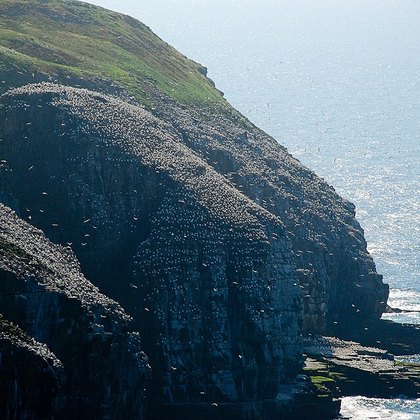
Rocky shores, boulder beaches, low rocky islands and the foot of cliffs, wherever there is a crevice or a cavity under a slab above the tideline. It feeds close to home, in shallow water no more than about thirty metres deep, over rocky or weed-covered bottom where it works between the stones for bottom-living fish. In the far north it is tied to sea ice, fishing at cracks, leads and along the ice edge where Arctic cod hang beneath the floes. It makes no use of deep water far offshore, of sandy beaches or of fresh inland waters.
Where the bird is most often found, arranged by the USNVC — the vegetation classification of the United States and Canada — and CMECS for sea and coast.


Range and movements
It breeds right around the pole. In North America from the Gulf of Maine — its southern limit on this side of the ocean — north along Nova Scotia, New Brunswick, the Gulf of St. Lawrence, Newfoundland and Labrador, along Hudson Bay as far as Churchill, through the Canadian Arctic Archipelago and all of Greenland, and west along the Beaufort and Chukchi coasts of Yukon and Alaska. Unlike most auks it does not travel far: southern birds stay by the colony all year and visit their crevice even in midwinter. High Arctic birds move with the ice and winter at leads and along the ice edge, sometimes hundreds of kilometres from where they bred. South of Maine it is a scarce winter visitor along the coast from New Hampshire to Rhode Island.
- Resident
- Winter
- Passage
- dark = core range, pale = thinly spread
Where and when to look
This is the auk you can see without a boat. From May to July watch from a breakwater, a pier or a rocky point in Maine or the Canadian Maritimes in the first hour after sunrise: pairs then sit in small parties on the water off their nest crevice, chase one another and lift the red feet clear of the surface. On a bird that flushes, look for the white panel on the wing — that alone decides it at long range. In winter it pays to scan harbours, piers and the edge of drifting ice for a small, almost white bird with a black bar across the wing.
Conservation
The world population is put at about 750,000 breeding birds and the species is listed as of least concern. On breeding islands introduced mink and rats are the chief threat, and as an inshore feeder it is among the first casualties of an oil spill; gill nets take their share as well. In the American Arctic the species has become one of the clearest gauges of shrinking sea ice: where the summer ice edge withdraws too far offshore the parents can no longer reach Arctic cod, and polar bears kept ashore by the missing ice plunder the nests among the boulders.
Scientific name
Cepphus grylle | (Linnaeus, 1758)
Linnaeus described the species in 1758 as Alca grylle, among the auks; because it was later placed in Cepphus, author and year stand in parentheses. The genus Cepphus was introduced by Pallas in 1769 and goes back to Greek kepphos, the name of a pale seabird in the ancient authors. grylle is not Latin but a local name: the word Linnaeus heard for this bird on Gotland in 1741. He gave the seas of northern Europe as the type locality; this was later restricted to Sweden.