All species › Passerines › Cardinals and allies › Black-headed Grosbeak
Black-headed Grosbeak | Pheucticus melanocephalus
Zwartkopkardinaal | Picogrueso cabecinegro
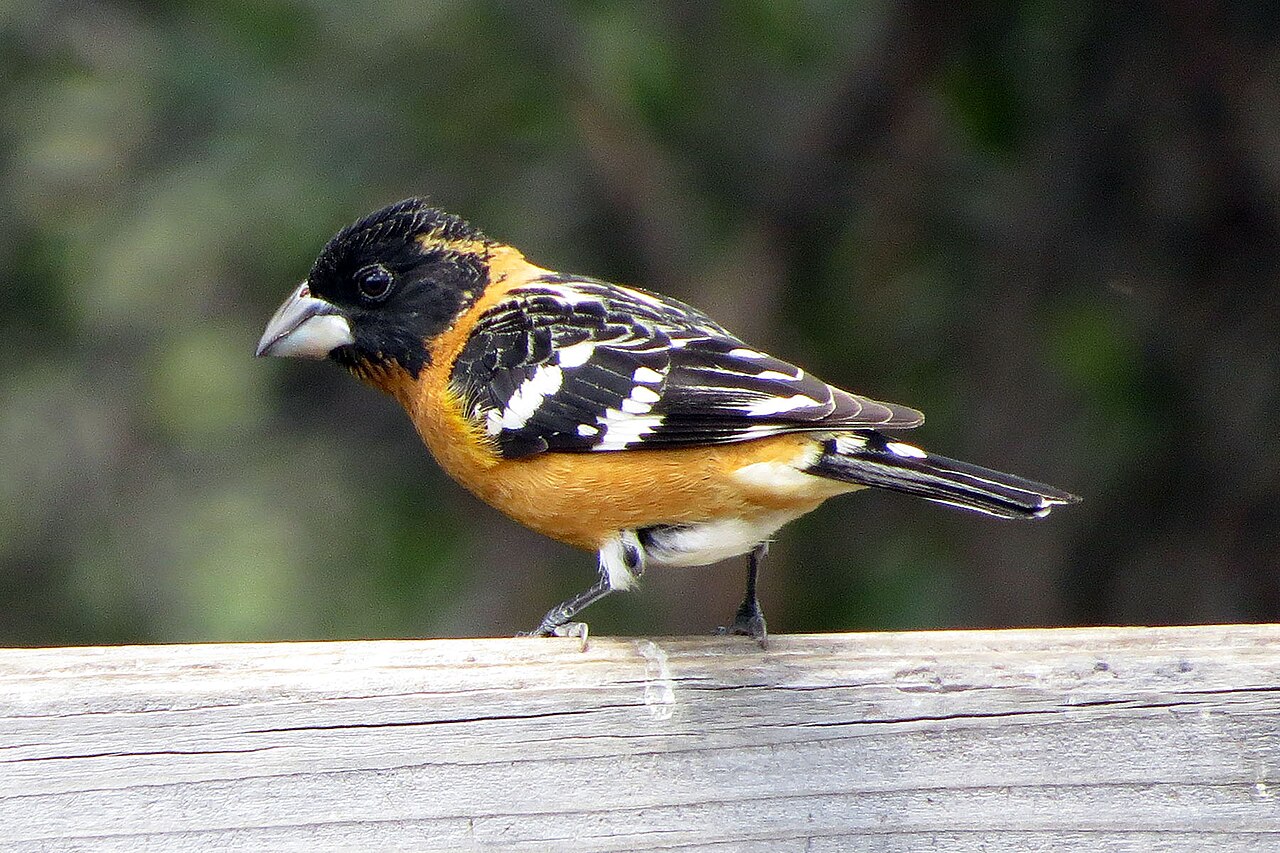
The Black-headed Grosbeak is the western counterpart of the Rose-breasted Grosbeak: a heavy seed-eater of streamside woodland and oak slopes, with a thick two-toned bill. The male has a black head and orange-brown underparts; it breeds from British Columbia to central Mexico and winters almost entirely in Mexico.
Voice
The call is a sharp, short pik with a squeaking quality, slightly softer than that of Rose-breasted Grosbeak. The song is a rich, continuous warble resembling that of the American Robin but faster, more fluent and softer, with rising and falling arcs. The female sings a shorter version too, sometimes from the nest, and both sexes sing while incubating.
Recording: Greg Irving — CC BY-NC-SA 4.0 · Upper Fish Hatchery Road, Sequim, Clallam County, Washington, United States · xeno-canto
Identification
The male has a black head, black wings with two white bars and large white patches, a back mottled black and buff, and orange-brown breast, collar and flanks grading to yellow on the belly. The underwing coverts are yellow and flash in flight. The female is buff with a broad white eyebrow, a pale central crown stripe and fine, limited streaking on the flanks — the breast is largely unstreaked. The bill in both sexes is thick and conical, with a dark upper and a pale lower mandible. First-year males resemble females but are more strongly orange on the breast.
Confusion species
Rose-breasted Grosbeak is the closest relative and overlaps on the Great Plains, where the two hybridise; its male has white underparts with a red triangle and rose-red underwing coverts. The females differ least: a female Black-headed is warm buff with an almost unstreaked breast and yellow underwing coverts, a female Rose-breasted whiter and sharply streaked throughout, with rose-red underwing coverts. Yellow Grosbeak, which turns up as a vagrant in Arizona, is larger and has a wholly yellow head and underparts.
Habitat
Open woodland with a shrub layer: streamside deciduous woodland in dry country, oak and pine-oak woodland in the mountains, aspen stands and young regrowth after logging, generally between sea level and 2500 metres. In the western United States the species is also numerous in suburbs with mature trees and in orchards. In winter it occupies pine-oak and tropical deciduous woodland of the Mexican highlands, where it eats monarch butterflies at the overwintering colonies, tolerating their toxins.
Where the bird is most often found, arranged by the USNVC — the vegetation classification of the United States and Canada — and CMECS for sea and coast.






Range and movements
The breeding range runs from southwestern British Columbia and southern Alberta through nearly the whole western United States east to the western Dakotas, Nebraska and western Kansas, and south through northern Mexico. Migration starts early: many birds leave as soon as August. The wintering range lies in central and southern Mexico, from Sinaloa and Hidalgo south to Oaxaca and Chiapas; only small numbers stay in the extreme southwestern United States. In the highlands of central Mexico resident birds also breed.
- Resident
- Breeding (summer)
- Winter
- Passage
- dark = core range, pale = thinly spread
Where and when to look
Look in May and June along a western stream with willow, alder or cottonwood: the song carries far and the male sings from a half-open branch halfway up the canopy. For a female-type bird the quickest check is the breast — warm buff and nearly unstreaked points to this species, sharply streaked across the whole breast to Rose-breasted Grosbeak.
Conservation
The IUCN places the species in the Least Concern (LC) category. The North American Breeding Bird Survey shows a stable to slightly rising trend, and Partners in Flight puts the breeding population at several million birds. The loss of streamside woodland in the dry west, through water abstraction and grazing, is the main local pressure; against that, the species holds on in suburbs and planted greenery.
Scientific name
Pheucticus melanocephalus | (Swainson, 1827)
Swainson described the species in 1827 as Guiraca melanocephalus from a specimen from the tableland near Temascaltepec in the State of Mexico; because of the move to another genus, author and year stand in parentheses. The species name melanocephalus comes from Greek melas 'black' and kephalē 'head' and thus means 'black-headed', after the male. The genus Pheucticus goes back to Greek pheuktikos 'shy, inclined to avoid'.