All species › Passerines › Shrike-babblers, Erpornis and vireos › Black-whiskered Vireo
Black-whiskered Vireo | Vireo altiloquus
Baardvireo | Vireo bigotudo
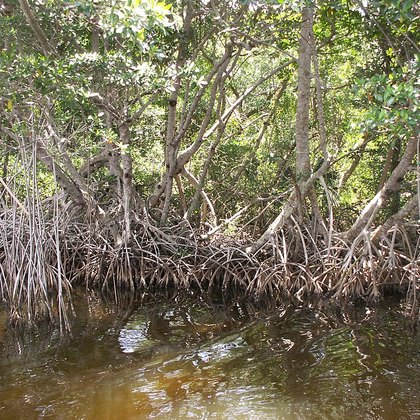
The Black-whiskered Vireo is the vireo of the mangroves: in the United States it breeds only in southern Florida and the Keys, and beyond that on almost every island of the West Indies. A thin black malar stripe on each side of the throat separates it from Red-eyed Vireo.
Voice
Only the male sings, usually from a perch in the canopy. The song consists of short, clear phrases of two to four notes, each one slightly different from the last, separated by short pauses, and is kept up for hours at a stretch in the breeding season; in the Caribbean the bird is named after those phrases, rendered as whip-Tom-Kelly. Migratory populations sing only in the breeding season, resident ones year-round. The song carries far across mangrove and is usually the first sign of the species.
Recording: Noah Khanti Steinberg — CC BY-NC-SA 4.0 · Key Biscayne, Miami-Dade County, Florida, United States · xeno-canto
Identification
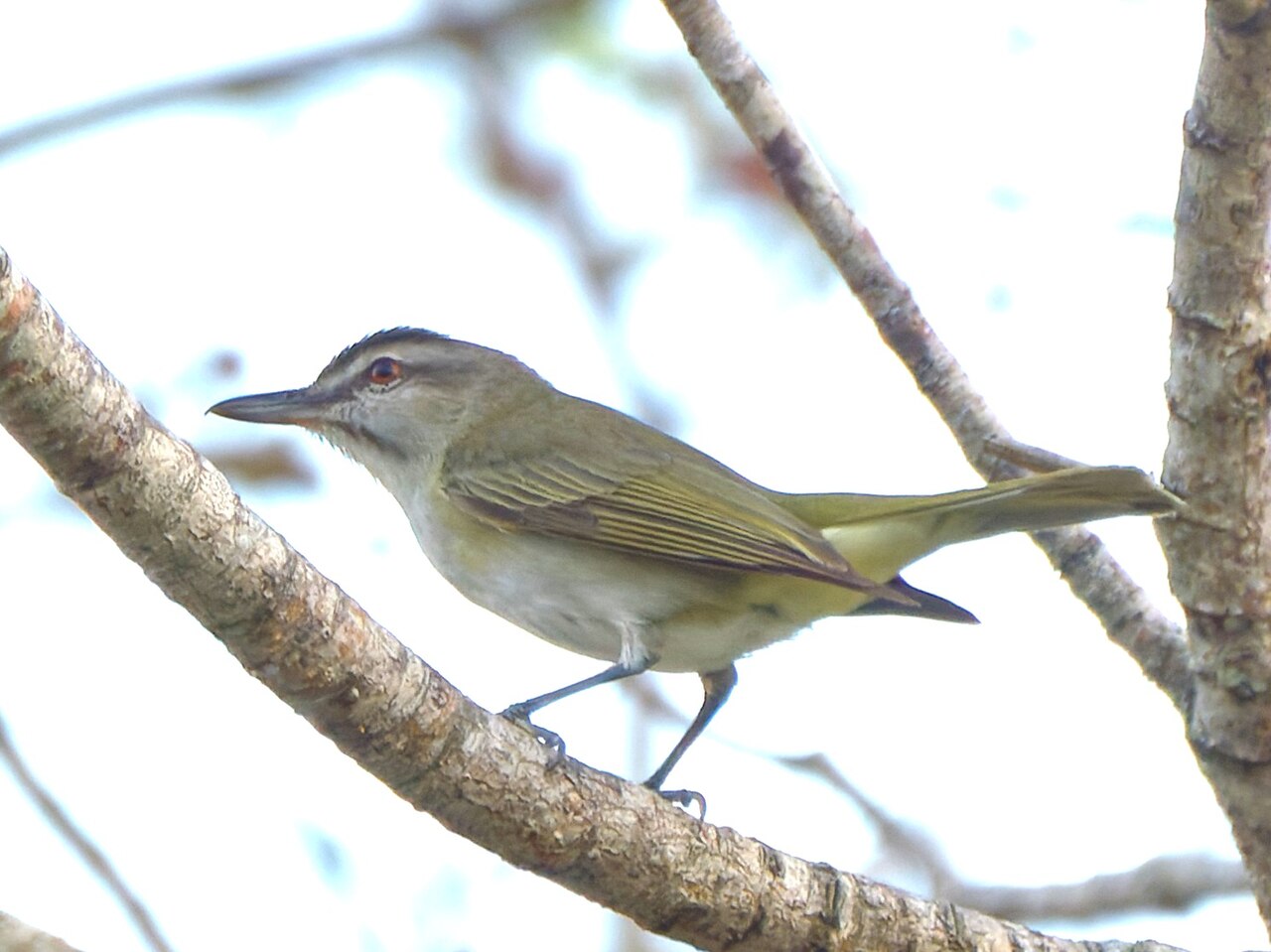
A large vireo with a blue-grey forehead and crown washed olive-buff, a buffy-white supercilium running from the bill to behind the eye and a broad dusky stripe through the eye. On each side of the throat stands a thin black line — the whisker — which is not always immediately obvious in the field and shows best in profile or from below. The upperparts are olive-green, the flight feathers blackish brown edged cream and olive. The underparts are mostly white with lemon-yellow undertail coverts. The iris is red-brown, the bill heavy, black and clearly hooked, the legs black. The sexes look alike.
Confusion species
Red-eyed Vireo is the main confusion species: it lacks the black whisker, has a slightly finer and less strongly hooked bill and a more sharply drawn head pattern with a black border above the supercilium. In poor light or a head-on view the whisker can stay invisible; then go by the heavier bill and by the song, which in Black-whiskered Vireo is made of shorter, constantly varying phrases. Yellow-green Vireo has no whisker and shows extensive yellow on breast sides and flanks. Young Black-whiskered Vireos have a less distinct whisker than adults.
Habitat
In Florida, coastal mangrove and subtropical hardwood hammocks. Elsewhere in the Caribbean it uses virtually all forest types at all elevations, from mangrove and coastal woodland to montane forest. In South America it occupies forest edge and clearings in evergreen forest, from sea level to about 3000 metres. It takes roughly equal amounts of fruit and arthropods, more fruit than the other vireos of its range, and forages mainly by gleaning from foliage while perched, rarely in flight.
Where the bird is most often found, arranged by the USNVC — the vegetation classification of the United States and Canada — and CMECS for sea and coast.




Range and movements
Breeds in southern Florida, the Bahamas, the Greater and Lesser Antilles, Providencia and San Andrés, Trinidad and Tobago and northern South America. The species is a partial migrant: the subspecies barbatulus, of Florida and the northern Antilles, leaves the breeding range entirely and winters in the Amazon basin, while the forms of Bonaire, Curaçao and Aruba and those of several other islands are resident. In Florida males arrive in April and breeding runs from late April to mid-August. Along the northwestern Gulf coast stray birds appear regularly in spring.
- Resident
- Breeding (summer)
- Winter
- Passage
- dark = core range, pale = thinly spread
Where and when to look
The best chance in Florida falls between mid-April and June, in the mangroves of the Keys and along the coastal woodland of the mainland; in the early morning males sing almost without a break. Track it down by song, then look at the bird from below, from a trail or a boardwalk: the whisker shows well against the white throat from underneath and hardly at all from above.
Conservation
The IUCN places the species in the Least Concern category (LC), with an estimated 6.2 million mature birds and a large range; it is common in Florida and the West Indies and locally scarce in South America. Along Florida's west coast numbers fell in the 1980s through loss of mangrove after severe winters and through increased parasitism by Brown-headed Cowbird; in parts of the range more than half of nests contain a cowbird egg. On the islands the Shiny Cowbird also lays in them.
Scientific name
Vireo altiloquus | (Vieillot, 1808)
Vieillot described the species in 1808 as Muscicapa altiloqua, placing it with the Old World flycatchers; since it now stands in Vireo, author and year go in parentheses. Vireo is a Latin word for a green migratory bird, from virere 'to be green'. The species name altiloquus combines altus 'loud, high' and loqui 'to speak', so 'loud-speaking', after the far-carrying song. The type locality was given as Jamaica and Santo Domingo; the specimens came, according to Stenhouse (1930), from St. Thomas in the Virgin Islands.