All species › Passerines › New World warblers › Blackpoll Warbler
Blackpoll Warbler | Setophaga striata
Zwartkopzanger | Reinita estriada
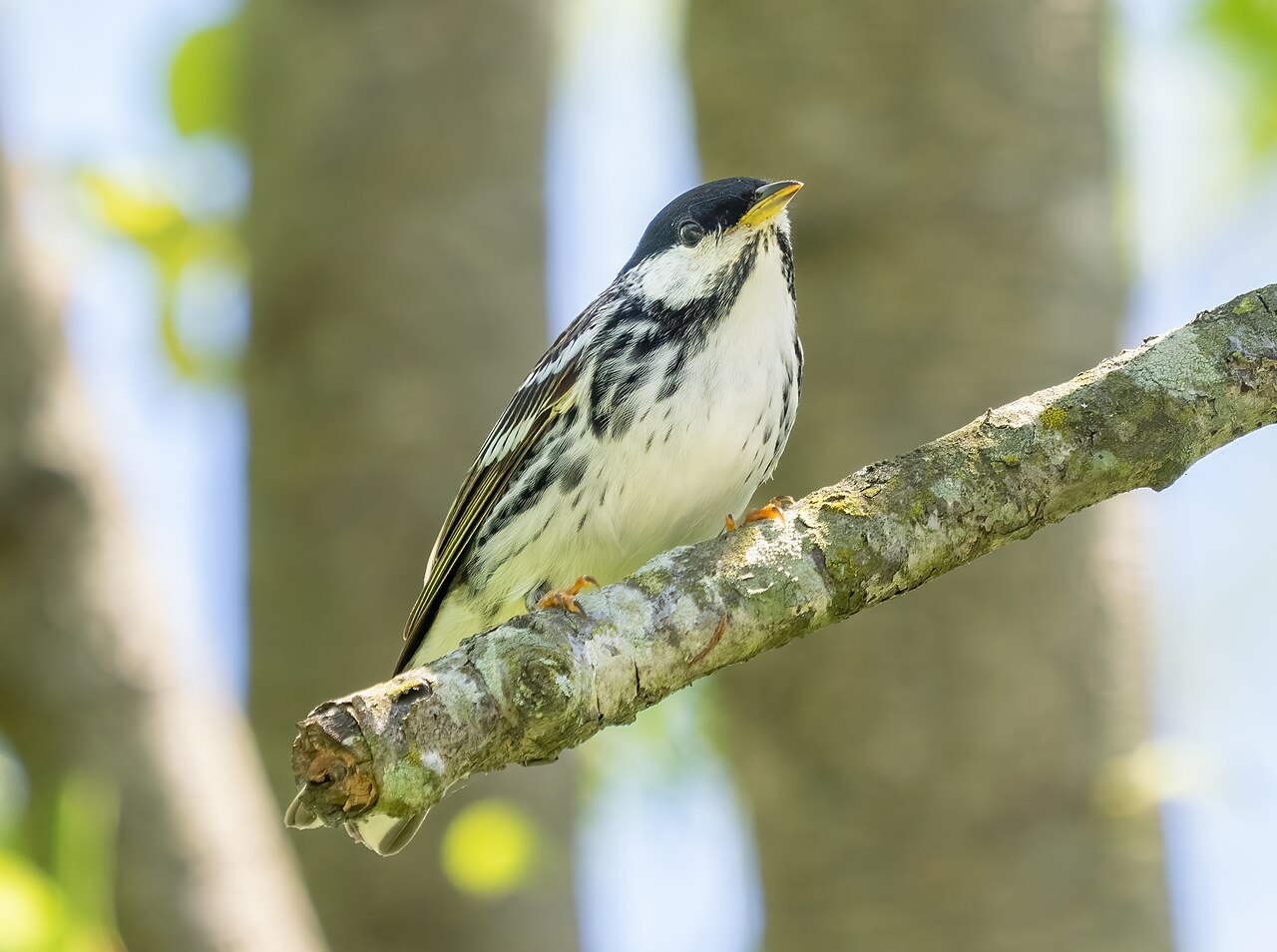
The Blackpoll Warbler is one of the larger species in its genus and makes one of the longest migrations of any North American songbird: from the boreal forests of Alaska and Canada in a single flight across the Atlantic to northern South America. In summer the male is black and white with a black cap, a white cheek and orange legs.
Voice
The song is a series of ten to twenty identical, high tsi notes that first swell in volume and then fade away at the end; the whole thing lies so high that many ears no longer register it, and in the United States it is half-jokingly called a hearing test. The call is a thin, sharp sit. On the breeding ground the male sings from a spruce, often halfway up rather than from the top.
Recording: Stanislas Wroza — CC BY-NC-SA 4.0 · La Côte-de-Beaupré (near La Barrière-du-Maurice), Capitale-Nationale, Québec, Canada · xeno-canto
Identification
In summer the male has a wholly black crown, white cheeks, a white throat, black-streaked white underparts and two white wing bars; the back is grey with black streaks. The legs and feet are orange to yellowish; in autumn the legs are paler, but the soles of the feet stay yellow. The female is grey-green with fine streaking and lacks the black cap. In autumn both sexes are olive-green with dark streaks on the back, a yellow-green wash on breast and throat and fine streaks on the flanks; the undertail coverts are then white and the legs pale.
Confusion species
The autumn plumage is barely separable from that of Bay-breasted and Pine Warblers. From Bay-breasted it differs in white rather than buff undertail coverts, fine dark streaks on the flanks rather than plain flanks, and pale rather than dark legs. Pine Warbler has a longer tail, an unstreaked back and a heavier bill. In spring the male's black crown can suggest Wilson's Warbler, which has plain yellow underparts.
Habitat
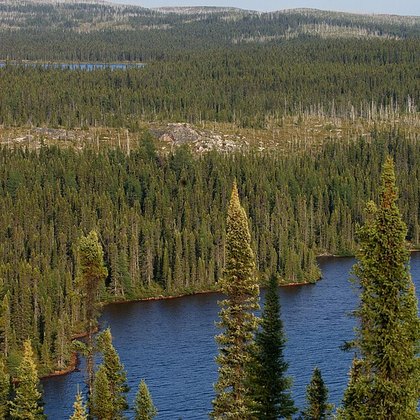
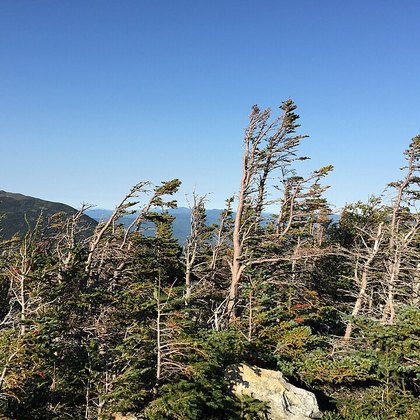
Breeds in boreal coniferous forest and taiga, favouring dense, low stands of black spruce and tamarack on damp, peaty ground, out into the dwarf scrub at treeline and on the bare summits of the New England mountains. On migration it uses scrub, coastal thickets and both coniferous and deciduous woodland. In winter it occupies forest edge, second growth and scrub up to about three thousand metres.
Where the bird is most often found, arranged by the USNVC — the vegetation classification of the United States and Canada — and CMECS for sea and coast.



Range and movements
The breeding range extends from western Alaska through Yukon, the Northwest Territories and all of boreal Canada to Labrador and Newfoundland, with southern outliers in the Adirondacks of New York and the mountains of New England. In autumn the birds first move east to the coast of New England and the Maritimes and from there fly 2500 to 3000 kilometres non-stop over the sea in 62 to 88 hours to the Greater Antilles and northern South America, nearly doubling their body mass beforehand. In spring the route runs overland, through Florida, the Gulf Coast and the centre of the continent. The winter range lies in Colombia, Venezuela, the Guianas, Peru and western Amazonian Brazil.
- Resident
- Breeding (summer)
- Winter
- Passage
- dark = core range, pale = thinly spread
Where and when to look
September on the New England coast is the best place: with northwest winds behind a cold front large numbers gather to wait for the crossing, and Bermuda receives wind-drifted birds in the same weeks. On any greenish autumn warbler, check the legs and the undertail coverts; those two marks separate it from Bay-breasted when the plumage itself does not settle the matter.
Conservation
The IUCN places the species in the Near Threatened (NT) category. Partners in Flight puts the breeding population at about 60 million birds, but the Breeding Bird Survey records a loss of more than two per cent per year, 71 per cent in total between 1966 and 2019; the species is listed among common birds in steep decline. The causes are sought in loss of winter habitat in Amazonia, changes in the boreal forest and mortality during the ocean crossing, which offers no way out if the weather turns.
Scientific name
Setophaga striata | (Forster, 1772)
Johann Reinhold Forster described the species in 1772 as Muscicapa striata, from material taken at the Severn River on the west coast of Hudson Bay; the parentheses around author and year mark its later move to another genus. The epithet striata is Latin for 'striped', after the black streaks on back and flanks. The English name Blackpoll uses the old word poll for crown or head, thus 'black-crowned', which the Dutch name also follows. The genus Setophaga means 'moth-eater', from Greek ses 'moth' and phagos 'eating'.