All species › Passerines › New World warblers › Bay-breasted Warbler
Bay-breasted Warbler | Setophaga castanea
Kastanjezanger | Reinita castaña
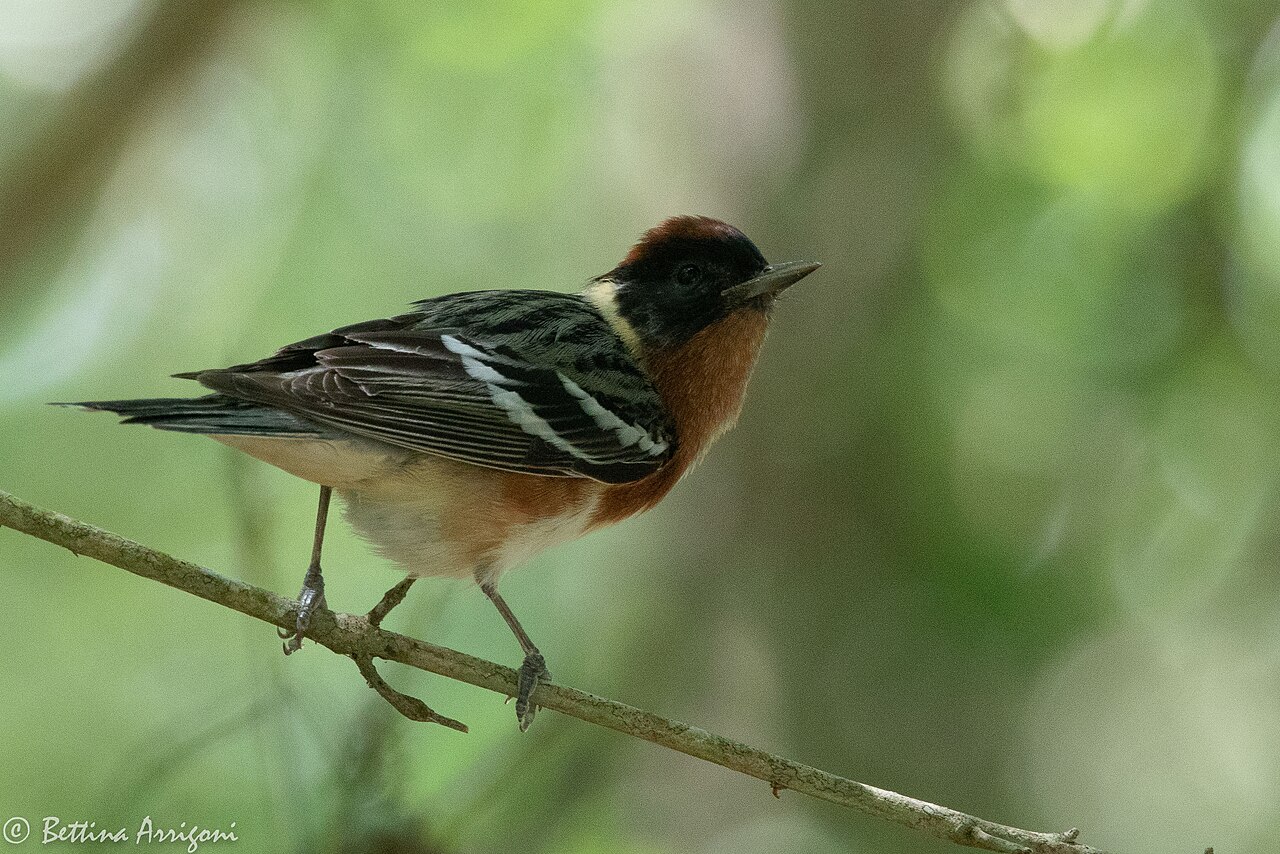
The Bay-breasted Warbler is a heavy-set warbler of the boreal spruce forest, known in breeding plumage by the chestnut crown, throat and flanks against a black face and a creamy neck patch. Its numbers rise and fall with outbreaks of spruce budworm, which it lives on almost entirely through the breeding season.
Voice
The song consists of four to eight high, wiry notes on one pitch, see see see see, thinner and slower than the rattle of Blackpoll Warbler and without its swelling and fading. A second, slightly lower version has a two-syllable rhythm. The call is a sharp, high tsip; on nocturnal migration a short rising flight note is given. Males sing as they forage and chase rivals through the crown.
Recording: David Darrell-Lambert — CC BY-NC-SA 4.0 · Point Pelee National Park, Essex County, Ontario, Canada · xeno-canto
Identification
The breeding male is grey above with black back streaks and two broad white wing bars; the face is black, the crown, throat and flanks are dark chestnut and a large creamy patch stands on the side of the neck. The female has the same pattern but paler and with less chestnut. In autumn both are olive-green on back, nape and head, with faint dark back streaks, unstreaked dull yellow underparts and buff undertail coverts; a trace of chestnut often remains on the flank. The legs are then dark.
Confusion species
The autumn plumage closely resembles that of Blackpoll Warbler. Bay-breasted has buff undertail coverts where Blackpoll has white, plain flanks where Blackpoll shows fine dark streaks, and dark rather than pale legs. Pine Warbler lacks the back streaks and has a longer tail. In breeding plumage confusion is impossible: no other warbler combines a black face with a chestnut crown and flanks.
Habitat
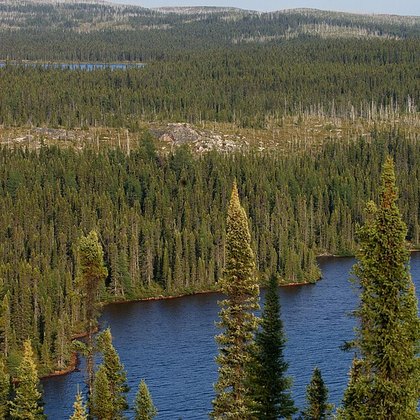
Breeds in closed, mature spruce and fir forest of the boreal zone, and within it forages by preference in the lower and middle branch layers, which keeps it clear of relatives feeding in the top. During spruce budworm outbreaks it also uses other forest types and breeds at higher density. On migration it stops in deciduous and mixed woodland. In winter it occupies humid lowland and montane forest, where it joins mixed flocks in the canopy.
Where the bird is most often found, arranged by the USNVC — the vegetation classification of the United States and Canada — and CMECS for sea and coast.



Range and movements
The breeding range runs from northeastern British Columbia and northern Alberta east through Saskatchewan, Manitoba, Ontario and Quebec to Newfoundland, with an extension into northern Minnesota, northern Michigan, northern New York and New England. Migration is largely over the eastern United States and the Gulf of Mexico. It winters in Panama and northwestern South America, with smaller numbers in southern Central America and on a few Caribbean islands; the winter range thus lies almost entirely outside the guide area.
- Resident
- Breeding (summer)
- Winter
- Passage
- dark = core range, pale = thinly spread
Where and when to look
The best chance is passage in May, when breeding plumage is still complete and the chestnut flanks show well from below. In September it pays to look under the tail of every pale olive warbler: the buff undertail coverts settle the difference from Blackpoll faster than any other mark.
Conservation
The species is listed as Least Concern (LC). Partners in Flight puts the world population at about 9.9 million birds and records a decline of roughly nine per cent since 1970; the Continental Concern Score is 11 out of 20. Because numbers track the spruce budworm cycle, short runs of data say little and trends only read over decades. Large-scale spraying against budworm reduces its food supply, and fragmentation of the boreal forest and deforestation in the winter range press on the population; collisions with towers during migration are a further loss.
Scientific name
Setophaga castanea | (Wilson, 1810)
Alexander Wilson described the species in 1810 as Sylvia castanea, from a specimen taken in Pennsylvania; because it was later placed in another genus, author and year stand in parentheses. The epithet castanea is Latin for 'chestnut-coloured', after the crown, throat and flanks of the breeding male, which the English and Dutch names also refer to. The genus Setophaga was introduced in 1827 by William Swainson, from Greek ses 'moth' and phagos 'eating'.