All species › Passerines › New World warblers › Chestnut-sided Warbler
Chestnut-sided Warbler | Setophaga pensylvanica
Roestflankzanger | Reinita de Pensilvania
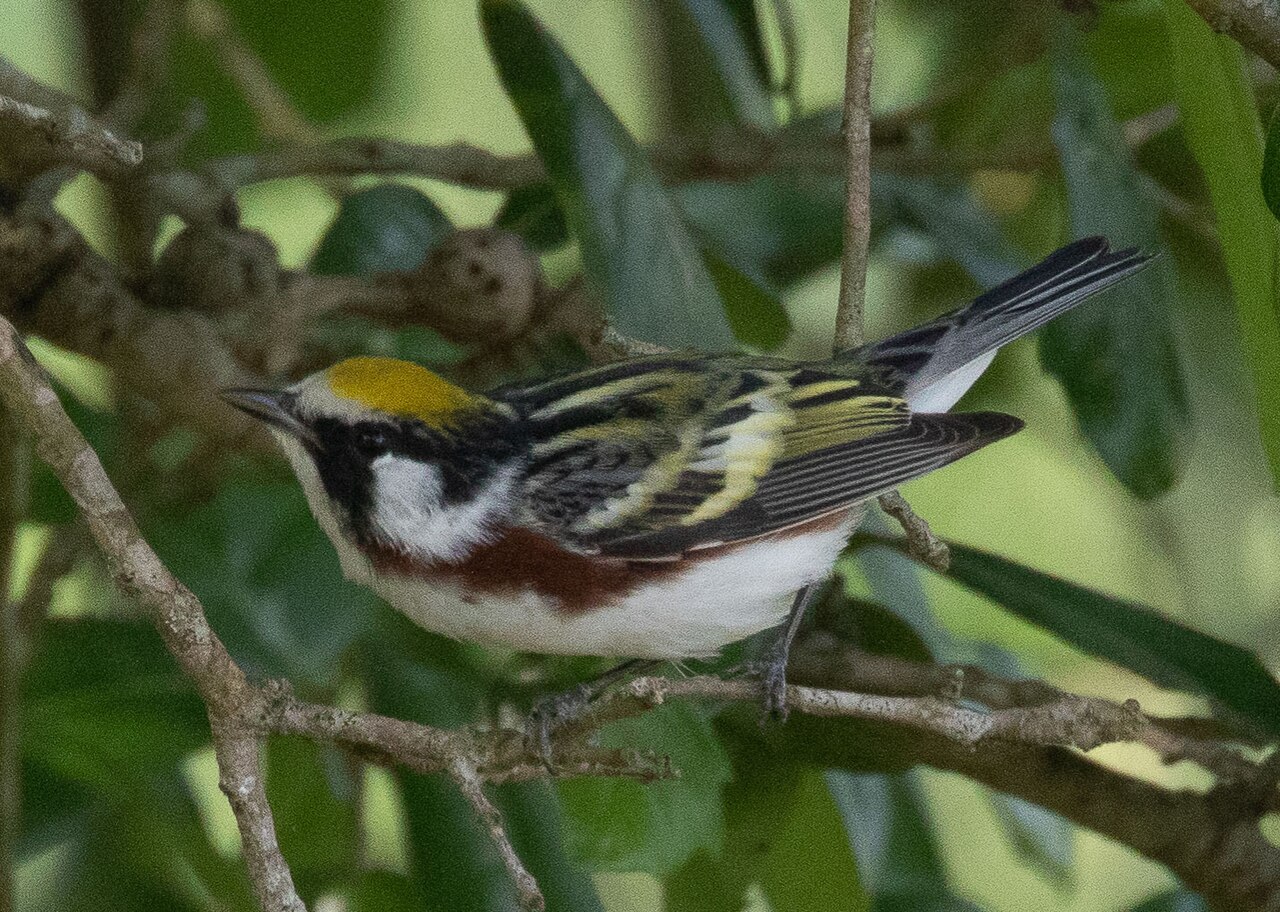
The Chestnut-sided Warbler is the warbler of young regrowth and neglected cutover: a bird with a yellow crown, a white face with black eye and moustachial stripes and a chestnut band along the flank. In Audubon's day it was a rarity; the wholesale clearing of the eastern old-growth forest made it one of the commonest species of American scrub.
Voice
The best-known song is a short, clear series rendered in North America as pleased, pleased, pleased to MEET-cha, with a sharply accented final syllable; it serves to attract a female. There is also an unaccented, flatter version without that ending, used mainly against neighbouring males and easily taken for the song of a Yellow Warbler. The call is a hard, dry chip, heavier than in most relatives.
Recording: Mario Reyes Jr — CC BY-NC-SA 4.0 · Raven Run, Fayette County, Kentucky, United States · xeno-canto
Identification
The breeding male has a bright yellow crown, a white face with a black eyeline and a black moustachial stripe running down, and a broad chestnut band along the flank up onto the side of the breast. The back is grey-green with black streaks, the wing bars are yellowish and the underparts white. The female is the same but paler, with less chestnut and a vaguer head pattern. The autumn plumage is wholly different and readily known: lime-green crown and unstreaked back, a plain grey face with a bold white eye-ring, unstreaked white-grey underparts and two yellow wing bars. The bird often holds the tail slightly cocked, with drooped wings.
Confusion species
In breeding plumage the flank band is distinctive; only the pale female can suggest a female Bay-breasted at a distance, but that species has a black face pattern, broad white wing bars and buff undertail coverts. The autumn plumage is separable from almost all relatives by the combination of lime-green upperparts, white eye-ring and entirely unstreaked underparts; Yellow Warbler is yellow across the whole underside and lacks the eye-ring, Prairie Warbler has a yellow face and white tail spots.
Habitat
Scrub and young regrowth in the first years after cutting or fire, neglected pasture growing in, forest edges and the wide strips under power lines. It settles within a few years of a disturbance and leaves again as soon as the regrowth closes into forest; small patches suffice. It avoids town and village. In winter it occupies the middle and upper layers of tropical forest, second growth, streamsides and shaded coffee plantings.
Where the bird is most often found, arranged by the USNVC — the vegetation classification of the United States and Canada — and CMECS for sea and coast.





Range and movements
The breeding range runs from central Saskatchewan east through Manitoba, Ontario, Quebec and the Maritimes, and in the United States through the Great Lakes states, New England and the mid-Atlantic states, with a narrow extension along the Appalachians to northwestern Georgia. Migration crosses the east of the continent and the Gulf Coast. It winters from southern Mexico and Guatemala to Panama and northern Colombia, with the bulk in Costa Rica and Panama, hence largely south of the guide area.
- Resident
- Breeding (summer)
- Winter
- Passage
- dark = core range, pale = thinly spread
Where and when to look
Look for it in June in a cutover or under a power line, where males sing from a low bush and the chestnut flank shows at a distance in side light. In September the lime-green upperparts and the white eye-ring are enough; waiting for the chestnut usually yields nothing, since many autumn birds lack that colour entirely.
Conservation
The species is listed as Least Concern (LC); Partners in Flight puts the breeding population at about 18 million birds and the Continental Concern Score at 12 out of 20. The Breeding Bird Survey shows a loss of some 1.2 per cent per year between 1966 and 2015, nearly 45 per cent in total. The cause lies mainly in the closing up of the eastern forest: as the cutovers of the nineteenth and early twentieth centuries mature into grown forest, the young scrub the species lives in disappears. Collisions with buildings and towers during nocturnal migration are a second loss.
Scientific name
Setophaga pensylvanica | (Linnaeus, 1766)
Carl Linnaeus described the species in 1766 as Motacilla pensylvanica, after the origin of the specimen described; the spelling with a single s is his and is retained under the rules of nomenclature, even though Pennsylvania is now spelled otherwise. The parentheses around author and year mark its later move to another genus. The English and Dutch names refer to the chestnut flank band of the breeding plumage. The genus Setophaga was introduced in 1827 by William Swainson, from Greek ses 'moth' and phagos 'eating': moth-eater.