All species › Passerines › New World warblers › Northern Yellow (Yellow) Warbler
Northern Yellow (Yellow) Warbler | Setophaga aestiva
Gele zanger | Reinita amarilla
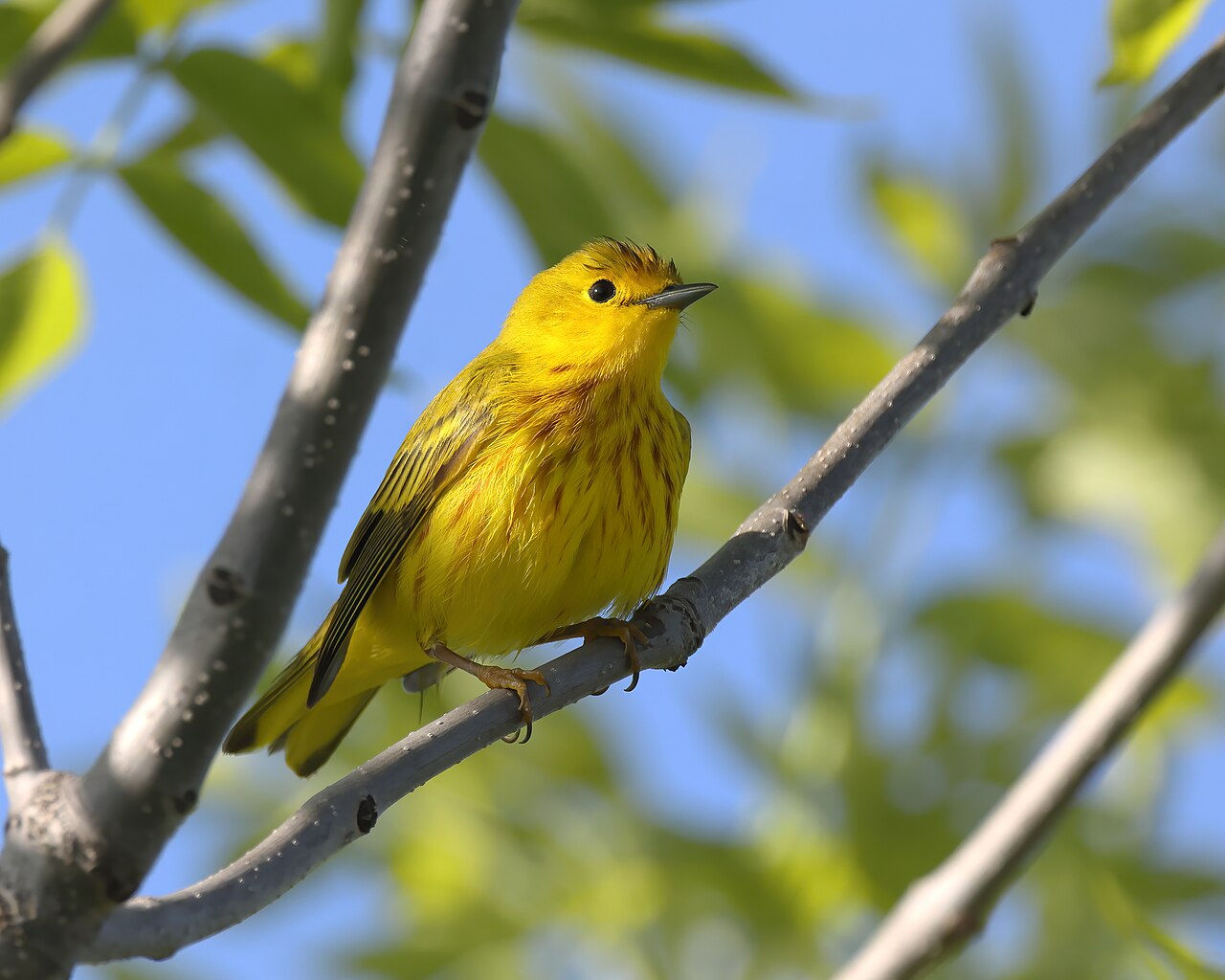
The Northern Yellow Warbler is the most evenly yellow of all the American warblers: no cap, no mask, no wing bars, just yellow, with chestnut streaks on the breast and flanks in the male. It breeds from the willow thickets of Alaska to the riverside woods of northern Mexico, giving it one of the largest breeding ranges in the whole family.
Voice
The song is a clear, rapid series of seven to ten whistles with a rising ending, rendered in English as sweet sweet sweet I'm so sweet. A male usually has two types: a fixed version sung towards the female and a variable one used against rivals at the territory edge. The call is a sharp, full chip; the nocturnal flight call is a thin, slightly buzzy zeet. Females often call shortly after the male has finished a song.
Recording: Ray Cooke — CC BY-NC 4.0 · Whitlock's Pond, Observation Tower, Albion Cross, Prince Edward Island, Canada · xeno-canto
Identification
A small, short-tailed warbler that is yellow from head to rump, with an olive-green wash over the back and crown. In breeding plumage the male has sharp chestnut streaks across the yellow breast; in the female these are faint or absent. The eye is large and dark and sits in a plain face without an eye stripe, giving an open expression. The clinching mark is the tail spots: they are yellow, where almost every related warbler has white ones. The bill base and the legs are pale as well.
Confusion species
Male Mangrove Yellow Warbler has a wholly chestnut head or crown and occurs only in mangrove. Wilson's Warbler has a black cap and a longer, often cocked tail with white outer edges. Orange-crowned Warbler is duller olive-yellow, has a thin dark eye line and fine diffuse breast streaking, and lacks the yellow tail spots. In autumn birds and juveniles the differences are smallest: then look for the wholly yellow underwing, the yellow tail spots and the plain face.
Habitat
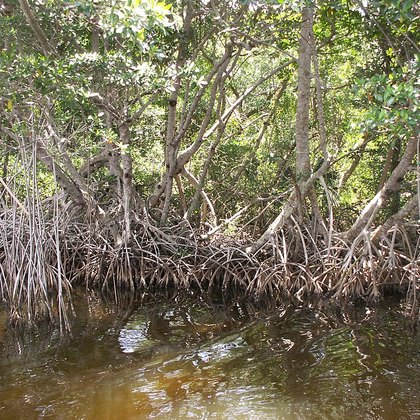
Damp thickets of willow, alder, ash and hawthorn along creeks, rivers and marsh edges; also rank meadows, hedgerows, orchards and gardens with a dense shrub layer. It avoids closed high forest and dry open plains. In the west breeding is tied almost entirely to the narrow willow belt along watercourses. In winter it occupies mangrove, gardens, coffee plantations and second-growth lowland woodland.
Where the bird is most often found, arranged by the USNVC — the vegetation classification of the United States and Canada — and CMECS for sea and coast.





Range and movements
Breeds from western and central Alaska and the Yukon east across Canada to Newfoundland, and south through nearly all of the United States; only the Gulf coast and Florida remain empty as breeding ground. Migration runs broadly across the east and centre of the continent in August and September, partly in a single crossing of the Gulf of Mexico. Winters from northwestern Mexico and the Caribbean coast of Central America south into the Amazon basin and Bolivia; within this guide's window that means the lowlands of western and southern Mexico, Guatemala, Belize, Honduras, El Salvador and Nicaragua.
- Resident
- Breeding (summer)
- Winter
- Passage
- dark = core range, pale = thinly spread
Where and when to look
The best chance is in May in a willow thicket beside water: males then sing from an exposed twig near the top of the bush and repeat the phrase every ten to fifteen seconds. If you see only the underside against the sky, watch for the yellow tail spots — that mark also works on a silent bird sitting against the light.
Conservation
Partners in Flight put the world population before the split with Mangrove Yellow Warbler at about 97 million birds, with a score of 8 out of 20 on the Continental Concern Score. The Breeding Bird Survey shows a decline of roughly 0.4 per cent a year since 1966, some twenty per cent in total. Loss of streamside thicket through grazing, channelisation and water extraction is the heaviest pressure in the west. About forty per cent of nests are laid in by Brown-headed Cowbird; the Yellow Warbler recognises a foreign egg and then builds a new nest floor over the old clutch, sometimes six layers deep.
Scientific name
Setophaga aestiva | (Gmelin, 1789)
Gmelin described the species in 1789 as Motacilla aestiva; because it was later moved to another genus, author and year stand in parentheses. The genus Setophaga was introduced in 1827 by William Swainson, from Greek sēs, sētos 'moth' and -phagos 'eating'. The species name aestiva is Latin for 'of the summer', after the northern residence. The type locality was originally given as Guiana and was later fixed on the city of Quebec. Until recently the species was treated as one with the Mangrove Yellow Warbler; differences in mitochondrial DNA, plumage and song led to the split.