All species › Passerines › New World warblers › Mangrove Yellow (Yellow) Warbler
Mangrove Yellow (Yellow) Warbler | Setophaga petechia
Mangrovezanger | Reinita de manglar
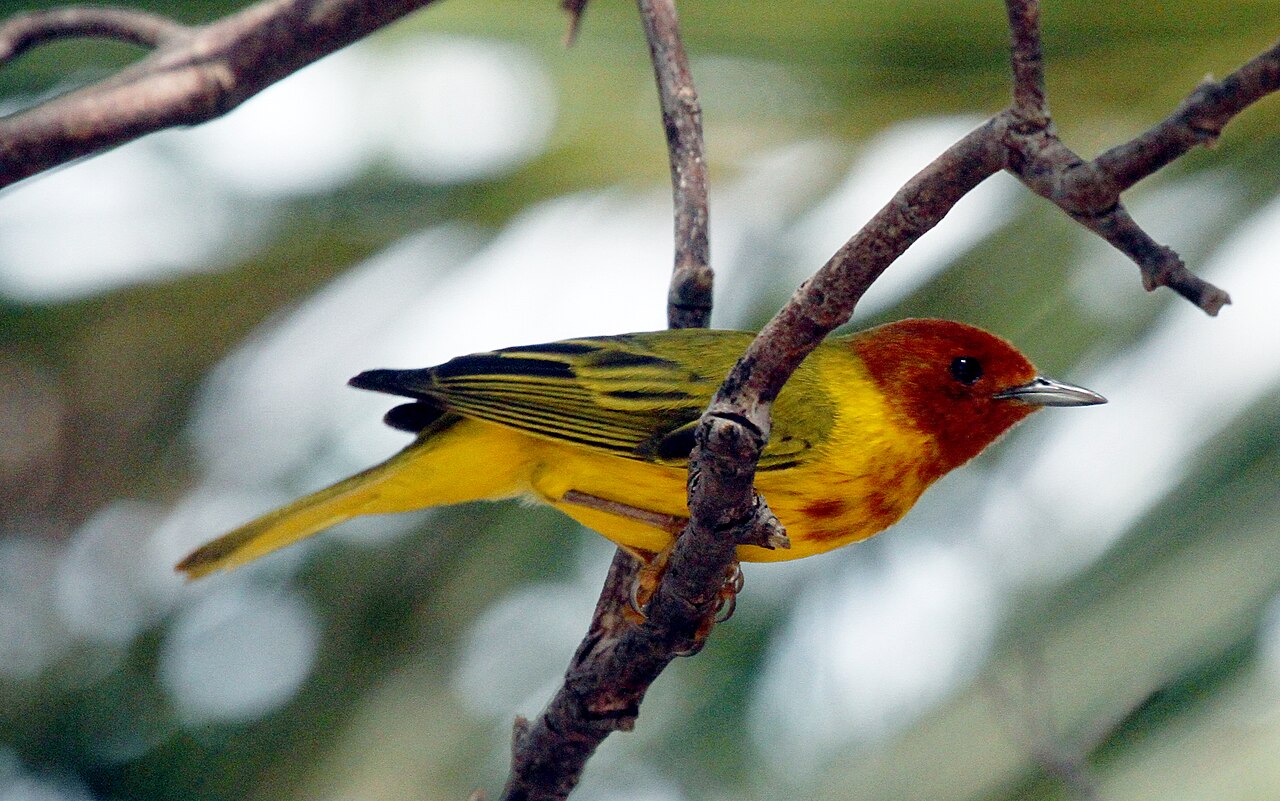
The Mangrove Yellow Warbler is the resident counterpart of the Northern Yellow Warbler: the same build and the same yellow body, but with a chestnut cap or a wholly chestnut head in the male. It stays year-round in the mangrove of tropical coasts and Caribbean islands, with the Florida Keys as its northern limit in the United States.
Voice
The song resembles that of the Northern Yellow Warbler, but is generally lower, slower and with a less strongly rising ending; in the Caribbean males sing a shorter phrase of four to six notes. The call is a full, low chip, heavier than in the Northern Yellow Warbler. Unlike migratory warblers, it sings throughout the year, with a peak at the start of the rainy season.
Recording: Bobby Wilcox — CC BY-NC-SA 4.0 · Reserva Natural Estatal Arroyo Moreno, Mexico · xeno-canto
Identification
The shape is that of the Northern Yellow Warbler: small, short-tailed, with a pale bill and yellow tail spots. The difference lies in the male's head. In the erithachorides group of the Mexican and Central American coasts the whole head is chestnut, cut off sharply against the yellow body; in the gundlachi and cruciana forms of Cuba, the Bahamas, the Florida Keys and Puerto Rico only the crown is chestnut and the rest of the head is yellow. Females are duller olive-yellow, often with a grey wash over head and back, and lack the chestnut head.
Confusion species
The Northern Yellow Warbler, which occurs in the same area only on passage and in winter, has a wholly yellow head and at most chestnut streaks on the breast, never a solid chestnut crown or head. Females and young of both species often cannot be separated with certainty in the field; habitat and season help most, since the Mangrove Yellow Warbler stays in mangrove all year and the Northern passes mainly in autumn and winter. Bananaquit has a decurved bill and a white supercilium.
Habitat
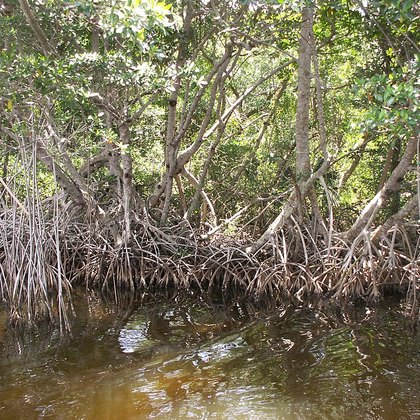
Red and black mangrove along sheltered coasts, lagoons and river mouths, often right into the narrow belt that floods at high tide. Also adjoining scrub with sea grape, coastal woodland and gardens immediately behind the mangrove. It forages low, often within two metres of the mud and the prop roots, and rarely leaves the coastal zone. On the islands it reaches locally further inland into dry coastal forest.
Where the bird is most often found, arranged by the USNVC — the vegetation classification of the United States and Canada — and CMECS for sea and coast.




Range and movements
Resident along both coasts of Mexico, from Sonora and Baja California Sur southwards and from Tamaulipas through to the Yucatán Peninsula, on along the coasts of Belize, Guatemala, Honduras, El Salvador and Nicaragua and south to Colombia, Venezuela and the Galápagos. In the Caribbean it breeds on Cuba, the Bahamas, the Cayman Islands, Jamaica, Hispaniola, Puerto Rico and the Lesser Antilles. In the United States the range is confined to the mangrove of the Florida Keys. There is barely any migration; a few birds wander short distances after the breeding season.
- Resident
- Breeding (summer)
- Winter
- Passage
- dark = core range, pale = thinly spread
Where and when to look
Look for it from a canoe route or a boardwalk through the mangrove in the first hour after sunrise: it then sings from a bare twig above the canopy of the red mangrove. With any yellow warbler in mangrove, watch the boundary between head and body — a break in colour at the neck means a male of this species.
Conservation
On the Red List the species is rated Least Concern (LC) together with the Northern Yellow Warbler, with which it was until recently treated as one species. The Barbadian subspecies petechia has held protected status in the United States since 1970 and has a small range. The main pressure is the clearing and infilling of mangrove for shrimp ponds, harbours and tourism; that intervention destroys the entire habitat of a local population at a stroke, and it does not return on its own. Restored mangrove is reoccupied.
Scientific name
Setophaga petechia | (Linnaeus, 1766)
Linnaeus described the species in 1766 as Motacilla petechia; because it was later moved to another genus, author and year stand in parentheses. The genus Setophaga was introduced in 1827 by William Swainson, from Greek sēs, sētos 'moth' and -phagos 'eating'. The species name petechia comes from Italian petecchia, a small red spot on the skin, after the chestnut streaking on the breast. The type locality was later fixed on Barbados. The English name follows the habitat, which the species hardly ever leaves.