All species › Passerines › Tits, chickadees and titmice › Boreal Chickadee
Boreal Chickadee | Poecile hudsonicus
Hudsonmees | Carbonero boreal
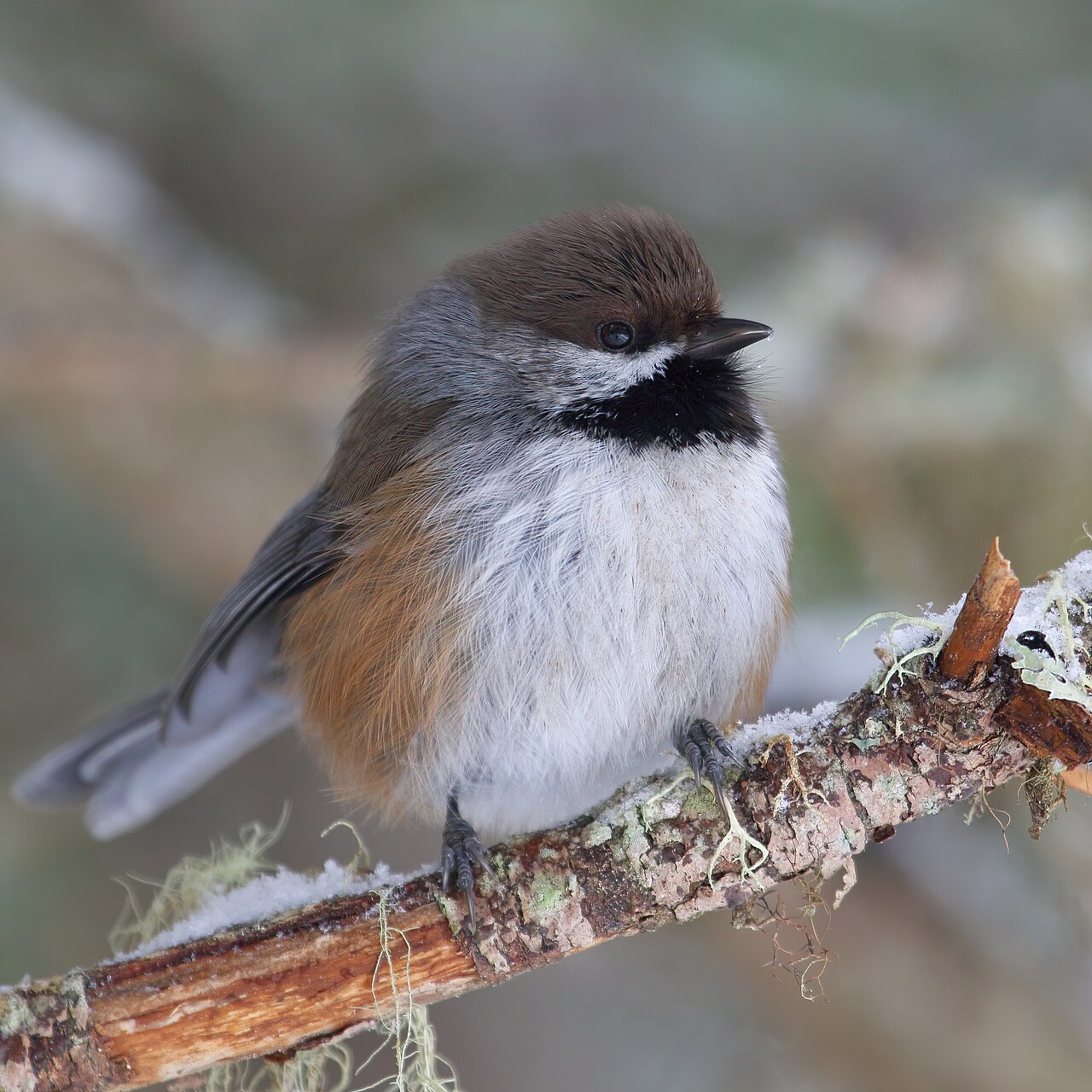
The Boreal Chickadee is the chickadee of the northern spruce forest: brown cap, greyish-brown back and cinnamon flanks. It occupies a broad belt from western Alaska to Newfoundland and stays in that forest through the hardest winter, living on seeds and insects it stored away in autumn.
Voice
The call is a hoarse, swallowed tsee-day-day in which the day notes come slowly and nasally, clearly lower and rougher than the clean chick-a-dee of Black-capped Chickadee. There is also a high, rapid trill dididididi and a thin tsee used as a contact note within the flock. A whistled song is absent; the species holds its territory with calls.
Recording: Stanislas Wroza — CC BY-NC-SA 4.0 · La Côte-de-Beaupré (near La Barrière-du-Maurice), Capitale-Nationale, Québec, Canada · xeno-canto
Identification
A compact chickadee with a relatively long, slightly notched tail. The cap is dull greyish brown to chocolate and runs onto the nape. The cheek is white in front of the eye but grades into grey behind it — a patch less sharply bounded than in the other chickadees. The bib is black. The back is greyish brown without gloss, the flanks cinnamon and the belly dingy white. The bill is short and black.
Confusion species
Black-capped Chickadee has a black cap, an entirely white and sharply bounded cheek and a grey back; where the two occur together that difference in cap colour settles it. Chestnut-backed Chickadee has a bright chestnut back instead of the dull brown one of Boreal Chickadee, and the ranges barely meet. Grey-headed Chickadee of western Alaska and northwestern Canada is paler, with a greyer cap, a whiter face and lighter flanks. In doubt the call decides: the slow, nasal tsee-day-day sounds unlike any other chickadee of the region.
Habitat
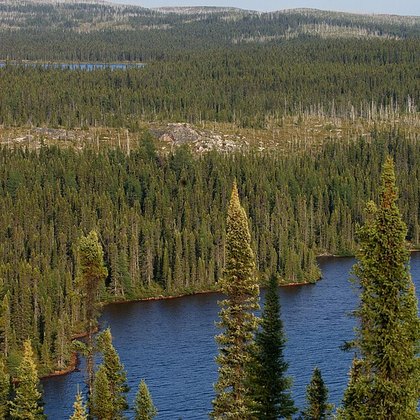
Mature, closed conifer forest of black spruce, white spruce, balsam fir and tamarack, often near water and on wet, peaty ground. In the west of the range also mixed woodland and willow and alder scrub along streams. In winter the species forages low in the forest and visits feeders at the forest edge. It nests in a cavity in a dead tree, between half a metre and ten metres up; the female excavates part of it herself and lines it with moss, bark, hair, feathers and lichen.
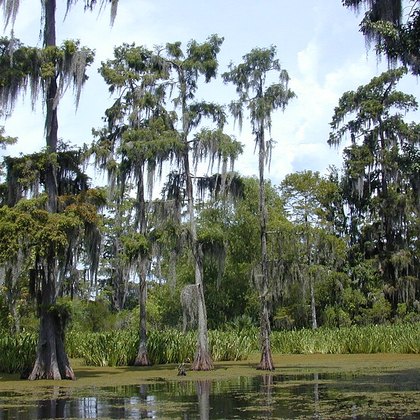
Where the bird is most often found, arranged by the USNVC — the vegetation classification of the United States and Canada — and CMECS for sea and coast.



Range and movements
Resident across the boreal zone: from western and central Alaska through Yukon, the Northwest Territories, British Columbia, the prairie provinces, Ontario and Quebec to Labrador, Newfoundland and the Maritimes. South of the border in the United States it reaches only northern Washington, northern Idaho, northwestern Montana, northern Minnesota, northern Michigan and the mountains of the northeast: the Adirondacks in New York, northeastern Vermont, the White Mountains of New Hampshire and much of Maine. It does not migrate; in some winters an irruption occurs and birds turn up well south of the breeding range.
- Resident
- Breeding (summer)
- Winter
- Passage
- dark = core range, pale = thinly spread
Where and when to look
Look for it in June in old black spruce on peaty ground, where it often hangs at the cones halfway up the tree. It responds poorly to imitations of Black-capped Chickadee but does answer its own slow tsee-day-day. In the northeastern mountains it sits higher on the slope than Black-capped Chickadee, above roughly 800 metres.
Conservation
The species is listed as Least Concern (LC). Partners in Flight puts the breeding population at about 12 million birds; counts indicate an increase of some 38 per cent between 1970 and 2017. Most of the range lies in thinly settled country that is barely surveyed, so the trend is less certain than the figure suggests. The pressure is clearcutting of old black spruce forest used in winter; in the southern edge populations of New England and New York numbers are falling.
Scientific name
Poecile hudsonicus | (Forster, 1772)
Johann Reinhold Forster described the species in 1772 as Parus hudsonicus; because it was later moved to another genus, author and year stand in parentheses. The genus Poecile was introduced in 1829 by Johann Jakob Kaup, from Greek poikilos 'pied, dappled'. The species name hudsonicus means 'of Hudson Bay'; the specimen described came from the Severn River on the west coast of that bay.