All species › Passerines › Tits, chickadees and titmice › Mountain Chickadee
Mountain Chickadee | Poecile gambeli
Gambels Mees | Carbonero montañés
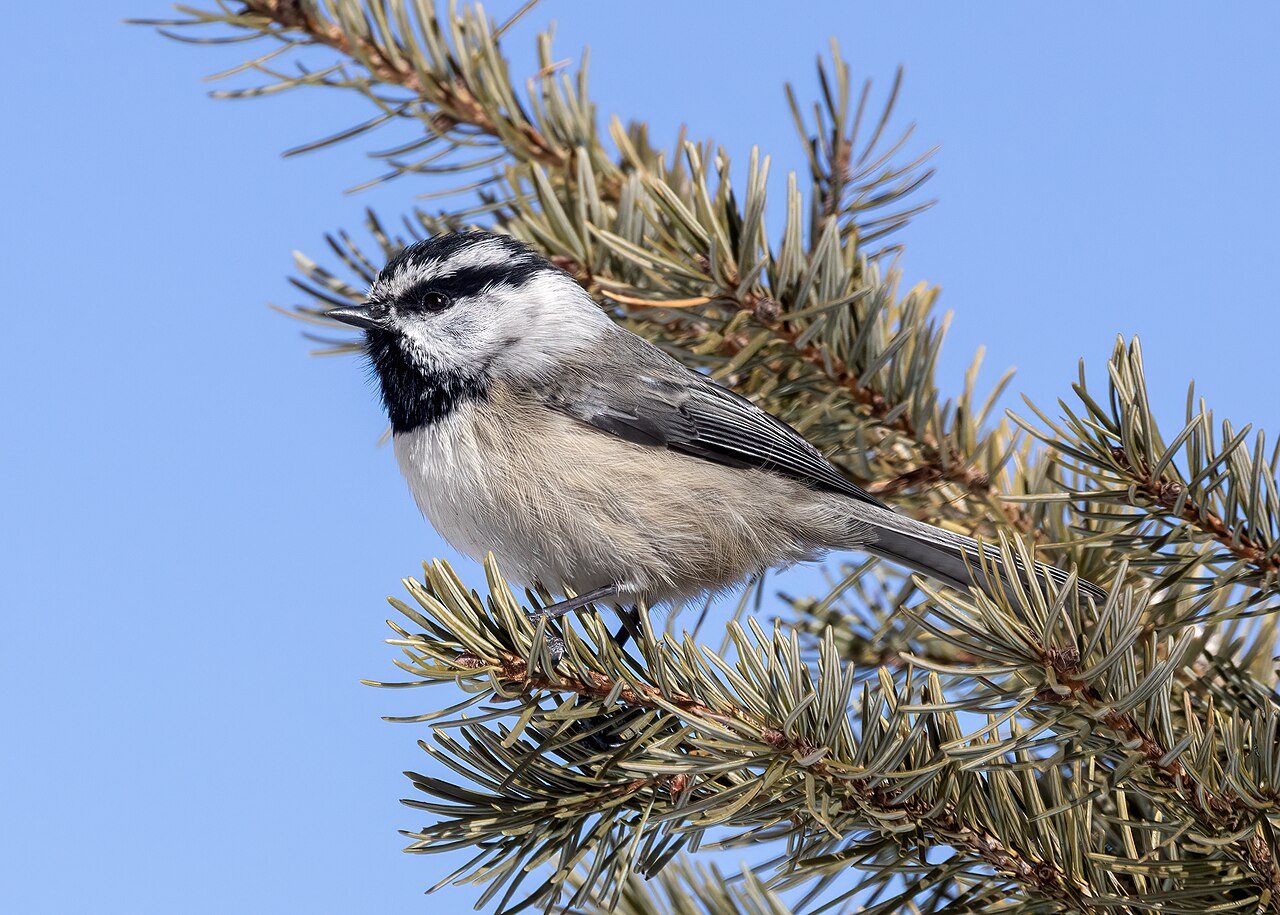
The Mountain Chickadee is the chickadee of the dry montane conifer forests of the West. It is the only North American chickadee with a white eyebrow dividing the black cap. The range runs from southern Yukon and British Columbia through the Rocky Mountains, the Great Basin and the Sierra Nevada to the mountains of Arizona, New Mexico and Baja California.
Voice
The call is a hoarse, slow chick-a-dee-dee-dee, lower and rougher than that of Black-capped Chickadee. The song is a whistled series of three or four notes stepping down in pitch, often written fee-bee-bee; birds vary the number of notes from range to range. Thin tsee notes carry within winter flocks, and a rapid rattle is given at disturbance near the nest cavity.
Recording: Diana Doyle — CC BY-SA 4.0 · Manning Camp, Saguaro National Park, Rincon Mtns, Arizona, United States · xeno-canto
Identification
A grey chickadee with a black cap, a black bib and a white cheek. The mark is the white eyebrow running between the black crown and the black eyestripe back onto the nape; in worn summer birds it may become narrow and dirty, but it is almost always visible. Back and flanks are grey without brown or buff, the underparts pale grey to white. The bill is short and black. Bill shape differs between ranges: shorter and blunter in the Rocky Mountains, longer and more pointed in the Great Basin, largest in the Sierra Nevada and the Cascades.
Confusion species
Black-capped Chickadee lacks the white eyebrow, has buff flanks and a clear two-note fee-bee; in the western mountains it lives lower down, along streams and in broadleaved trees, while Mountain Chickadee sits higher in the conifers. Chestnut-backed Chickadee has a chestnut back and no eyebrow. Mexican Chickadee of southeastern Arizona and southwestern New Mexico has no eyebrow, a much larger black bib and grey flanks; their ranges hardly overlap. Bridled Titmouse has a crest and a black-and-white patterned face.
Habitat
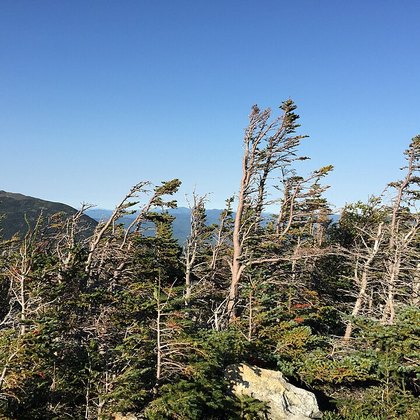
Montane conifer forest: ponderosa pine, lodgepole pine, Douglas-fir, spruce-fir stands and, on lower slopes, pinyon-juniper woodland. For the nest it often seeks out quaking aspen, whose soft, decayed wood can be worked. The species cannot excavate a sound cavity itself and uses woodpecker holes, natural crevices and nest boxes. The female builds a cup of animal fur and covers the eggs with a plug of fur while she is away. In winter the birds drop to lower forest and to gardens with seed feeders.
Where the bird is most often found, arranged by the USNVC — the vegetation classification of the United States and Canada — and CMECS for sea and coast.



Range and movements
Resident from southern Yukon and interior British Columbia and southwestern Alberta south through Washington, Oregon, Idaho, Montana, Wyoming, Nevada, Utah, Colorado and California to the mountains of Arizona and New Mexico. Eastward the range reaches the Guadalupe Mountains of West Texas, southward the Sierra San Pedro Mártir in Baja California. There is no true migration, but after the breeding season birds move down the slope; in years of poor cone crops they appear in numbers in lowlands and desert valleys outside the usual range.
- Resident
- Breeding (summer)
- Winter
- Passage
- dark = core range, pale = thinly spread
Where and when to look
In summer look above roughly 2000 metres in ponderosa or spruce-fir forest and listen for the descending whistle; the bird often comes in to an imitation. Always check the head first: in strong backlight the white eyebrow is the only reliable mark. In winter a seed feeder in a mountain town is the simplest place to see it close up.
Conservation
Partners in Flight puts the breeding population at about 7.9 million birds. The Breeding Bird Survey shows a decline of roughly 39 percent between 1966 and 2019, which places the species on the Common Birds in Steep Decline list even though its Red List status is not threatened. Large-scale wildfire and conifer mortality from bark beetles are changing the breeding habitat; at the same time dead wood yields nest cavities in the short term.
Scientific name
Poecile gambeli | (Ridgway, 1886)
Robert Ridgway described the species in 1886 as Parus gambeli; because it was later moved to another genus, author and year stand in parentheses. The genus Poecile was introduced in 1829 by Johann Jakob Kaup, from Greek poikilos 'pied, dappled'. The species name gambeli refers to the American naturalist William Gambel (1823–1849). The specimen described came from a place about one day's journey west of Santa Fe, New Mexico.