All species › Passerines › Tits, chickadees and titmice › Mexican Chickadee
Mexican Chickadee | Poecile sclateri
Grijsflankmees | Carbonero mexicano
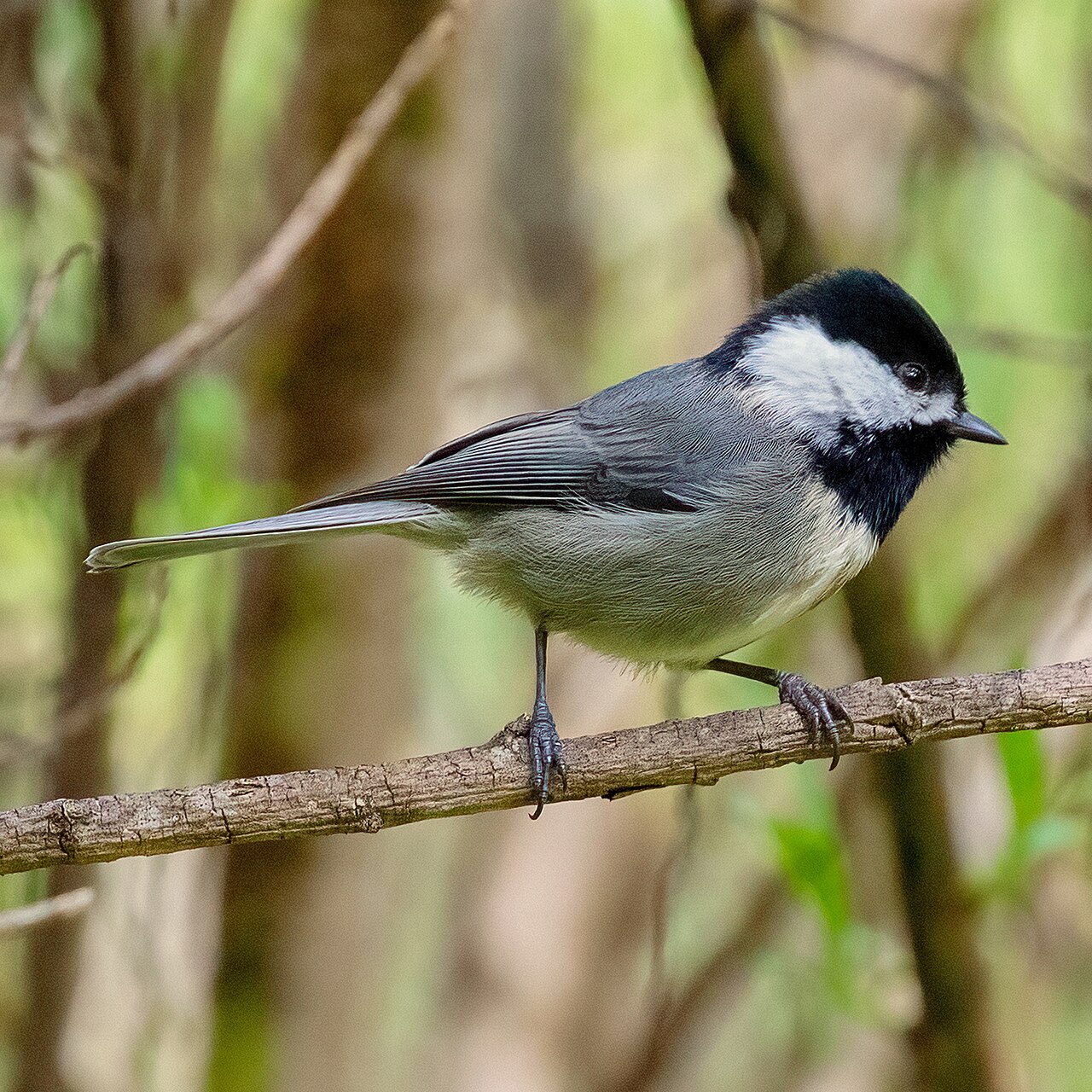
The Mexican Chickadee is the darkest chickadee in North America: a large black bib running down onto the breast, grey flanks without any buff. The range lies almost entirely in the Mexican mountains; in the United States it occurs only in the Chiricahua Mountains of southeastern Arizona and the Animas and Peloncillo Mountains of southwestern New Mexico.
Voice
The voice differs from that of the other chickadees. The song is a series of short, abrupt phrases written peeta peeta peeta, with a gurgling undertone. The calls are a high, buzzy sschleeer and a rasping tzee tzee shhh shhh; the ordinary chick-a-dee sounds hoarse and hissing here. In mixed foraging flocks it is usually these calls that give the flock away.
No freely licensed recording has been found for this species yet; what to listen for is described below.
Identification
A grey chickadee with a black cap running onto the nape, showing a faint bluish gloss in good light. The cheek is white but smaller than in the other chickadees because the black of chin and throat extends far down: the bib covers throat and upper breast and is the largest of any North American chickadee. Back and scapulars are dark olive to mouse grey, the flanks and undertail coverts a paler olive grey, the lower breast and belly white. Warm buff or brown tones are entirely absent.
Confusion species
Within its small United States range there is no other chickadee it is likely to be confused with; Mountain Chickadee occurs in those mountains on other slopes and at other elevations and has a white eyebrow, a small bib and paler grey flanks. In Mexico the range meets that of Mountain Chickadee only in the far northwest, and there too the eyebrow is the quickest distinction. Bridled Titmouse of the same mountains has a crest and a black-and-white patterned head. The voice works in all cases: the hoarse, gurgling phrases cannot be taken for the clear chick-a-dee of Mountain Chickadee.
Habitat
Montane conifer and pine-oak forest, with pines, firs and spruces, roughly between 1500 and 3900 metres. In the United States it breeds almost only above 2100 metres, in Douglas-fir and fir on the higher slopes of the Chiricahuas. Nests are placed in cavities, usually an old woodpecker hole or a natural crevice. Outside the breeding season the species travels in mixed flocks with kinglets, warblers and nuthatches, the chickadees forming the core of the flock.
Where the bird is most often found, arranged by the USNVC — the vegetation classification of the United States and Canada — and CMECS for sea and coast.



Range and movements
Resident in the Sierra Madre Occidental from Sonora and Chihuahua south through Sinaloa, Durango, Zacatecas and Jalisco, in the Sierra Madre Oriental in Coahuila and Nuevo León, and in the Trans-Mexican Volcanic Belt in Michoacán, the State of Mexico, Puebla and Veracruz into the mountains of Oaxaca. In the United States it amounts to a few dozen to a few hundred pairs in two sky islands close to the border. The species does not migrate; in winter the birds drop a little lower on the slope.
- Resident
- Breeding (summer)
- Winter
- Passage
- dark = core range, pale = thinly spread
Where and when to look
In the United States, Rustler Park in the Chiricahua Mountains is the usual place: drive up in May or June and listen for the buzzy call in the fir forest. Do not watch the colour of the back but the underside: the black bib running down onto the breast shows at distance and against the light.
Conservation
The IUCN puts the population at about two million mature birds and regards the trend as decreasing, without the species being threatened. In the Mexican core range logging and conversion of pine-oak forest are the pressure; that forest is hardly surveyed systematically, so the trend rests on estimates of habitat loss. The United States population is small and confined to two sky islands, where large wildfires such as the 2011 fire in the Chiricahuas can alter much of the breeding habitat in a single season.
Scientific name
Poecile sclateri | (Kleinschmidt, 1897)
Otto Kleinschmidt described the species in 1897 as Parus sclateri; because it was later moved to another genus, author and year stand in parentheses. The genus Poecile was introduced in 1829 by Johann Jakob Kaup, from Greek poikilos 'pied, dappled'. The species name sclateri refers to the British zoologist Philip Lutley Sclater. The specimen described came from El Jacale in southern Mexico, probably in Veracruz or Puebla.