All species › Passerines › New World blackbirds, troupials and allies › Common Grackle
Common Grackle | Quiscalus quiscula
Glanstroepiaal | Zanate común
The Common Grackle is the black, long-tailed blackbird of lawns, parking lots and cornfields across eastern North America. It walks over short grass with its head raised, nests in loose colonies in conifers, and outside the breeding season gathers in roosts that can hold hundreds of thousands of birds.
Voice
The song is a short, grating ogle-cheek, often compared to a rusty gate swinging open, and is given with the body stretched and the feathers raised. The usual call is a hard, low chack. At a roost the sound of thousands of birds runs together into a continuous rattle. It takes up sounds made by other species, but less exactly than the Northern Mockingbird.
Recording: Stanislas Wroza — CC BY-NC-SA 4.0 · La Haute-Yamaska (near Granby), Estrie, Québec, Canada · xeno-canto
Identification
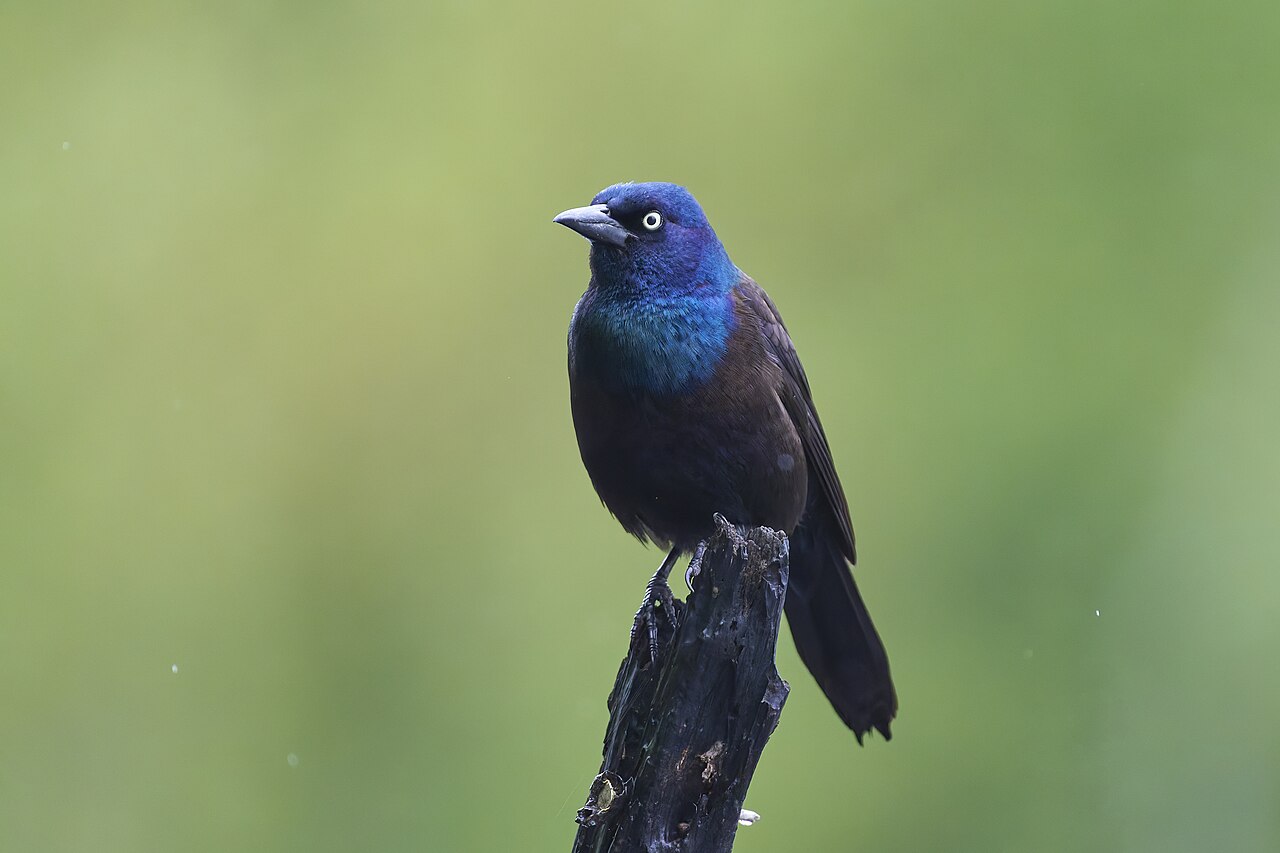
Larger and longer than an American Robin, with a long, heavy bill, long legs and a pale yellow iris. At close range the plumage is not black but metallic: head and neck gloss purple or blue-green, the body bronze or purple, with fine dark barring. The tail is long and wedge-shaped and is folded lengthwise into a shallow keel in flight — a mark that works well at a distance. The female is smaller and duller; young birds are plain brown with a dark iris.
Confusion species
Boat-tailed and Great-tailed Grackles are clearly larger with much longer tails; the ranges overlap only along the Gulf Coast and in Texas, where size and the lack of a bronze sheen decide the matter. Brewer's Blackbird and Rusty Blackbird are smaller, with a thinner bill and a shorter, straight tail. Brown-headed Cowbird is far smaller and has a short conical bill. In females and young birds the differences are smallest; the keeled tail and the long bill remain the best marks.
Habitat
Open and half-open country with scattered trees: lawns, parks, cemeteries, roadsides, farmyards, fields of maize and small grain, reed fringes and shorelines. For the nest it seeks dense conifers, shrubs over water, or structures such as bridges and light masts. Closed forest it avoids; it profits from human working of the landscape and forages on pavements, parking lots and stubble fields.
Where the bird is most often found, arranged by the USNVC — the vegetation classification of the United States and Canada — and CMECS for sea and coast.







Range and movements
It breeds across North America east of the Rocky Mountains, from northeastern British Columbia and the Canadian prairies to Newfoundland and south to the Gulf Coast and Florida. Populations in Canada and the northern states move southeast in autumn; from Kansas and Ohio southward the species is resident. The range spread westward during the twentieth century with the planting of farm shelterbelts on the prairies.
- Resident
- Breeding (summer)
- Winter
- Passage
- dark = core range, pale = thinly spread
Where and when to look
Watch the tail in flight: if it is folded lengthwise into a shallow keel, this is the species and not one of the smaller blackbirds. On a lawn it allows an approach to within a few metres; take up a position with the sun behind you, since the purple and bronze gloss shows only in direct light.
Conservation
The species is numerous, but the North American Breeding Bird Survey has shown a steady decline since 1966; a 2011 analysis found a fall of about 61 per cent from a historical maximum of more than 190 million birds to some 73 million. The IUCN therefore places it in the Near Threatened (NT) category. Because it causes damage in maize and rice, it falls in the United States under an exception to the Migratory Bird Treaty Act that permits control at roosts; how far that affects the national trend has not been established.
Scientific name
Quiscalus quiscula | (Linnaeus, 1758)
Linnaeus described the species in 1758 as Gracula quiscula, in the genus of the Asian mynas; because it was later moved, author and year stand in parentheses. The genus Quiscalus was introduced in 1816 by Vieillot; the origin of the name is uncertain and is usually derived from Latin quisquiliae 'refuse'. The species name is a diminutive of the same stem. The Dutch name points to the metallic gloss of the plumage.