All species › Passerines › New World blackbirds, troupials and allies › Rusty Blackbird
Rusty Blackbird | Euphagus carolinus
Zwarte troepiaal | Zanate canadiense
The Rusty Blackbird is the blackbird of the wet boreal forest: it breeds in peatlands, willow edges and beaver ponds from Alaska to Newfoundland and winters in the swamp forests of the southeastern United States. Of all the widespread North American songbirds it has declined the most steeply, and the Red List places it in the Vulnerable (VU) category.
Voice
The song is a short, squeaky phrase like an unoiled hinge: two or three gurgling notes followed by a high, thin tsree. A group singing together produces a continuous creaking above a swamp forest. The call is a dry chek, lower and flatter than that of the Common Grackle.
Recording: Valerie Heemstra — CC BY-NC-SA 4.0 · Bay de Noc Township (near Rapid River), Delta County, Michigan, United States · xeno-canto
Identification
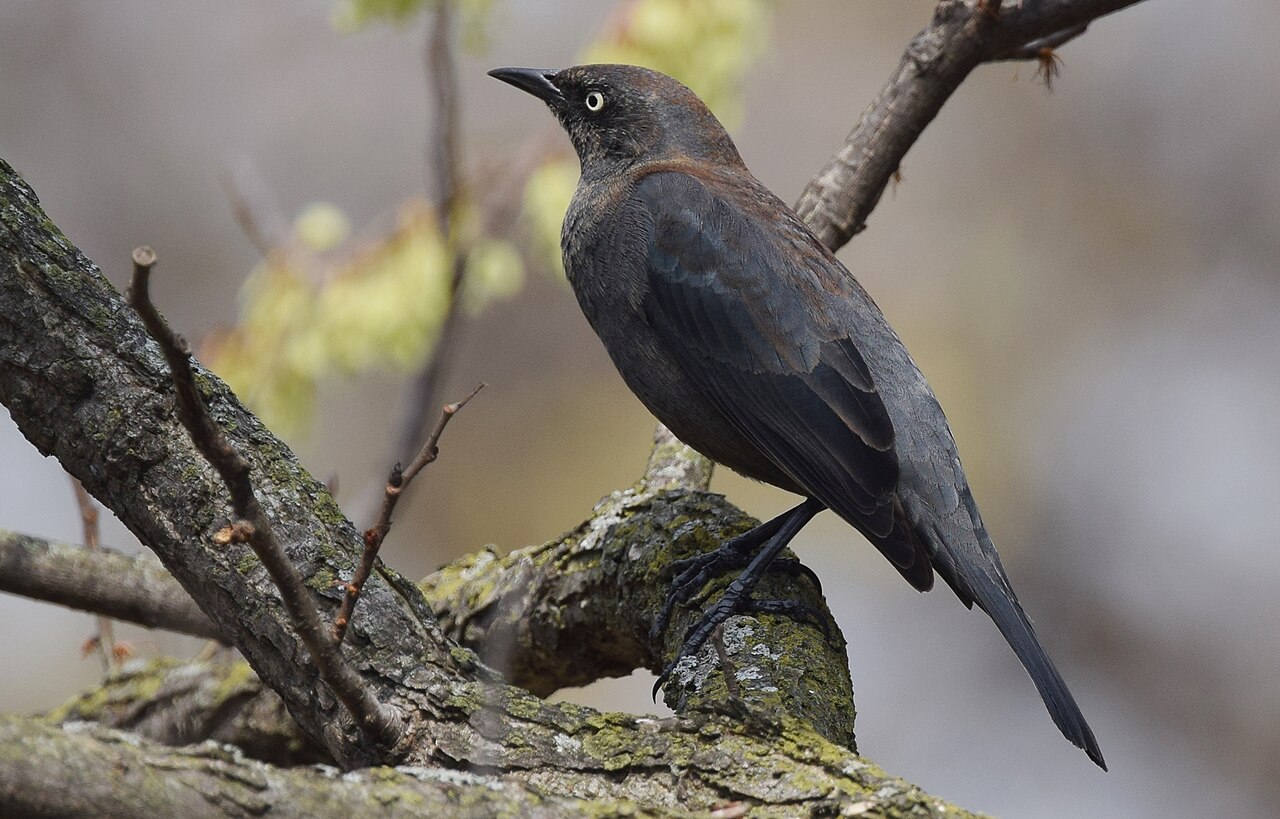
A slim blackbird with a thin, straight bill and a pale yellow iris. In summer the male is plain black with a faint green gloss, without the bronze or purple sheen of the Common Grackle and without that species' long keeled tail. In fresh autumn plumage both sexes show broad rusty feather edges on the head, back and breast, which give the English name; those edges wear away through the winter. The female is grey-brown with a pale eyebrow and a dark eye-stripe.
Confusion species
Brewer's Blackbird is the same size, but the male has a purple head against a green-glossed body, and the female has a dark iris and a plainer, colder grey-brown plumage without rusty edges. Common Grackle is larger, with a heavier bill and a tail it folds into a keel in flight. Brown-headed Cowbird has a short conical bill. The autumn plumage with rusty edges is the surest mark of this species.
Habitat
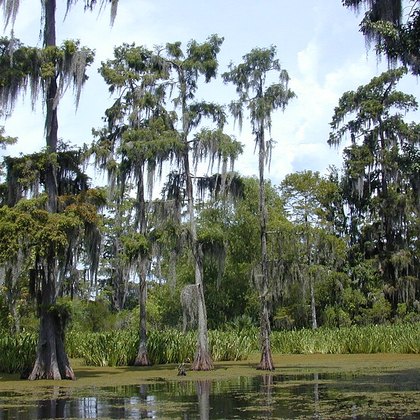
In the breeding season wet conifer country: sedge fen, muskeg (boggy spruce peatland typical of boreal Canada), alder and willow edges along streams, and above all the drowned woodland margins of beaver impoundments. Outside the breeding season swamp forest of oak, ash and pecan, flooded woodland edges and the banks of streams and ponds; in mixed blackbird flocks it also visits farmland, but far less than those species. It feeds walking and wading in shallow water, flipping over leaves and twigs.
Where the bird is most often found, arranged by the USNVC — the vegetation classification of the United States and Canada — and CMECS for sea and coast.





Range and movements
The breeding range runs as a broad band through the boreal forest, from central Alaska and Yukon east across the Canadian provinces to Labrador and Newfoundland, with outliers in northern New England and the Adirondacks. Birds move south in August and September; roughly four fifths of the population winters in the southeastern United States, from eastern Texas and Arkansas to the Carolinas and northern Florida. Through the Midwest and the Northeast it is mainly a migrant.
- Resident
- Breeding (summer)
- Winter
- Passage
- dark = core range, pale = thinly spread
Where and when to look
Look for it on migration in March and April, in flooded woodland or along a weedy pond, where it forages among the leaf litter. Watch for the yellow iris and the narrow, straight bill; in late autumn the rusty patterning on head and breast identifies it at a distance.
Conservation
The North American Breeding Bird Survey shows a decline of about 75 per cent between 1966 and 2019, close to three per cent a year; Partners in Flight puts the world population at some 6.8 million birds and the IUCN lists the species as Vulnerable (VU). Causes put forward include the draining and clearing of swamp forest in the wintering range, changes in beaver numbers and in the hydrology of the boreal forest, mercury loads in its prey, and the past large-scale control of mixed blackbird roosts. An international working group has gathered targeted data since 2005, but the leading cause has not been established.
Scientific name
Euphagus carolinus | (Müller, 1776)
Müller described the species in 1776 as Turdus carolinus, that is as a thrush; because it was later moved to another genus, author and year stand in parentheses. The species name means 'of Carolina', after the type locality. The genus Euphagus was introduced in 1867 by John Cassin, from Greek eu 'well' and phagein 'to eat'. The English name Rusty Blackbird refers to the rust-coloured feather edges of the autumn plumage.