All species › Waders, gulls and terns › Plovers and lapwings › European Golden-Plover
European Golden-Plover | Pluvialis apricaria
Goudplevier | Chorlito dorado europeo
The European Golden-Plover is a European bird with only two footholds in the guide area: a small breeding population in Greenland, and a spring appearance in Newfoundland that in some years brings dozens of birds down at once. Of the four plovers in its genus it is the bulkiest, and the only one with snow-white axillaries.
Voice
The call is a single, mournful whistled note, tluu, soft in tone and dipping slightly at the end — where the American and Pacific Golden-Plovers use two or three syllables, this bird keeps to one. On the breeding grounds the male sings a plaintive per-pee-oo in a slow display flight on stiff, shallow wingbeats, a sound that carries far over open bog. Outside the breeding season flocks on fields and pasture are largely silent and give themselves away only on taking off. Vagrants in North America seldom call; whoever finds one finds it on plumage and shape, not on voice.
Recording: Stanislas Wroza — CC BY-NC-SA 4.0 · Soppavann, Finland · xeno-canto
Identification
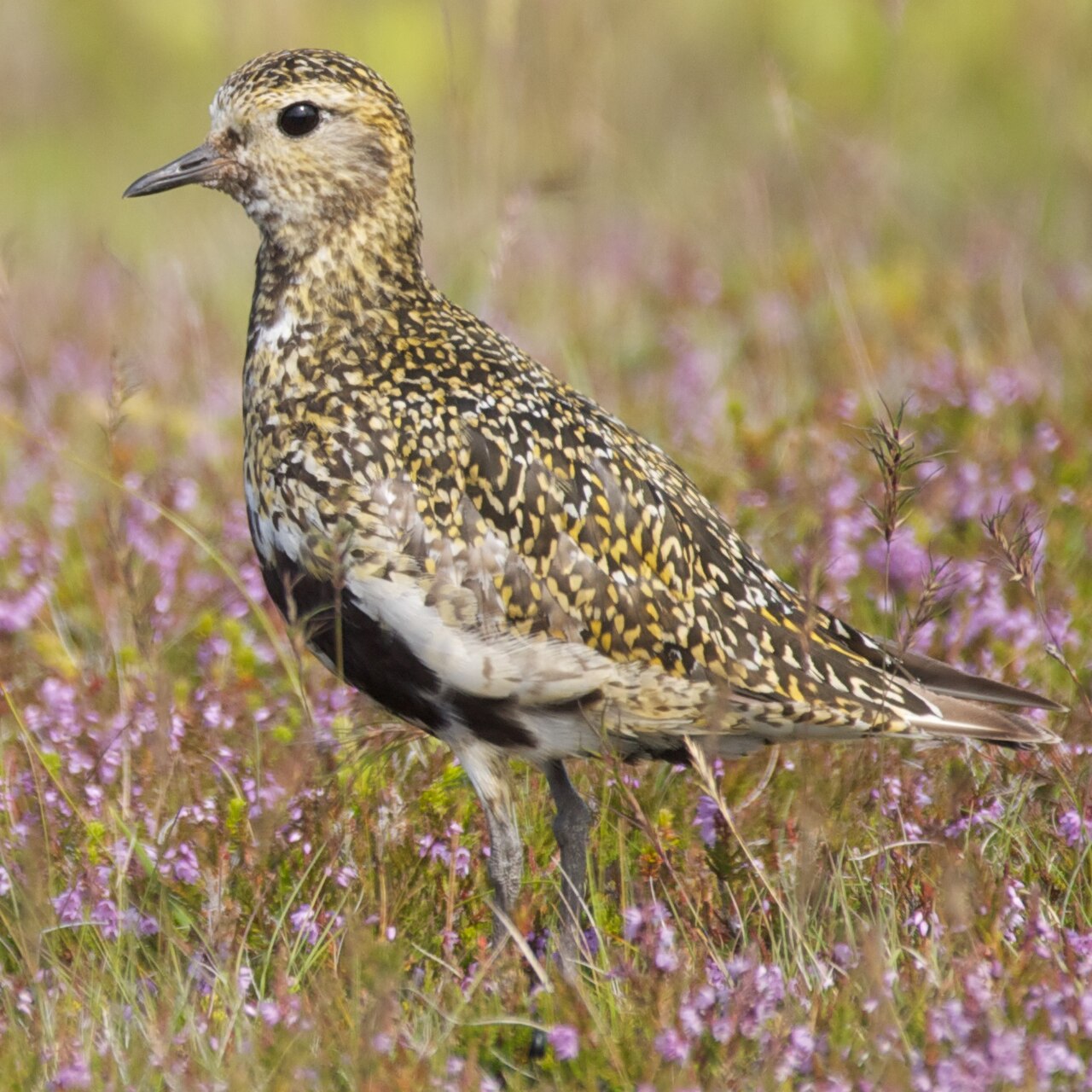
In breeding plumage the face, throat, breast and belly are black, but that black is narrower than in the other golden-plovers and broadly bordered with white on either side; the flanks, lower belly and undertail stay white. The upperparts are densely spangled with bright yellow and gold on blackish brown, more evenly patterned than in its relatives. The female shows less black and more broken, often shot through with white feathering; juveniles and winter birds are golden brown above and streaked buff on breast and flanks. It is compact and thick-necked, with a short bill and short legs, and the wingtips barely reach past the end of the tail. In flight the axillaries and underwing coverts are pure white — no other plover in the region shows that.
Confusion species
The axillaries decide it: white in European Golden-Plover, grey-white in American Golden-Plover (Pluvialis dominica) and Pacific Golden-Plover (P. fulva), black in Black-bellied Plover (P. squatarola). In breeding plumage this bird keeps white flanks and a white lower belly, while P. dominica is black right down to the undertail and P. fulva is white there with black blotching. In winter plumage it is yellower and fuller in shape than either, with shorter wingtips and shorter legs; P. dominica is then dull grey with a pale supercilium under a dark cap, P. fulva warm golden brown and noticeably longer-legged. Black-bellied Plover is larger, greyer and heavier-billed and shows a white rump and a white wingbar in flight, which all three golden-plovers lack.
Habitat
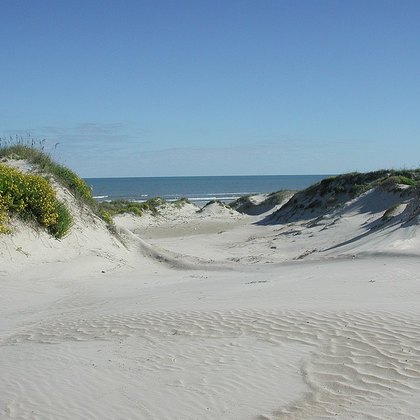
Breeds on open, low-growing ground in the north: extensive blanket bog, lichen tundra and bare upland, where the terrain is flat and the vegetation stays below the ankle. Outside the breeding season it is a bird of grassland and arable — short-grazed pasture, ploughed land, stubble and flooded fields — standing in large, tight flocks, often together with lapwings. It moves to the coast only when the inland ground freezes hard. Vagrants in North America stand almost always on short coastal pasture, airfield grass or bare heath near the sea.
Where the bird is most often found, arranged by the USNVC — the vegetation classification of the United States and Canada — and CMECS for sea and coast.



Range and movements
Its breeding range runs from Greenland and Iceland across Scandinavia and northern Russia to the Taymyr Peninsula, with scattered remnant populations on the moors of Ireland, Britain and Denmark; it winters in western and southern Europe, North Africa and the Middle East. Within the guide area it breeds only in Greenland, in small numbers. In Newfoundland it appears in some springs in April and May, occasionally dozens at a time, when a persistent north-easterly pushes the Iceland-to-Europe migration out over the Atlantic; there are a few further spring records elsewhere in eastern Canada, and scattered late-summer and autumn records reaching into the north-eastern United States. Along the southern edge of its range, on the lowland bogs of north-western Europe, it declined sharply during the twentieth century.
- Resident
- Breeding (summer)
- Winter
- Passage
- dark = core range, pale = thinly spread
Where and when to look
Look for it in Newfoundland in the last week of April and the first half of May, after a persistent north-easterly over the Atlantic, on short coastal pasture and airfield grass. Work such fields with a telescope on shape and colour: a European Golden-Plover stands more compactly and lower on the leg than the American Golden-Plovers it may share the field with. Then wait for the flock to lift of its own accord — the white axillary is the observation that settles it, and it cannot be seen on a standing bird.
Conservation
The world population runs to more than a million birds and is assessed as Least Concern (LC); Iceland alone is thought to hold about a third of it. Along the southern edge of the range the picture is different: on the bogs and heaths of Britain, Denmark, Germany, Poland and southern Sweden the species has declined or gone, through drainage, afforestation and the conversion of heath to farmland. For the guide area itself it is too scarce for any trend to be read; the handful of Greenland pairs is not counted annually.
Scientific name
Pluvialis apricaria | (Linnaeus, 1758)
Linnaeus described the species in 1758 in the tenth edition of Systema Naturae as Charadrius apricarius; because it was later placed in another genus, author and year stand in parentheses. The genus Pluvialis was introduced by Brisson in 1760 and is Latin for 'of rain', from pluvia. apricarius means 'basking in the sun', from apricari, 'to sun oneself', beside apricus, 'sunny' — a reference to the golden sheen of the plumage. Linnaeus gave the locality as 'Oelandia, Canada', an ambiguous entry resting on a drawing by Rudbeck. The type locality was later restricted to Lapland.