All species › Waders, gulls and terns › Plovers and lapwings › American Golden-Plover
American Golden-Plover | Pluvialis dominica
Amerikaanse goudplevier | Chorlito dorado americano
The American Golden-Plover flies a loop around half a hemisphere each year: north over the Great Plains in spring to the tundra, then out of eastern Canada in late summer on a single crossing of the Atlantic to South America. On ploughed spring fields the flocks stand hundreds together, black-bellied with a white stripe down the side of the neck.
Voice
The flight call is a short, slightly shrill two-syllable quee-dul or klu-ee, harder and more abrupt than the other golden-plovers' and without the mournful quality of Black-bellied Plover. Over the prairie in April that note betrays a flock at great height long before anything can be seen. On the breeding tundra the male delivers a sustained, wailing kee-dlee kee-dlee in a slow display flight on stiff wingbeats, repeated dozens of times. At the nest there is a soft, repeated too-too that presses the chicks flat to the ground.
Recording: Doug Hynes — CC BY-SA 4.0 · Landing Lake, Churchill, MB, Canada · xeno-canto
Identification
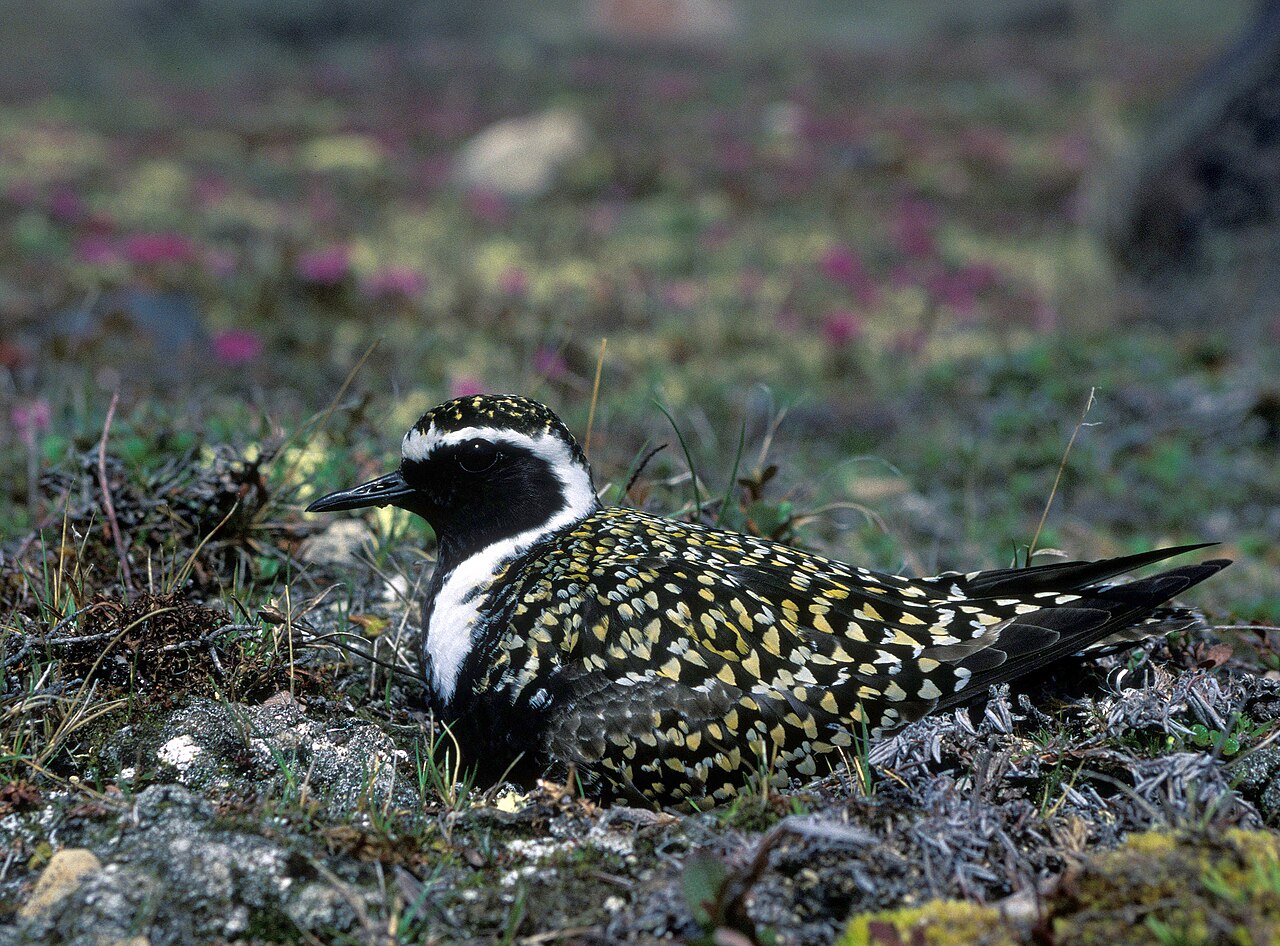
In breeding plumage the whole underside is jet black from chin to undertail, with no white on the flank; a broad white band runs from the forehead over the eye to the side of the neck and ends in a white patch on the shoulder. The upperparts are blackish brown with fine spangling that reads silvery white rather than golden. The female shows duller black shot through with white feathering, and juveniles are grey-brown with a grey-streaked breast and a pale supercilium. In non-breeding plumage it is cold, dull grey, the dark crown set off by the pale supercilium into an obvious cap. The wings are long: folded, the tips reach well past the end of the tail, further than in any other plover of the region, and in flight the underwing is smoky grey, with no wingbar and no white rump.
Confusion species
Pacific Golden-Plover is the hard one: in breeding plumage it shows white blotching on flank and undertail where American Golden-Plover stays black to the tail, and in every plumage it has shorter wingtips and longer legs, so that it looks taller and shorter behind; in flight the toes of Pacific Golden-Plover project beyond the tail tip, and those of this species do not. European Golden-Plover (Pluvialis apricaria) has white axillaries and white flanks and is shorter-legged and thicker-necked; both American and Pacific show grey-white axillaries. Black-bellied Plover (P. squatarola) is larger and heavier-billed, shows no gold at all, and flashes black axillaries, a white rump and a white wingbar in flight. In winter plumage American Golden-Plover is the dullest and greyest of the four, with the clearest cap and the palest supercilium.
Habitat
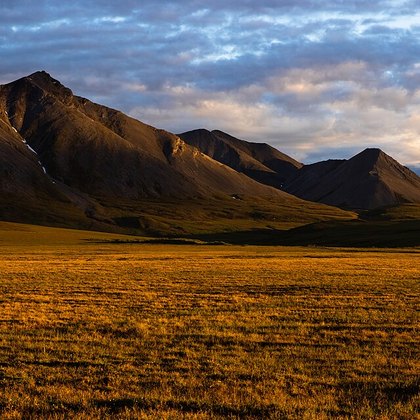
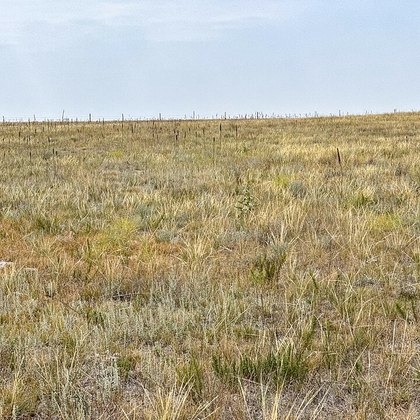
Breeds on dry, higher tundra with lichen and dwarf shrubs, on ridges and slopes above the wet hollows where Pacific Golden-Plover settles. On passage it is a bird of short grass and bare soil: closely grazed prairie, ploughed fields, stubble, flooded pasture and recently burnt grassland. It uses mudflats and beaches far less than Black-bellied Plover, and then usually only where no dry short-cropped ground is available nearby. In the wintering area it stands on the grasslands and closely grazed plains of South America.
Where the bird is most often found, arranged by the USNVC — the vegetation classification of the United States and Canada — and CMECS for sea and coast.



Range and movements
Breeds on the tundra of northern and western Alaska and across the Canadian Arctic east to Baffin Island and south to the Hudson Bay coast at Churchill. It winters on the grasslands of Argentina, Uruguay and Paraguay and along the coast of south-eastern Brazil, outside the area covered by this guide. The two legs of the journey do not match: in spring the great majority moves north up the Great Plains, while in late summer the birds gather in eastern Canada and cross the Atlantic from there to northern South America, so that numbers appear on the east coast mainly after a north-easterly gale. Autumn shooting at the staging grounds nearly wiped the species out in the nineteenth century; after the hunting ban of 1918 it recovered slowly, but the earlier numbers never returned.
- Breeding (summer)
- Winter
- Passage
- dark = core range, pale = thinly spread
Where and when to look
Look for it in April and May on the freshly ploughed and newly drilled fields of the Great Plains, from Texas to Manitoba, where flocks of hundreds stand on black soil; at range they show as a black belly with a white stripe down the neck. Drive the back roads slowly and scan ground still wet from snowmelt, because that is where the worms are. In late summer the Atlantic coast is the place, but only after several days of persistent north-easterly wind.
Conservation
The world population is put at about half a million birds and is assessed as Least Concern (LC), but numbers lie well below those of the pre-hunting era and the trend is slightly downward. The pressure points are the staging grounds: the loss of closely grazed grassland on the Great Plains and the conversion of South American grassland to arable farming, with the pesticides that go with it. On the breeding grounds there is room enough, though the composition of the tundra is changing.
Scientific name
Pluvialis dominica | (Müller, 1776)
Müller described the species in 1776 as Charadrius dominicus, among the plovers; because it was later placed in another genus, author and year stand in parentheses. The genus Pluvialis was introduced by Brisson in 1760 and is Latin for 'of rain', from pluvia. The epithet refers to Santo Domingo on Hispaniola, where the described specimen came from — an island the species now touches only on passage. The description appeared in the supplementary volume of the German edition of Linnaeus's Natursystem.