All species › Waders, gulls and terns › Plovers and lapwings › Pacific Golden-Plover
Pacific Golden-Plover | Pluvialis fulva
Aziatische goudplevier | Chorlito dorado siberiano
The Pacific Golden-Plover breeds on both sides of the Bering Sea and flies from western Alaska in one hop of more than four thousand kilometres of open ocean to Hawaii. There it spends the whole winter on lawns, golf courses and schoolyards, so faithful to its patch that ringed birds hold the same piece of grass year after year.
Voice
The flight call is a clear two-syllable chu-weet rising sharply at the end — crisper and more whistled than the American Golden-Plover's, and somewhat like a Semipalmated Plover's. On Hawaiian lawns wintering birds call all season, above all in boundary disputes with the neighbour on the next patch of grass. On the breeding tundra the male delivers a sustained, plaintive klu-ee klu-ee in a slow display flight on stiff, shallow wingbeats. In April that display note suddenly sounds on the wintering grounds too, shortly before the birds leave.
Recording: Feather V — CC BY-NC-SA 4.0 · Shenzhen Talent Park, Guangdong Province, China · xeno-canto
Identification
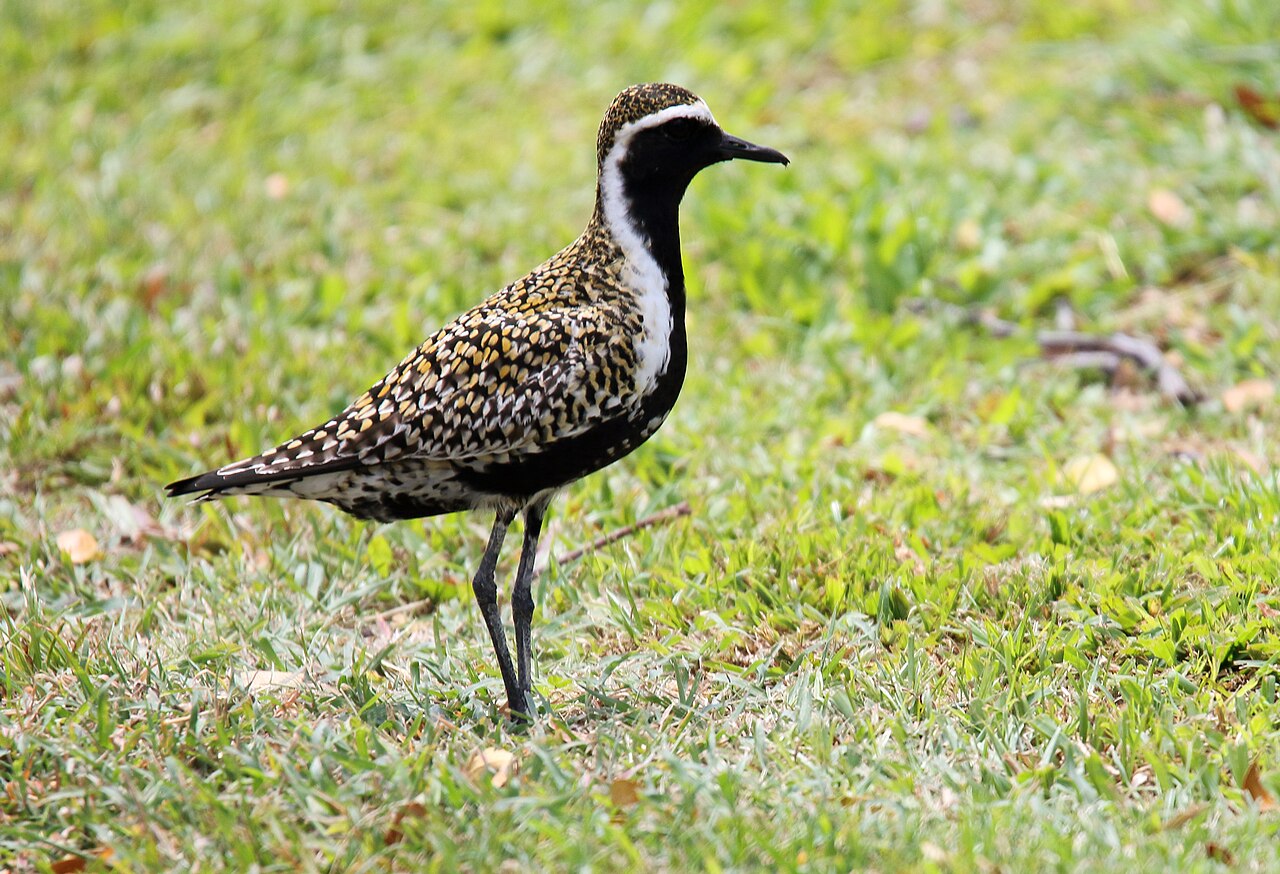
In breeding plumage the underside is black from chin to belly, but white blotches remain on the flanks and undertail, so that the black looks broken; the white band from forehead to neck-side continues as a broken stripe onto the flank. The upperparts are densely and brightly spangled with golden yellow, warmer in tone than American Golden-Plover's. The female is duller black with more white showing through; juveniles and winter birds are golden brown with a buff supercilium and a finely streaked breast. It is the smallest and slimmest of the four plovers in its genus, with long legs whose toes project just past the tail tip in flight, and with short wingtips that reach only a little beyond the tail when folded. The underwing coverts and axillaries are grey-white.
Confusion species
The sharpest contrast is with American Golden-Plover (Pluvialis dominica): that bird is black to the undertail in breeding plumage with no white on the flank, has cooler, silvery spangling above, longer wingtips and shorter legs, and its toes do not project past the tail in flight. In winter plumage Pacific Golden-Plover is warm golden brown with a buff supercilium, and American is cold, dull grey with a stronger capped look. European Golden-Plover (P. apricaria) is bulkier and shorter-legged and has white rather than grey-white axillaries; Black-bellied Plover (P. squatarola) is larger and grey, with black axillaries, a white rump and a white wingbar. In Hawaii the problem barely arises: this is the only golden-plover that occurs there regularly.
Habitat
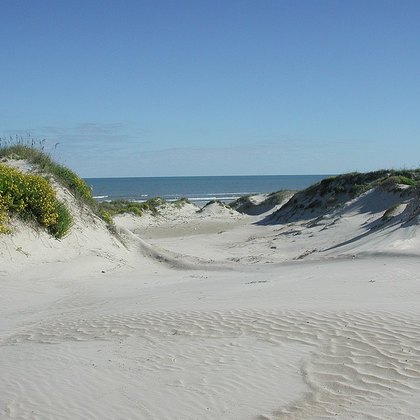
Breeds on flat, damp tundra with sedges and dwarf willow, generally lower and wetter than the ridges that American Golden-Plover chooses. In winter it is a bird of short grass and open ground, and that ground may be thoroughly man-made: lawns, parks, golf courses, playing fields, airfields, cemeteries and roadsides. It also uses mudflats, sandy beaches, saltmarsh and the margins of fishponds and salt pans. It avoids tall grass and closed vegetation, and is strongly site-faithful: one bird will hold a few hundred square metres all winter and drive off every other of its kind.
Where the bird is most often found, arranged by the USNVC — the vegetation classification of the United States and Canada — and CMECS for sea and coast.




Range and movements
Breeds on the tundra of northern and eastern Siberia and, within the guide's region, along the west coast of Alaska, from the Yukon-Kuskokwim Delta across the Seward Peninsula to St. Lawrence Island. Alaskan birds fly non-stop to Hawaii in autumn; some winter there, others carry on to the islands of the Pacific, Australia and New Zealand. Small numbers pass along the west coast of North America, mainly in late summer and autumn, and a handful winters on the California coast every year. Elsewhere in the guide's region it is a rare visitor; in Hawaii, by contrast, it is one of the commonest wintering birds of open ground.
- Resident
- Breeding (summer)
- Winter
- Passage
- dark = core range, pale = thinly spread
Where and when to look
In Hawaii there is no need to search: look at any patch of short grass — a hotel lawn, a schoolyard, a cemetery — and count the birds standing each on its own ground, usually tens of metres apart. From March to early May watch the moult: the unremarkable brown turns to black and gold within a few weeks, and the progress can be followed from day to day. On the mainland, late summer and autumn on the Pacific coast are the best time, among the flocks of Black-bellied Plovers on the flats.
Conservation
The world population is put at a few hundred thousand birds and is assessed as Least Concern (LC); Hawaii alone holds more than ten thousand in winter. The Asian flyways are under pressure from the reclamation of tidal ground along the Yellow Sea, and on the islands cats and rats are a danger to roosting and wintering birds. For the Alaskan share of the population there is no long-running count, so the trend there is not established.
Scientific name
Pluvialis fulva | (Gmelin, 1789)
Gmelin described the species in 1789 in the thirteenth edition of Systema Naturae as Charadrius fulvus; because it was later placed in another genus, author and year stand in parentheses. The genus Pluvialis was introduced by Brisson in 1760 and is Latin for 'of rain', from pluvia. fulvus is Latin for 'tawny' or 'golden brown' and refers to the spangling of the upperparts. The type locality is Tahiti: the described specimen came back from one of Cook's Pacific voyages, and so from a wintering ground rather than from the breeding range.