All species › Waders, gulls and terns › Plovers and lapwings › Killdeer
Killdeer | Charadrius vociferus
Killdeerplevier | Chorlo tildío
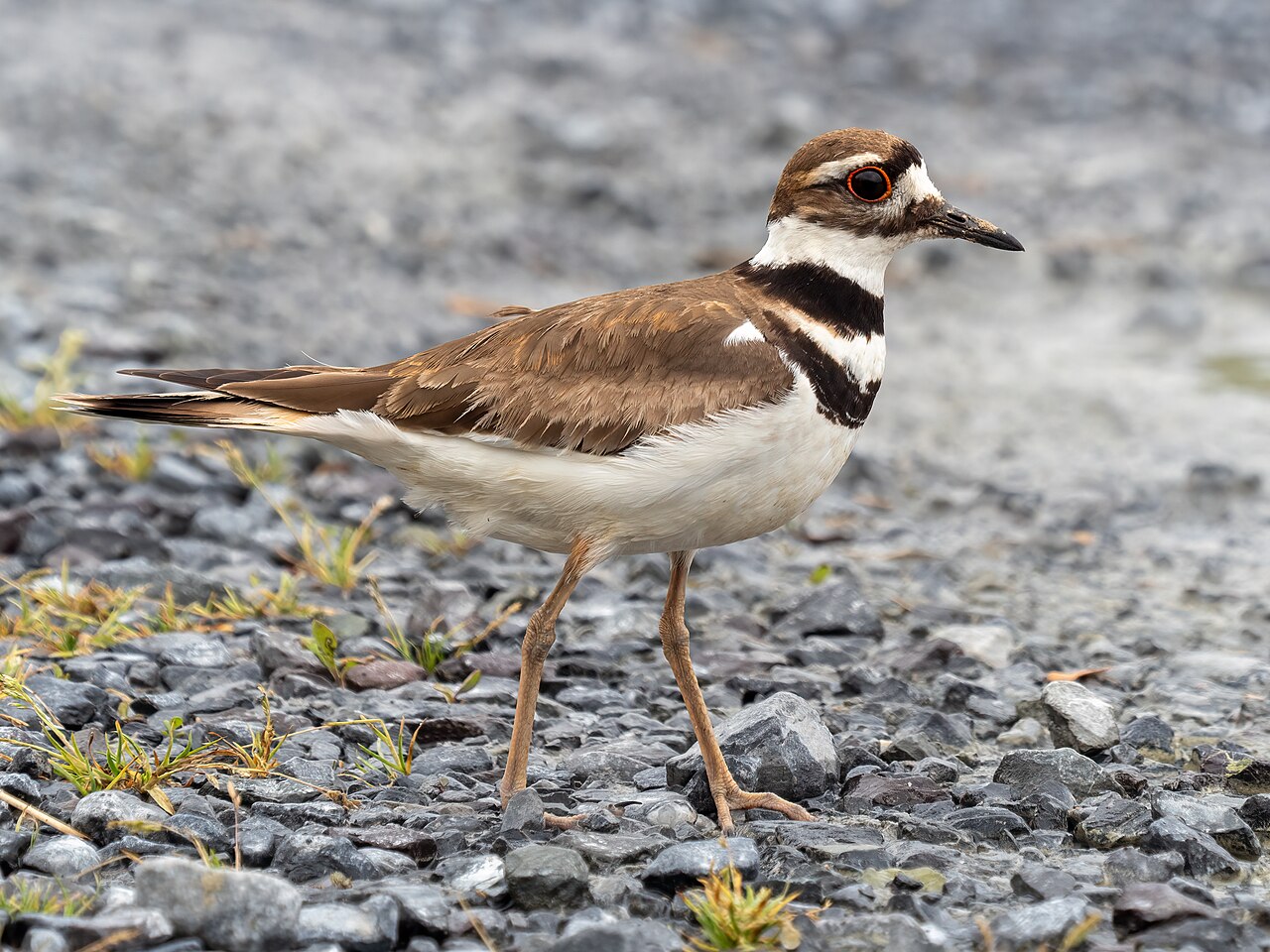
The Killdeer is the plover that ignores water altogether: it nests on gravel, pasture, parking lots and flat roofs, far from any shoreline. Two black breast bands make it the only plover in the guide area that can be separated from all others on pattern alone.
Voice
Noisier than any other plover, and usually heard before it is seen: a shrill, high kill-deee that gave the bird its English name, and an excited, rapidly repeated dee-dee-dee-dee the moment anyone comes near the nest. In display flight it delivers a long, drawn-out, plaintive tyew-tyew-tyew, slow and wailing, kept up for minutes on end. It also calls after dark: on clear spring nights its voice over fields and small towns is often the only bird sound to be heard.
Recording: Rory Nefdt — CC BY-NC-SA 4.0 · Flag Ponds Nature Park Delaware, United States · xeno-canto
Identification
A slim, long-tailed plover, brown above and white below, with two crisp black breast bands — every other plover in the region has at most one. The face is boldly patterned in black and white with a white forehead band and supercilium, the orbital ring is red, and in flight the orange-rufous rump and tail base flash, with a black subterminal band and a white wingbar. The legs are long and dull pink, the carriage upright; it runs in short bursts with abrupt stops and a forward-leaning peck. Juveniles are patterned like the adults; only downy chicks show a single band, which misleads observers every spring.
Confusion species
Semipalmated Plover is far smaller and more compact, has one breast band, a short orange-and-black bill, orange legs and a plain brown rump. Wilson's Plover of the southern coasts also has a single band, but a broad and heavy one, and its heavy black bill is distinctive. Mountain Plover of the high plains lacks a breast band altogether and is uniformly sandy; Snowy Plover is paler and much smaller. In flight the Killdeer's long orange tail is always the clinching mark.
Habitat
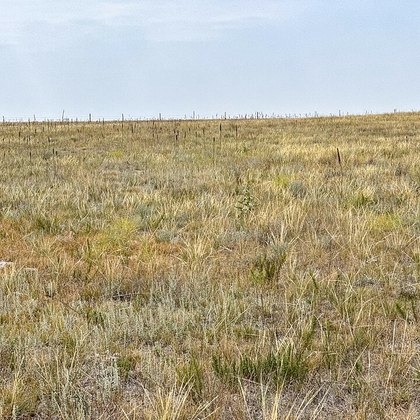
Open ground that is bare or short-grazed, and almost anywhere will do: river gravel bars, overgrazed pasture, ploughed fields, the muddy margins of ponds, golf courses, lawns, airfields, railway yards and the gravel strips of commercial rooftops. Water is welcome but not required; it feeds on earthworms, beetles and grasshoppers on dry ground. The nest is a scrape lined with pebbles, shell fragments or wood chips, holding four dark-blotched eggs that are hard to tell from the gravel around them.
Where the bird is most often found, arranged by the USNVC — the vegetation classification of the United States and Canada — and CMECS for sea and coast.




Range and movements
Breeds from central Alaska across interior Canada — north to roughly the sixtieth parallel — through the entire United States into northern and central Mexico. Northern birds are migratory, wintering in the southern United States, Mexico, Central America, the Caribbean and northern South America; from about the line Oregon–Ohio southward they stay all year. Migration is in small loose parties, often at night, and it is among the earliest returning species: in the north it stands on the last of the snow. In Greenland it is a rare vagrant.
- Resident
- Breeding (summer)
- Winter
- Passage
- dark = core range, pale = thinly spread
Where and when to look
If a Killdeer stumbles away in front of you with a drooping wing and a widely fanned orange tail, do not follow it: that is the distraction display, and the nest or chicks lie exactly where you are standing. Look at your feet first, then retreat the way you came. On a parking lot or a gravel roof in town, the noisy pair in March is often the first breeding bird of the year.
Conservation
Still widespread and numerous — the world population is put at a few million birds — yet Breeding Bird Survey counts have shown a steady decline for decades, exceeding twenty per cent over three generations. On that basis the species has been reassessed as Near Threatened (NT) on the Red List. It sits awkwardly with the birder's daily experience of seeing Killdeer everywhere, but the causes are familiar enough: loss of lightly grazed grassland, insect scarcity from pesticides on farmland and lawns, roadside collisions, and nests on building sites and parking lots that are simply driven over.
Scientific name
Charadrius vociferus | Linnaeus, 1758
Linnaeus described the species in 1758 in the tenth edition of Systema Naturae as Charadrius vociferus; because it still stands in the genus in which he placed it, author and year appear without parentheses. He introduced the genus Charadrius in the same work. Charadrius is Late Latin for a yellowish bird mentioned in the fourth-century Vulgate, taken from Greek kharadrios, a bird of ravines and stream beds (kharadra, 'ravine'); vociferus is Latin for 'clamorous', from vox, 'voice', and ferre, 'to bear' — one of the aptest epithets Linnaeus ever coined. His description rested on Mark Catesby's 'Chattering Plover' from Carolina; the type locality reads North America and was later restricted to South Carolina.