All species › Waders, gulls and terns › Plovers and lapwings › Common Ringed Plover
Common Ringed Plover | Charadrius hiaticula
Bontbekplevier | Chorlitejo grande
The Common Ringed Plover breeds on the shingle beaches and bare tundra of Greenland and the high Arctic islands of Nunavut, but its winter lies in the Old World: nearly every bird crosses the ocean in autumn to western Europe and West Africa. That makes it one of the few breeding birds of the guide's region to leave the continent eastward.

Voice
The call is a soft two-syllable too-lee, pure in tone and rising at the end — the mark that picks it out fastest among other small plovers. In display flight, on slow, deep, butterfly-like wingbeats over the breeding ground, the male repeats a rhythmic too-weeya too-weeya dozens of times over. Disturbance brings a short, hard chip, and near the nest a sustained piping that leads the chicks away. Voice separates it from Semipalmated Plover more decisively than any plumage mark does: that bird's call is hoarse and rising, chu-weet, and far less pure in tone.
Recording: Philippe Grange — CC0 · Mairie de St André (near La Roche-sur-Yon), Vendée, Pays de la Loire, France · xeno-canto
Identification
A small, compact plover, sandy brown above and white below, with a single broad black breast band, a black mask through the eye and a white forehead patch below a black crown bar. The bill is short and orange with a black tip, the legs orange. The female usually shows browner and narrower black on the face; juveniles lack the black altogether — mask and breast band are brown, the band often broken in the middle, and the bill is dark. In flight a broad white wingbar shows, with a dark tail edged white at the sides. It runs in short bursts with abrupt stops and pecks with a quick forward stab, often trembling one foot on the mud to bring prey to the surface.
Confusion species
Semipalmated Plover (Charadrius semipalmatus), which takes its place across most of the guide's region, is nearly identical: slightly smaller, with a narrower breast band, a shorter bill, a conspicuous yellow orbital ring and usually no white behind the eye, and its call is hoarse and rising rather than purely whistled. Common Ringed Plover has a broader black breast band, deepest at the centre, and a white supercilium that continues behind the eye. Piping Plover (C. melodus) is far paler, almost sandy white above, with orange legs and a narrow, often broken breast band. Killdeer is much larger, long-tailed, and has two breast bands and an orange rump.
Habitat
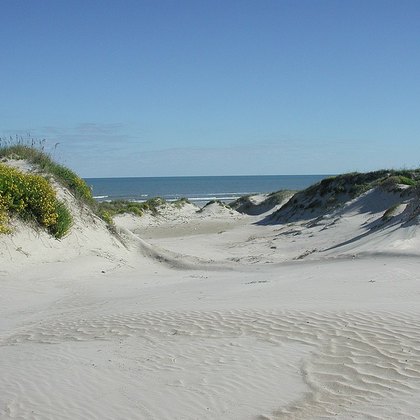
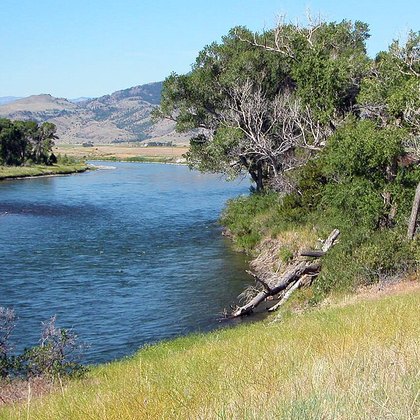
Breeds on open, sparsely vegetated ground with nothing tall on it: shingle beaches, sand flats, dried-out river beds, bare tundra and the gravel plains behind the shoreline. Outside the breeding season it stands on mudflats, sandy beaches and the muddy margins of estuaries and lagoons, usually in small loose parties rather than dense flocks. It avoids closed vegetation and steep banks; the nest is no more than a scrape in shingle or sand holding four eggs that are hard to tell from the pebbles around them. On passage it also uses inland mud, river shores and the drying edges of lakes.
Where the bird is most often found, arranged by the USNVC — the vegetation classification of the United States and Canada — and CMECS for sea and coast.



Range and movements
Within the guide's region it breeds along almost the whole coast of Greenland and on the high Arctic islands of Nunavut — Baffin and Ellesmere — and in small numbers in western Alaska, on and around St Lawrence Island. Beyond that its breeding range runs across Iceland, Svalbard and northern Europe to the Chukotka Peninsula in eastern Siberia. Greenland and Canadian birds do not move south along the American coast in autumn but east across the ocean, by way of Iceland and the British Isles to western Europe and West Africa; on North American coasts it is therefore a scarce bird, with most records in Newfoundland and along the Atlantic seaboard in late summer. In western Alaska it is seen mainly in late spring, when Siberian birds make landfall on St Lawrence Island.
- Resident
- Breeding (summer)
- Passage
- dark = core range, pale = thinly spread
Where and when to look
In the guide's region this is a bird to look for by ear: stand on St Lawrence Island or on a Greenland fjord flat in May or early June and listen for the pure, rising too-lee among the hoarse calls of the Semipalmated Plovers. Along the Atlantic coast in August and September it pays to work through every party of small plovers on breast-band width and orbital ring. When in doubt, record the call: a recording carries further than a description and can be checked afterwards.
Conservation
The world population is put at some nine hundred thousand birds and is assessed as Least Concern. On the European side numbers are falling on some coasts through disturbance of nesting birds on recreational beaches and the loss of bare shingle and sand; for the Greenland and Canadian breeders there is no long-running count. For the Arctic population much depends on the staging sites along the European and West African coasts, where the birds must refuel on migration.
Scientific name
Charadrius hiaticula | Linnaeus, 1758
Linnaeus described the species in 1758 in the tenth edition of Systema Naturae as Charadrius hiaticula; because it still stands in the genus in which he placed it, author and year appear without parentheses. He introduced the genus Charadrius in the same work; it is Late Latin for a yellowish bird named in the fourth-century Vulgate, taken from Greek kharadrios, a bird of ravines and stream beds. hiaticula is formed from hiatus, 'cleft' or 'chink', and -cola, 'dweller' — 'one that lives in clefts', after the nest scrape among the pebbles. The name was already used for this bird by sixteenth-century writers before Linnaeus. He gave the locality as 'Europe and America'; the type locality was later restricted to Sweden.