All species › Waterfowl › Ducks, swans and geese › Garganey
Garganey | Spatula querquedula
Zomertaling | Cerceta carretona
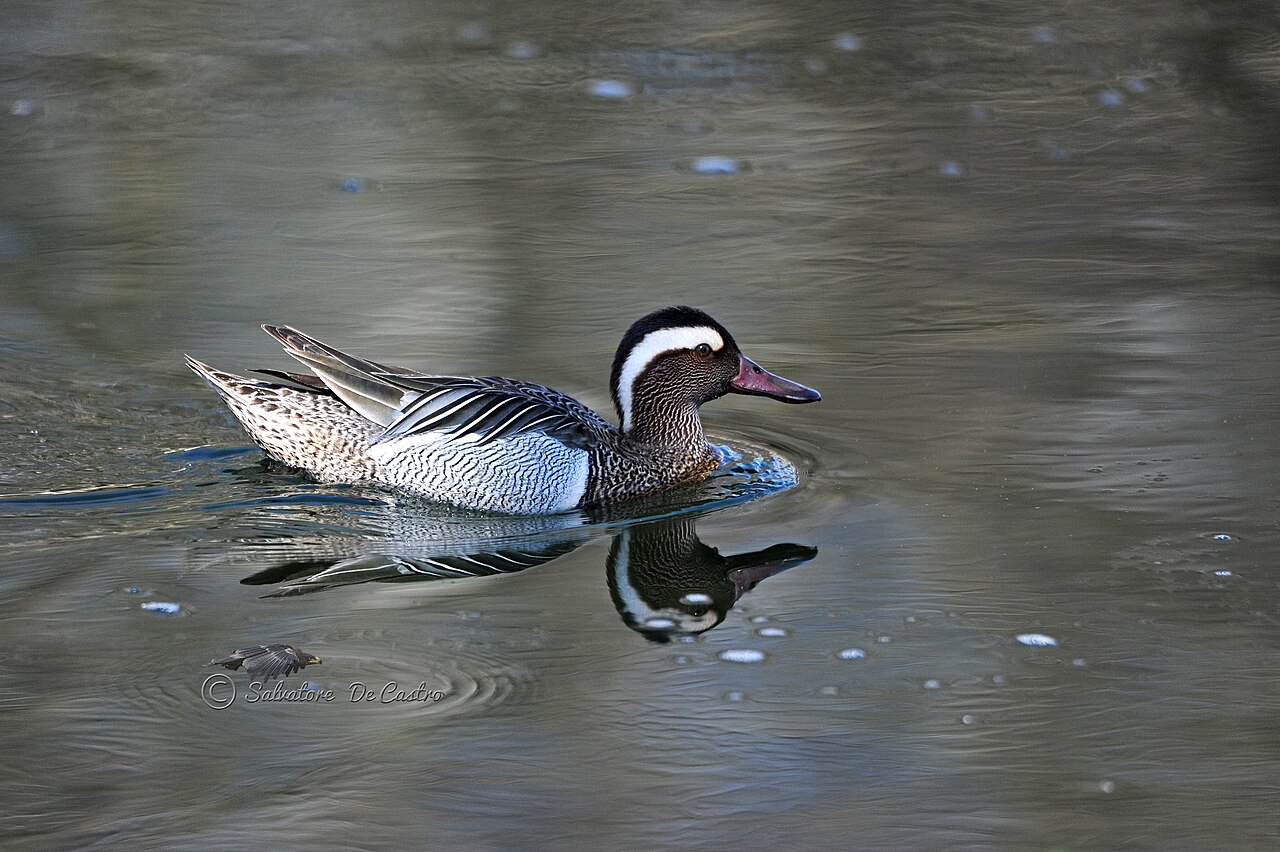
Garganey breeds across almost all of temperate Europe and Siberia and is known in North America chiefly as a scarce but nearly annual vagrant, most often found among groups of Blue-winged Teal. The male is distinctive, with a broad white eyebrow stripe running back from the eye across the chestnut-brown head.
Voice
The male makes a dry, crackling sound, often compared to a fingernail run across the teeth of a comb — a call unlike that of any other North American duck. The female quacks softly, higher and weaker than most other teal. When disturbed, a flock gives a series of short, hoarse notes. Outside display, the species is quiet.
Recording: Stanislas Wroza — CC BY-NC-SA 4.0 · Kerkini Lake, Greece · xeno-canto
Identification
The breeding male has a chestnut-brown head and breast with a broad white eyebrow stripe running from the eye into the nape, finely marked grey flanks, and long, grey, sickle-shaped scapular feathers drooping over the back. The female is streaky brown, with a pale eyebrow stripe, a dark eye-line and a pale spot at the base of the bill — more subtle than the male's pattern, but a touch more sharply marked than in comparable female teal. In flight the speculum is greyish green with a narrow white edge, less blue than in Blue-winged Teal.
Confusion species
Females are hard to tell apart in the field from a female Blue-winged Teal (Spatula discors); the best mark is the slightly more sharply defined pale eyebrow stripe and the absence of a strongly blue shoulder patch. The breeding male has a unique mark: the broad white eyebrow is shown by no other North American teal. When in doubt about a female in a mixed flock, a good look at the speculum is the most reliable feature.
Habitat
Shallow freshwater marshes, wet meadows and flooded grassland are its breeding habitat in Europe and Siberia. In North America it turns up in similar places — shallow ponds, sewage lagoons and flooded fields — usually among groups of Blue-winged Teal, with which it shares the same habitat.
Where the bird is most often found, arranged by the USNVC — the vegetation classification of the United States and Canada — and CMECS for sea and coast.



Range and movements
Breeds across almost all of temperate Europe and Siberia except the far north; winters south of the Sahara and from South to Southeast Asia. In North America the species is a scarce but nearly annual vagrant, chiefly through Alaska's Bering Sea islands during spring migration, with scattered records elsewhere on the continent — usually among early-spring groups of Blue-winged Teal.
Where and when to look
Check every group of early-spring Blue-winged Teal carefully: the white eyebrow stripe of a male Garganey stands out even at a distance within a mixed flock.
Conservation
Numerous and widespread worldwide within its breeding range and listed as Least Concern (LC), with a population in the millions, though parts of Europe have seen declines from the loss of marshland. Its occurrence in North America says nothing about that trend: here the species remains a genuine rarity regardless of what happens to its numbers in Europe or Asia.
Scientific name
Spatula querquedula | (Linnaeus, 1758)
Linnaeus described the species in 1758 as Anas Querquedula, within the then catch-all genus for nearly all ducks. Boie established the genus Spatula in 1822, Latin for 'spoon'; only DNA research in 2009 placed this species within it too, hence the parentheses around author and year. querquedula is classical Latin for a teal-like duck and probably imitates the bird's call. The type locality lies in Europe, restricted by Linnaeus himself to Sweden in 1761.