All species › Waterfowl › Ducks, swans and geese › Baikal Teal
Baikal Teal | Sibirionetta formosa
Siberische taling | Cerceta del Baikal
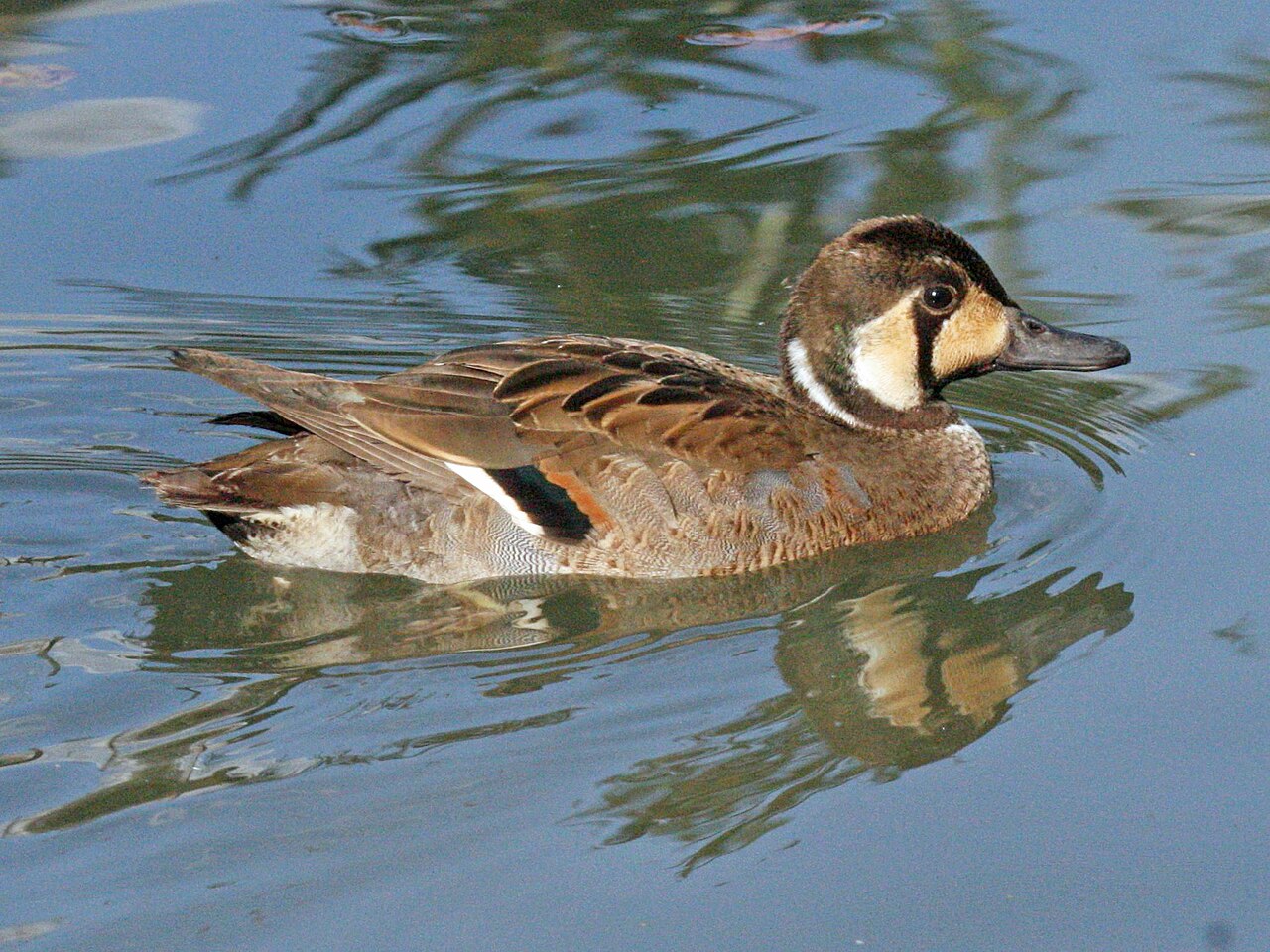
Baikal Teal breeds only in eastern Siberia and winters in large numbers in East Asia; in North America it is a genuine rarity, with Alaska almost the only place it ever turns up. The male carries one of the most intricate head patterns of any duck: cream and black bands sweeping across the cheek like a wavy ribbon.
Voice
The male gives a low, grunting note, deeper and rougher than most other teal. The female quacks softly, similar to other small teal but slightly higher in pitch. Groups on the water produce a soft, muffled murmuring, especially while feeding. There is no true song; most calls serve to keep contact within the group.
Recording: Albert Lastukhin — CC BY-NC-SA 4.0 · Sibirtsevo, Chernigovskiy rayon, Primorskiy kray, Russian Federation · xeno-canto
Identification
The breeding male has a banded head: a creamy patch around the eye and cheek, outlined with black and green bands forming a sickle-shaped pattern, together with a spotted pinkish breast and grey flanks marked by a vertical white stripe at the shoulder. The female is evenly streaked brown like most female teal, but has a distinctive pale spot at the base of the bill and a faint pale eye-ring. In flight it shows a green speculum with a narrow brown leading edge, less blue than in the North American teal.
Confusion species
The breeding male, with its banded head, cannot be confused with any other North American duck. The female resembles a female Garganey (Spatula querquedula) and a female Green-winged Teal, but shows a more clearly defined pale spot at the base of the bill, a feature nearly absent in the other two.
Habitat
Breeds in taiga bog and damp tundra of eastern Siberia; winters on shallow freshwater lakes, reservoirs and rice paddies in East Asia, often in colossal mixed flocks. As a vagrant in North America it is found on shallow tundra ponds and coastal marshes of the western Aleutians and the Bering Sea islands, usually among other duck species.
Where the bird is most often found, arranged by the USNVC — the vegetation classification of the United States and Canada — and CMECS for sea and coast.



Range and movements
Breeds only in northern and eastern Siberia and winters almost entirely in Japan, Korea and eastern China, where the world population concentrates in winter at a handful of sites. North America lies far outside this range; the species is seen there only occasionally, chiefly on the western Aleutians and the Bering Sea islands of Alaska during spring and autumn migration, when a single bird drifts off course.
Where and when to look
The best, and almost the only, chance in North America is on the western Aleutians or the Bering Sea islands during spring migration in May — check every group of ducks there carefully, since the species appears at most once a year.
Conservation
The world population crashed to a few thousand birds during the twentieth century through hunting and disturbance at its wintering sites, but has recovered strongly since key areas in Korea were protected, now numbering well over a million — one of the clearest recovery stories among ducks; the species is now listed as Least Concern (LC). Because the wintering population still concentrates at a handful of sites, the species remains vulnerable there to disturbance or a sudden disaster.
Scientific name
Sibirionetta formosa | (Georgi, 1775)
Georgi described the species in 1775 as Anas formosa, within the then catch-all genus for nearly all ducks; it has since been placed in its own genus Sibirionetta, hence the parentheses around author and year. The name Sibirionetta combines Siberia, where the species breeds exclusively, with the Greek word for duck. formosa is Latin for 'finely formed' or 'handsome', after the male's head pattern. The type locality is Lake Baikal.