All species › Waterfowl › Ducks, swans and geese › Greater Scaup
Greater Scaup | Aythya marila
Topper | Porrón bastardo
Greater Scaup is the only scaup that breeds on both sides of the Atlantic and the Pacific, high on the Arctic tundra, and it winters in dense flocks along both coasts of North America. On the water it is almost impossible to tell from its smaller counterpart, Lesser Scaup (Aythya affinis); telling the two apart comes down mostly to the shape of the head.
Voice
Males and females are quiet for most of the year and are heard mainly during courtship. The male then gives a soft, nasal whistle. The female gives a hoarse, raspy arr-arr-arr, usually while stretching her neck or when alarmed — a call heard year-round, including in the large winter flocks.
Recording: Andrew Spencer — CC BY-NC-SA 3.0 · Kuzitrin River Bridge, Kougarok Road, Nome Census Area, Alaska, United States · xeno-canto
Identification
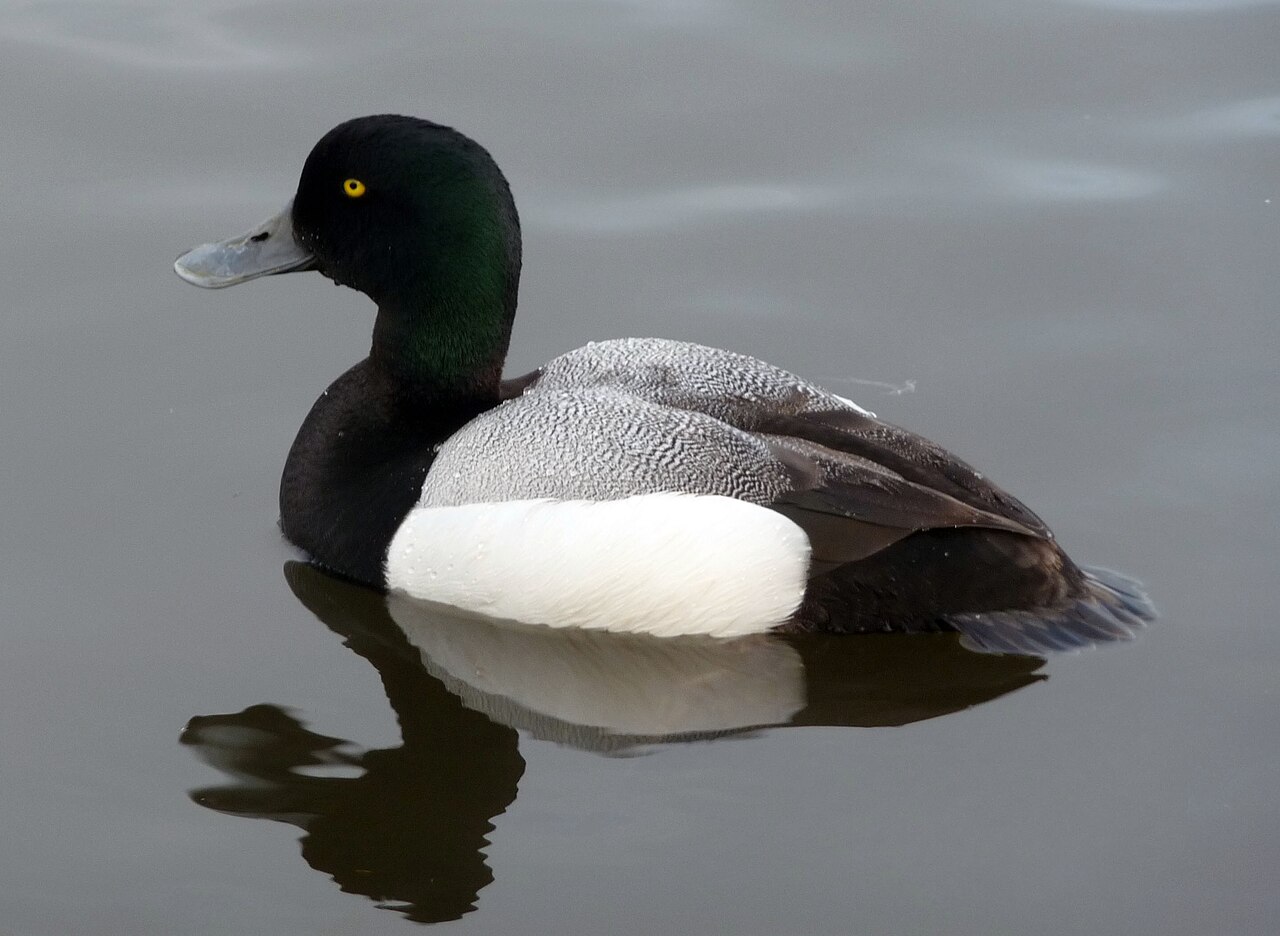
The breeding male is black and white with a greenish sheen on the head, a blue-grey bill with a black nail and a yellow eye; at close range the back is finely barred black and white. Outside the breeding season he is dull mottled brownish-grey with a blackish head. The female is brown with a darker head and a white patch at the base of the bill, often with a pale patch behind the eye in summer. The defining mark is the head: evenly rounded, without the rear-set peak of Lesser Scaup. In flight the white wingstripe reaches almost to the wingtip.
Confusion species
Lesser Scaup (Aythya affinis) is by far the most similar species: both are black-and-white with a yellow eye and nearly the same size, and the difference lies mainly in head shape — rounded on Greater Scaup, peaked on Lesser Scaup — and in the wingstripe, which stops short of the primaries on Lesser Scaup. Greater Scaup also favours the coast more, Lesser Scaup inland water more, though the overlap is wide enough that habitat alone is not something to rely on. Tufted Duck (Aythya fuligula) is smaller and carries an obvious tuft that Greater Scaup lacks.
Habitat
As a breeder it nests on islands in large, shallow Arctic lakes and on marshy tundra, hiding its nest among low shrubs. Outside the breeding season it is above all a coastal bird: it winters in sheltered bays, estuaries and on the Great Lakes, diving there to depths of more than twenty metres for shellfish on the bottom. Open, shallow marine water with a soft or shelly bottom is preferred over freshwater marsh, which it largely avoids.
Where the bird is most often found, arranged by the USNVC — the vegetation classification of the United States and Canada — and CMECS for sea and coast.




Range and movements
Greater Scaup is the only circumpolar scaup: it breeds on the tundra of Alaska, home to roughly three-quarters of the North American population, and further in northern Yukon, Manitoba and Saskatchewan, on Newfoundland and Labrador, and around Hudson and Ungava bays. In winter it moves to both coasts of North America, from British Columbia to Baja California in the west and from Nova Scotia to Florida in the east, with further concentrations on the Great Lakes and along the Gulf of Mexico; part of the population stays year-round in the Aleutian Islands. Range changes have been limited, though counts in parts of the winter range have fallen below levels of a few decades ago.
- Resident
- Breeding (summer)
- Winter
- Passage
- dark = core range, pale = thinly spread
Where and when to look
In winter look for it on an open, sheltered bay or on the lake-sized waters of the Great Lakes, rather than on a small inland lake where Lesser Scaup tends to dominate. If in doubt, compare the heads of several birds side by side: an evenly rounded skull without a peak shows up on Greater Scaup even when the light is not right for the greenish sheen.
Conservation
The species is listed as Least Concern (LC), with a large population that is stable in parts of its range and declining slightly elsewhere. Like other deep-diving shellfish-eaters, it is at risk from coastal pollution, including oil, alongside the historical problem of lead poisoning from ingested shot. For North America the evidence for a clear, sustained decline is not conclusive.
Scientific name
Aythya marila | (Linnaeus, 1761)
Linnaeus described the species in 1761 as Anas Marila, in the second edition of his Fauna Svecica, three years after the first edition of his Systema Naturae; because it was later moved to another genus, author and year stand in parentheses. The genus Aythya was introduced by Boie in 1822, from the Ancient Greek aithuia, a seabird mentioned by Aristotle but never reliably identified. The species name marila comes from the Ancient Greek marile, 'charcoal ashes', a reference to the grey pattern of the back. The type locality lies in Lapland.