All species › Waterfowl › Ducks, swans and geese › Lesser Scaup
Lesser Scaup | Aythya affinis
Kleine topper | Porrón bola
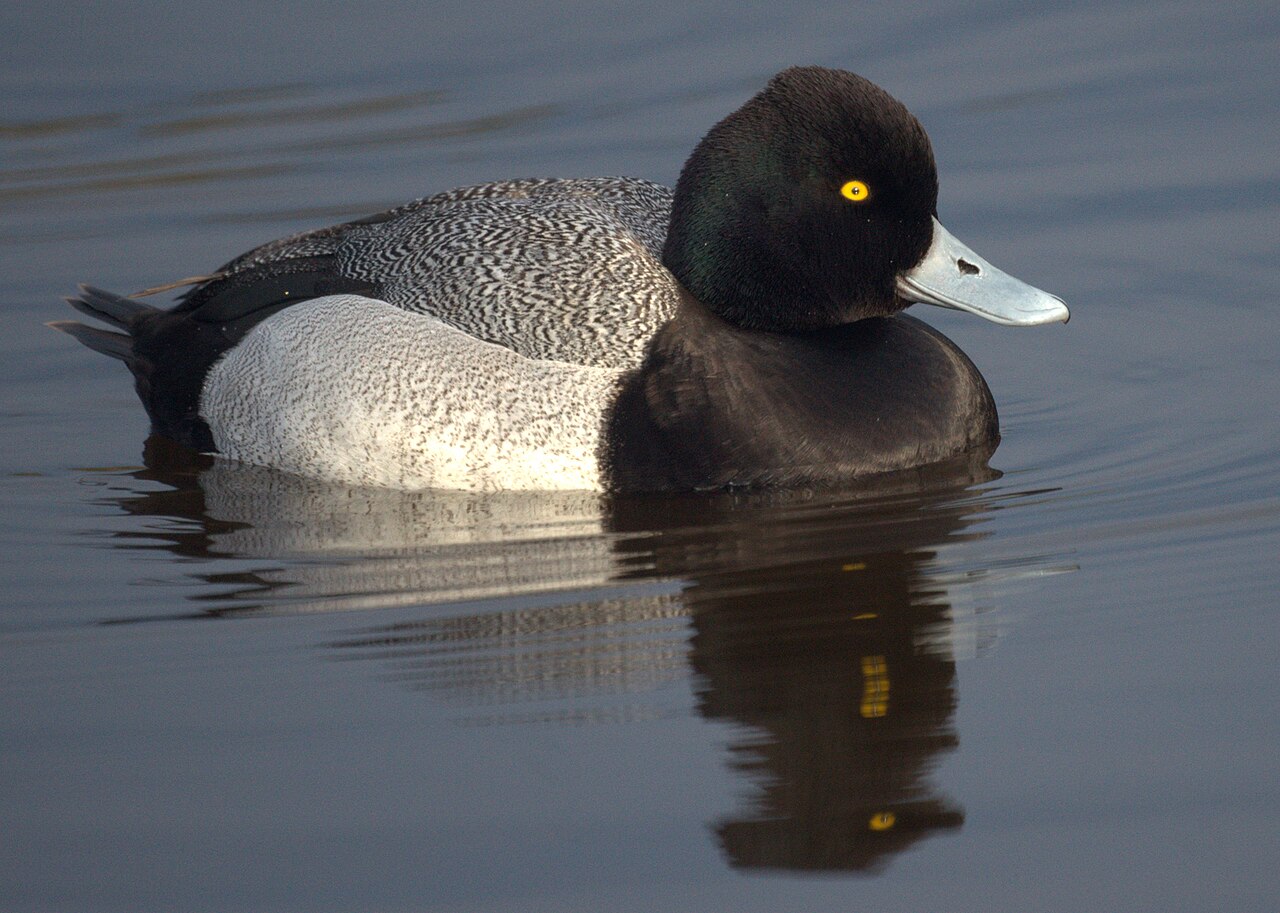
Lesser Scaup is the most abundant diving duck in North America and the member of its genus that winters farthest south, reaching all the way to Colombia. On the water it is almost impossible to tell from its larger counterpart, Greater Scaup (Aythya marila); the difference lies mainly in the shape of the head.
Voice
The male is mostly quiet, giving a soft gurgling sound and a faint wee-o during courtship. The female is far more vocal, with a harsh, burry grunt and a grating bark heard year-round, from the breeding grounds to the wintering areas. Flocks on the water in winter are therefore usually given away by the females' calls rather than the males'.
Recording: Stanislas Wroza — CC BY-NC-SA 4.0 · Sainte Fulgence, Canada · xeno-canto
Identification
The breeding male is black and white, with a purple to green sheen on the head, a blue-grey bill with a black nail and a yellow eye; the back and flanks are finely barred black and white. Outside the breeding season he is dull brownish-grey with a blackish head. The female is brown with a darker head and, not on every bird, a white patch at the base of the bill. The species' key mark is the head: a small peak set toward the rear above a flat back of the head, unlike the evenly rounded head of Greater Scaup. In flight the white wingstripe reaches only about halfway along the wing.
Confusion species
Greater Scaup (Aythya marila) is the most similar species: both are black-and-white with a yellow eye and roughly the same size, and the difference lies almost entirely in head shape — rounded on Greater Scaup, with a small peak toward the rear on Lesser Scaup — and in the wingstripe, which reaches into the primaries on Greater Scaup. Lesser Scaup also favours inland waters more than Greater Scaup, which leans toward the coast, though that habit is not a reliable field mark on its own. Tufted Duck (Aythya fuligula), a rare vagrant that often keeps company with flocks of Lesser Scaup, shows an obvious tuft that neither scaup has.
Habitat
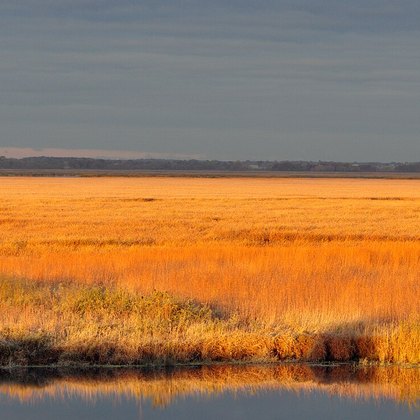
As a breeder it uses shallow inland lakes and marshy ponds in boreal forest, parkland and prairie, and locally on the subarctic tundra, with enough shoreline cover to hide the nest. Outside the breeding season it seeks out large lakes, reservoirs, estuaries and sheltered coastal lagoons, and in the south of its winter range also agricultural ponds. Unlike Greater Scaup, it is rarely seen on open sea when unfrozen fresh water is still available.
Where the bird is most often found, arranged by the USNVC — the vegetation classification of the United States and Canada — and CMECS for sea and coast.



Range and movements
The breeding range runs from Alaska through western Canada to Montana, with the highest densities in Alaska, the Mackenzie Valley and Old Crow Flats in the Yukon; few birds breed east of the Great Lakes. Migration runs mainly through the Central and Mississippi flyways, in flocks of a few dozen birds. Lesser Scaup winters farther south than any other scaup or pochard, from the southern United States through Mexico, Central America and the Caribbean to northern Colombia, with major concentrations at Topolobampo in Sinaloa and the Ciénaga Grande de Santa Marta in Colombia.
- Resident
- Breeding (summer)
- Winter
- Passage
- dark = core range, pale = thinly spread
Where and when to look
Look for Lesser Scaup among other diving ducks on a large inland lake or reservoir rather than at sea, and concentrate on the shape of the back of the head: a small peak points to Lesser Scaup, an even curve to Greater Scaup. In a mixed flock a scope usually shows that difference better than any difference in colour.
Conservation
With a world breeding population estimated at 3.8 million, Lesser Scaup is the most abundant diving duck in North America and is listed as Least Concern (LC). Earlier concern about a decline in the late twentieth century, possibly linked to food availability on migration, has not led to a higher IUCN status; loss of shallow inland waters remains the main point of attention.
Scientific name
Aythya affinis | (Eyton, 1838)
Eyton described the species in 1838 as Fuligula affinis, in the same monograph of the duck family in which he also described the Redhead; because it was later moved to another genus, author and year stand in parentheses. The genus Aythya was introduced by Boie in 1822, from the Ancient Greek aithuia, a seabird mentioned by Aristotle but never reliably identified. The species name affinis is Latin for 'related' or 'similar', a reference to the close resemblance to Greater Scaup that still makes identifying this species difficult today.