All species › Waterfowl › Ducks, swans and geese › Tufted Duck
Tufted Duck | Aythya fuligula
Kuifeend | Porrón moñudo
In Europe the Tufted Duck is the commonest diving duck of city parks and lakes, but in North America it is a scarce winter visitor almost always found among flocks of scaup and Ring-necked Duck. Newfoundland, a short hop from Iceland, is the only place where it turns up in real numbers every winter; elsewhere in North America it usually shows up as a single bird.
Voice
Outside courtship the Tufted Duck is a quiet species. The male gives a soft series of whistles when displaying, lasting less than a second, and uses the same whistle as a flight call. The female gives a harsh, grating call and a short, barking flight call. In flight the wings also make a soft whistling sound, which often gives away a passing flock before any call does.
Recording: Sonothèque ADVL — CC0 · Arrondissement de Fougères-Vitré (near Val-Couesnon), Ille-et-Vilaine, Brittany, France · xeno-canto
Identification
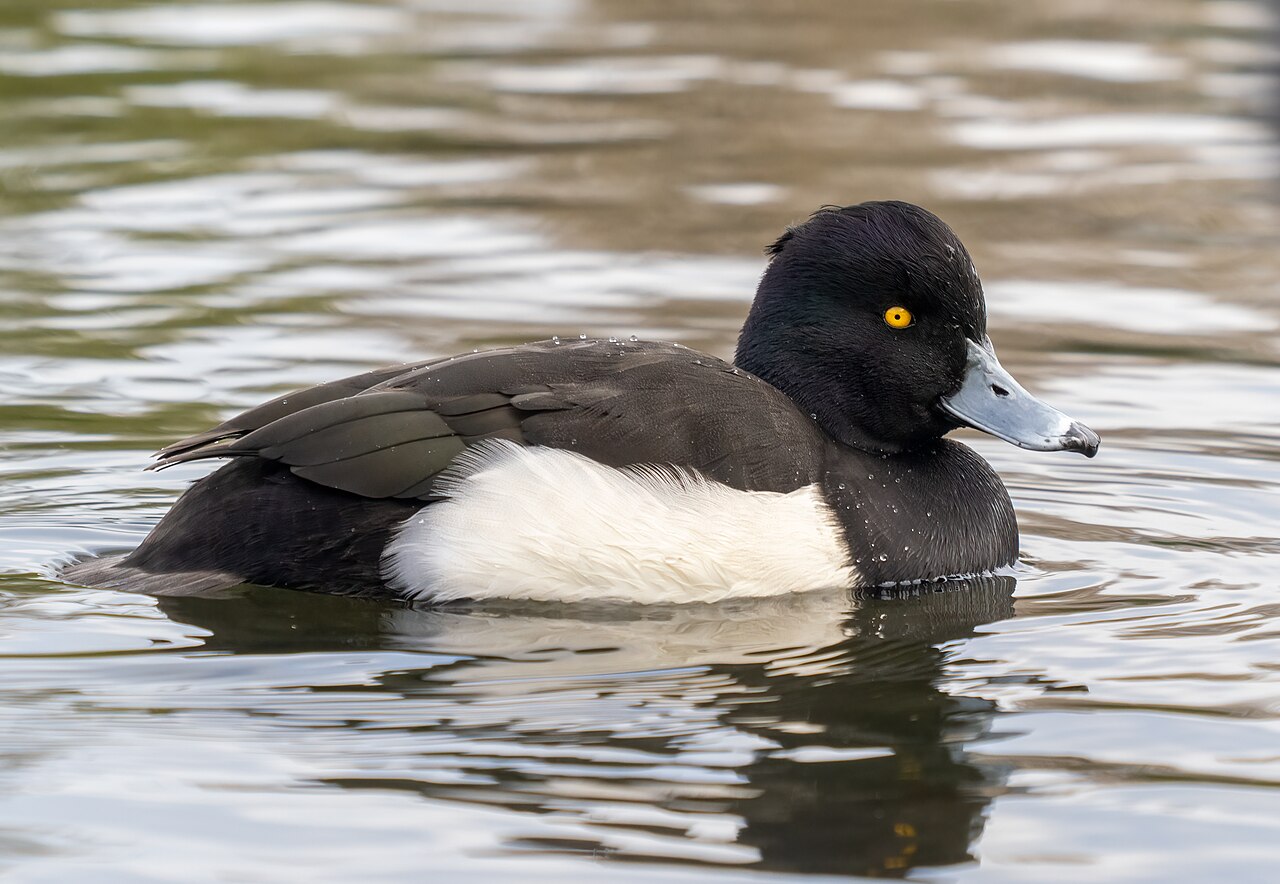
The male is almost entirely black, with sharply set-off white flanks, a yellow eye and a grey bill with a black tip; a thin, floppy tuft hangs from the rear of the head and can show a purplish or greenish sheen in the right light. The female is brown, with at least a hint of a tuft, a yellowish eye and sometimes white at the base of the bill and under the tail. Immature males are blackish-brown with a short tuft and touches of white on the flank. Both sexes have a rounded head with a steep forehead and a flat crown, and show a broad white wingstripe reaching into the primaries in flight.
Confusion species
In North America the Tufted Duck is almost always looked for among scaup, and it resembles Lesser Scaup (Aythya affinis) most closely: both are black-and-white with a yellow eye, but the Tufted Duck is smaller, has the longer tuft and white rather than grey flanks on the male, and a wingstripe that extends further than on Lesser Scaup. It differs from Greater Scaup (Aythya marila) in its smaller size and the tuft, which neither scaup shows. The female can also be confused with female Ring-necked Duck, but lacks that species' sharp white eyering and bill band.
Habitat
In its native Eurasian range the Tufted Duck uses both natural lakes and artificial water, down to town ponds. The few birds that reach North America join flocks of Lesser Scaup or Ring-necked Duck on exactly that kind of water: open, mostly fresh lakes and ponds, often within city limits, such as the town lake in St. John's where the species winters every year.
Where the bird is most often found, arranged by the USNVC — the vegetation classification of the United States and Canada — and CMECS for sea and coast.



Range and movements
The Tufted Duck breeds across the northern Palearctic, from Iceland to Kamchatka, and normally winters in western Europe, North Africa, and southern and southeastern Asia. Birds that cross the Atlantic land most often on Newfoundland, probably from Iceland, where the species appears every winter near St. John's in numbers that vary from year to year but sometimes reach several dozen. Elsewhere it has been recorded as a rare, irregular vagrant in thirty US states and all ten Canadian provinces, almost always as a single bird among a flock of scaup.
- Resident
- Breeding (summer)
- Winter
- Passage
- dark = core range, pale = thinly spread
Where and when to look
In winter look for it among flocks of Lesser Scaup and Ring-necked Duck on an open lake, and scan first for the tuft and the white flanks before checking colour — at a distance the tuft itself is the quickest thing to pick out. On Newfoundland, Quidi Vidi Lake in the middle of St. John's is the most reliable place to find it.
Conservation
Worldwide the Tufted Duck is not threatened and numbers in the millions; in North America the records always involve a handful of individuals joining scaup flocks, without any breeding or wintering population of its own. Conservation concerns that apply in Europe, such as loss of wintering water, therefore have no direct bearing on the North American records.
Scientific name
Aythya fuligula | (Linnaeus, 1758)
Linnaeus described the species in 1758 as Anas fuligula, among the ducks; because it was later moved to another genus, author and year stand in parentheses. The genus Aythya was introduced by Boie in 1822, from the Ancient Greek aithuia, a seabird mentioned by Aristotle but never reliably identified. The species name fuligula is Latin for 'sooty throat', from fuligo ('soot') and gula ('throat'), after the dark plumage. The type locality lies in Europe; Linnaeus himself restricted it to Sweden in 1761.