All species › Waterfowl › Ducks, swans and geese › Redhead
Redhead | Aythya americana
Amerikaanse tafeleend | Pato Cabecirrojo
The Redhead breeds in the reed fringes of the prairie potholes of the Midwest; females lay some of their eggs in the nests of other ducks, especially fellow Redheads and Ruddy Duck (Oxyura jamaicensis), leaving the incubation to someone else. Outside the breeding season it forms one of the largest duck concentrations in North America, with as many as sixty thousand birds gathering at once on the shallow Laguna Madre along the Texas–Mexico border.
Voice
In courtship the male gives a plaintive, almost catlike whee-ough or meow, heard most often when groups of males crowd around a female. When threatening he gives a low, hoarse err. The female answers with a quieter version of the same err, and when threatened or searching for a nest site she gives a deep, growling kurr-kurr-kurr. Outside the breeding season, in the large mixed winter flocks, the species is much quieter.
Recording: Stanislas Wroza — CC BY-NC-SA 4.0 · Baie-du-Febvre, Nicolet-Yamaska, Québec, Canada · xeno-canto
Identification
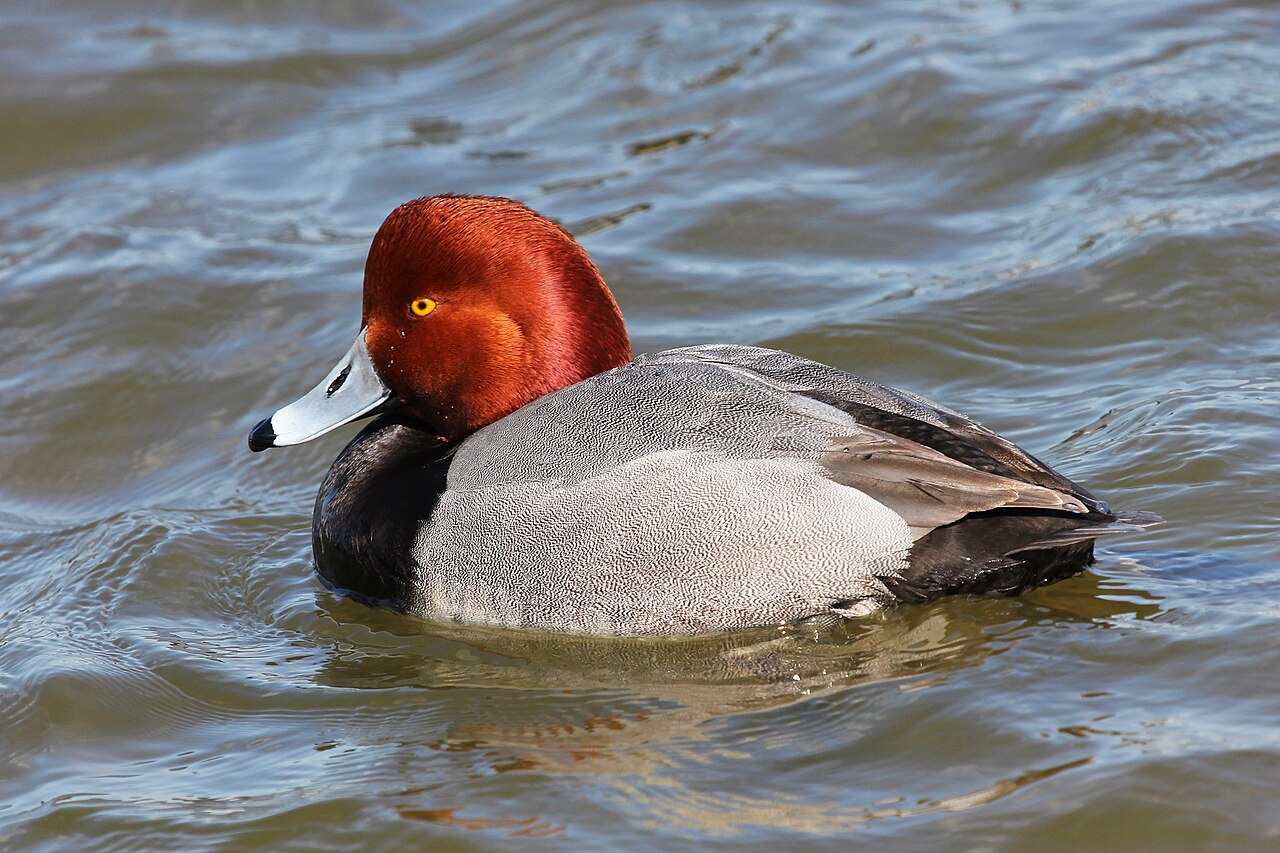
The male has a jet-black breast and rear, a grey body and a rounded, glossy cinnamon head that meets the moderately large, black-tipped grey bill at a steep angle. Females and non-breeding males are plain light brown with a paler face; a non-breeding male can be told from a female by a slightly warmer brown head. All plumages share the same grey, black-tipped bill. In flight the Redhead shows grey flight feathers and a fast, shallow wingbeat for a duck of its size.
Confusion species
The closest match is Canvasback (Aythya valisineria), which is larger, with a long, sloping bill-and-forehead line in place of the Redhead's steep angle. Ring-necked Duck (Aythya collaris) is smaller, with a peaked rather than rounded crown and a white rather than grey bill band. Females are often confused with female scaup; look then for the larger, heavier bill and the lack of the sharply defined white patch at the base of the bill that scaup show.
Habitat
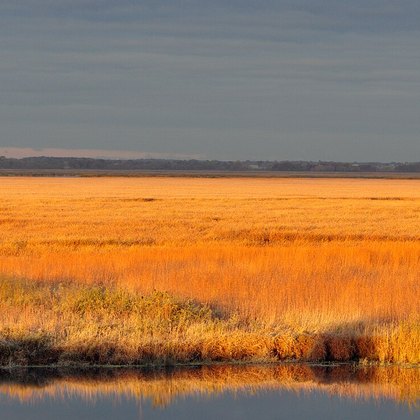
As a breeder it seeks reed- and cattail-fringed prairie potholes and shallow marsh lakes across the continental interior, hiding its nest in dense vegetation over the water. On migration it uses large open lakes and reservoirs; in winter it gathers above all in shallow, sheltered coastal lagoons with beds of seagrass, feeding on the roots and leaves. It avoids deep, fast-flowing water and closed forest entirely.
Where the bird is most often found, arranged by the USNVC — the vegetation classification of the United States and Canada — and CMECS for sea and coast.



Range and movements
The core breeding range lies in the pothole-studded prairies from British Columbia to Manitoba and in North and South Dakota, with smaller breeding areas in Ontario and Quebec and scattered sites across the western United States. Western birds migrate through the Great Basin to the Great Salt Lake region and the west coast; central birds move through the Great Plains straight to the Texas Gulf coast; eastern birds follow the Great Lakes to the Atlantic coast and Florida. The largest wintering concentrations gather along the Gulf of Mexico, above all in the Laguna Madre of Texas and Tamaulipas, with further numbers in Mexico, Guatemala, Cuba and the Bahamas.
- Resident
- Breeding (summer)
- Winter
- Passage
- dark = core range, pale = thinly spread
Where and when to look
In winter look for it on a shallow bay or lagoon with clear water: the Redhead dives there repeatedly by day for seagrass, often in dense, drifting rafts of hundreds to thousands of birds. The male's cinnamon head stands out even at a distance among the mostly grey and black bodies of the other diving ducks around it.
Conservation
The species is not considered threatened (LC), and the population has been stable to increasing in recent decades, helped by the restoration of prairie wetlands. Loss of breeding habitat through the draining of prairie potholes remains the main risk, and the large winter concentrations on a handful of lagoons make the species sensitive to local disturbance of the seagrass beds it depends on.
Scientific name
Aythya americana | (Eyton, 1838)
Eyton described the species in 1838 as Fuligula americana, in a monograph of the duck family; because it was later moved to another genus, author and year stand in parentheses. The genus Aythya was introduced by Boie in 1822, from the Ancient Greek aithuia, a seabird mentioned by Aristotle but never reliably identified. The species name americana is Latin for 'American', referring to the continent named in the type locality without further precision. The Dutch name 'Amerikaanse tafeleend' (American Pochard) sets it apart from the Common Pochard (Aythya ferina) of Europe, to which it is closely related.