All species › Waterfowl › Ducks, swans and geese › Ring-necked Duck
Ring-necked Duck | Aythya collaris
Ringsnaveleend | Porrón acollarado
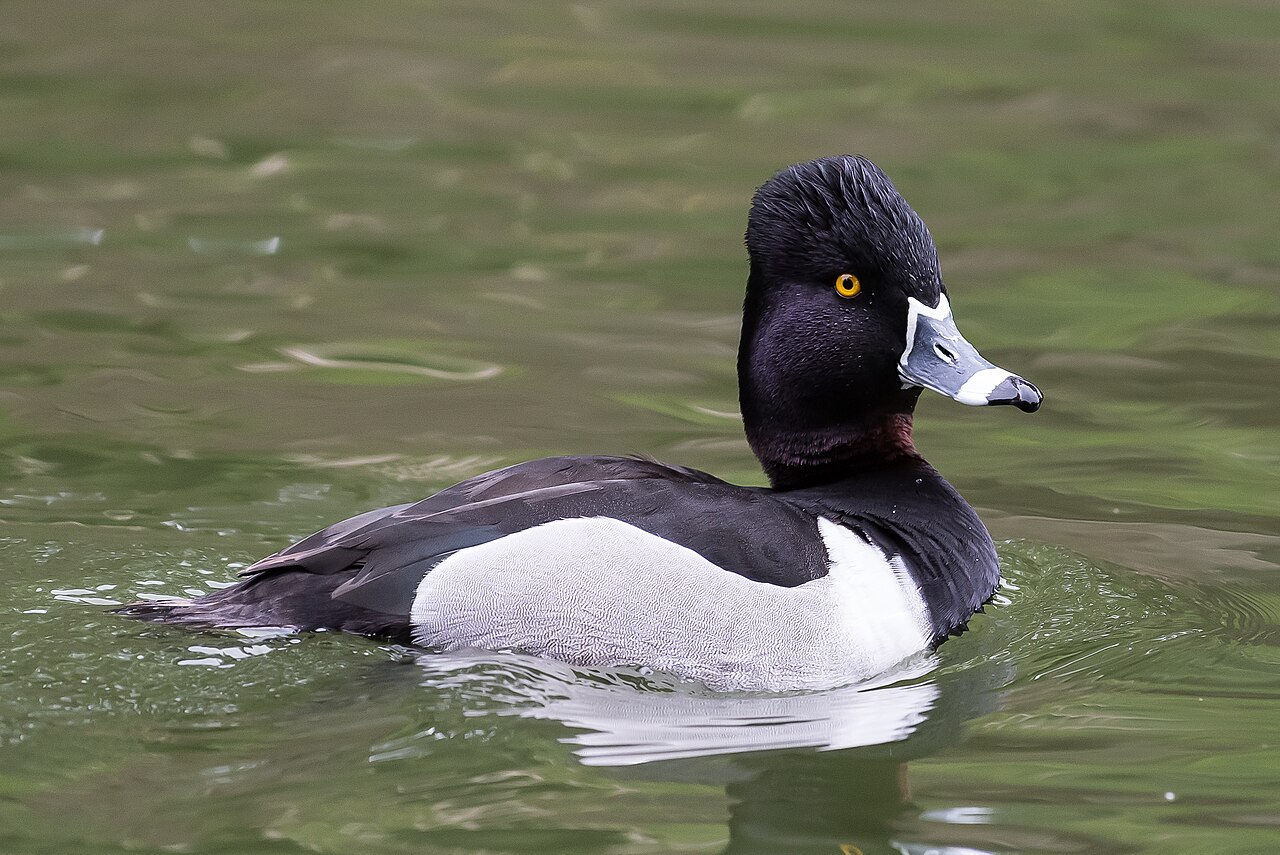
The Ring-necked Duck is a compact diving duck named for a chestnut collar that is almost never visible in the field; the broad white ring around the bill, which is clearly visible, plays no part in the name. It breeds on shallow, often acidic bog ponds in the boreal forest and gathers in large numbers each autumn on the wild-rice lakes of Minnesota before continuing south.
Voice
The Ring-necked Duck is a quiet species, rarely heard outside the breeding season. Both sexes give a series of short, high, grating barks or grunts, and the female adds a high peeping note of her own. Courtship begins as early as winter and continues through spring migration, when the pairs form. On the resting flocks seen the rest of the year, often packed tightly together, the species usually stays silent.
Recording: Stanislas Wroza — CC BY-NC-SA 4.0 · Charlevoix (near Saint-Joseph-de-la-Rive), Capitale-Nationale, Québec, Canada · xeno-canto
Identification
The breeding male is almost entirely black on the head, breast, foreback and back, with grey flanks set off by a sharp white wedge at the shoulder; the chestnut collar that gives the species its name is visible only at close range in good light. The silhouette is distinctive: a sloping forehead rising to a peaked rear crown. The grey bill carries a broad white band just before the black tip. The female is plain brown with a paler cheek, a white patch at the base of the bill and a crisp white eye-ring. In flight the species shows a grey, not white, wingstripe, and its large head, thin neck and short body give it a more compact look than most other diving ducks.
Confusion species
On the water the Ring-necked Duck is most often confused with Lesser Scaup (Aythya affinis), a duck of roughly the same size; the peaked, rear-set crown and the white band on the bill set it apart, and in flight its wingstripe is grey where both scaup show white. The female also resembles female Redhead (Aythya americana), which is larger, with a plain grey bill lacking a white band and without the sharp white eye-ring. A male Redhead further shows a rounded, not peaked, head profile.
Habitat
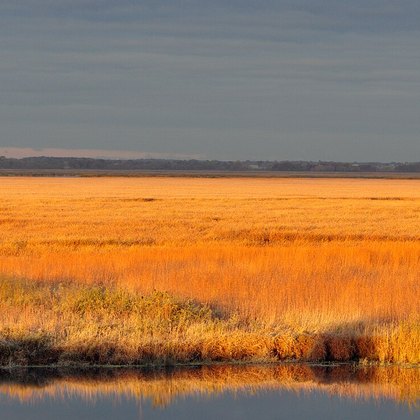
As a breeder it seeks shallow, often acidic bog ponds and marshy lakes in the conifer forest, with a dense fringe of sedge and other shoreline vegetation to hide its nest. Outside the breeding season it is above all the diving duck of small water: beaver ponds, shallow ponds, marshy river edges, cattle-watering holes and even flooded farmland draw it in, while it makes far less use of the large open lakes and salt bays favoured by scaup and Redhead.
Where the bird is most often found, arranged by the USNVC — the vegetation classification of the United States and Canada — and CMECS for sea and coast.



Range and movements
It breeds across almost the whole of boreal North America, from Alaska through Canada to Newfoundland, with an extension south into the northern states around the Great Lakes and into the mountains of the Pacific Northwest. In autumn several hundred thousand birds sometimes gather on the wild-rice lakes of Minnesota before moving on to winter from the southern United States through Mexico, the Caribbean and Central America; small numbers stray to western Europe every year. The range has changed little, and where beaver ponds have spread in the eastern part of its range the species has, if anything, increased.
- Resident
- Breeding (summer)
- Winter
- Passage
- dark = core range, pale = thinly spread
Where and when to look
During migration look for it not on the big lake where the scaup gather, but on the small, shallow water beside it: a beaver pond, a farm ditch or a flooded field is exactly what a Ring-necked Duck wants. Then check for the peaked rear crown and the white band on the bill — at a distance that is quicker to see than the collar the bird is named for.
Conservation
The species is listed as Least Concern (LC), with a large population that is stable to slightly increasing. It benefits from the creation of small wetlands and beaver ponds across its breeding range. Like other diving ducks that feed in shallow water, it has historically been at risk from lead poisoning through ingested shot; stricter rules on lead shot have reduced that risk in recent decades.
Scientific name
Aythya collaris | (Donovan, 1809)
Donovan described the species in 1809 as Anas collaris, among the ducks, from a specimen found not in the field but in Leadenhall Market in London — the type locality of Lincolnshire refers to the bird's presumed origin. Because the species was later moved to another genus, author and year stand in parentheses. The genus Aythya was introduced by Boie in 1822, from the Ancient Greek aithuia, a seabird already mentioned by Aristotle but never reliably matched to a living species. The species name collaris is Latin for 'collared', after the chestnut ring around the neck that explains the English name Ring-necked Duck, even though it is barely visible in the field.