All species › Waterfowl › Ducks, swans and geese › Canvasback
Canvasback | Aythya valisineria
Grote tafeleend | Porrón coacoxtle
Canvasback is the largest diving duck in North America, with a silhouette no other duck shares: the forehead runs in one straight line into the long, black bill, without the break almost every other duck shows. The male carries a chestnut-red head and neck, a black breast, and a pale grey, almost white body. Large, dense flocks on open water in winter are typical of this species.

Voice
Canvasback is largely a quiet duck. During courtship the male gives a soft cooing sound, and the female answers with a hoarse, growling kr-kr-kr; she may also quack when taking flight. Birds that are not displaying give a soft, wheezing sound whenever another bird comes too close to their feeding spot. Outside those moments the species is quiet, especially compared with most other ducks.
Recording: Paul Driver — CC BY-NC-SA 3.0 · Taylor's Refuge, Cinnaminson, NJ, United States · xeno-canto
Identification
The male has a chestnut-red head and neck, a black breast and stern, and a pale grey body marked with such fine wavy white lines that it looks almost white at a distance — the English name 'Canvasback' refers to that colour of unbleached linen. The eyes are red. The female is plain light brown on head and neck and dull grey-brown on the body, with dark eyes. Both sexes share the diagnostic profile: the forehead runs without a break into the long, black bill, giving the head a wedge-shaped silhouette recognisable on the water from a great distance.
Confusion species
The closest comparison is Common Pochard (Aythya ferina), though that species is itself rare in North America: Common Pochard has a rounded head, a much shorter bill and a greyer, less white body than Canvasback. Among the ducks that keep Canvasback company in winter, it stands out mainly through the elongated, wedge-shaped profile of head and bill, a line no other North American duck carries so far. From a distance on the water that profile is often the only mark needed to pick it out among hundreds of other diving ducks.
Habitat
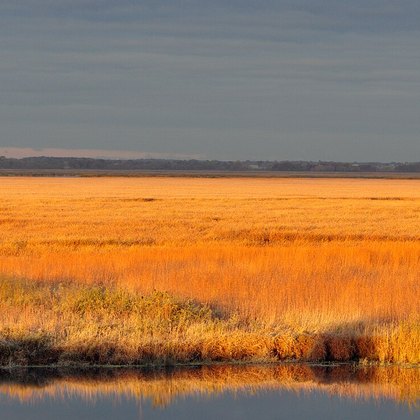
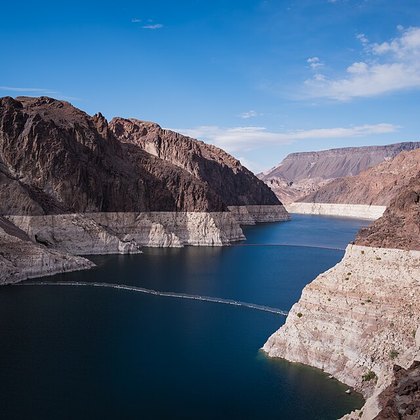
It breeds on shallow prairie potholes and deep marsh lakes with a dense border of cattail and bulrush, from the Great Plains to interior Alaska and the river deltas of Saskatchewan. In winter it gathers in the thousands on sheltered bays, river mouths and large lakes, diving to over two metres deep for the rhizomes and tubers of aquatic plants — historically above all wild celery, the plant that gave it its scientific name. Shallow, heavily vegetated water rich in those tubers is essential for wintering flocks.
Where the bird is most often found, arranged by the USNVC — the vegetation classification of the United States and Canada — and CMECS for sea and coast.


Range and movements
Breeds in the prairie potholes of the northern Great Plains and the southern Canadian prairie provinces, with smaller numbers in interior Alaska. Winters scattered across the whole southern United States: along the Atlantic coast, in the Mississippi Delta, along the Gulf Coast and in California, with smaller numbers reaching northwestern Mexico. Chesapeake Bay was once the species' most important wintering ground, but changes in its underwater vegetation have since shifted the centre of gravity further south, to the forested wetlands of the lower Mississippi Valley.
- Resident
- Breeding (summer)
- Winter
- Passage
- dark = core range, pale = thinly spread
Where and when to look
Look for it in winter on large, open bays and lakes, where it often gathers in dense, floating rafts of hundreds of birds at once; the wedge-shaped profile is visible before colour or pattern adds anything to the view. Choose a spot with plenty of submerged vegetation: wherever Canvasback dives for rhizomes, the chances of large numbers are greatest.
Conservation
The species is listed as Least Concern (LC). The breeding population was estimated at roughly 700,000 birds in 2017, with numbers reasonably stable since 1966 after a temporary dip in the 1980s. Loss of breeding marsh is the main concern: between 1951 and 1981, forty per cent of prairie wetlands in the Canadian prairie provinces disappeared. Pollution and siltation of wintering waters also damage the submerged plants the species depends on through the winter.
Scientific name
Aythya valisineria | (Wilson, 1814)
Wilson described the species in 1814 as Anas valisineria, among the ducks; because it was later placed in another genus, author and year stand in parentheses. The author is Alexander Wilson, the Scottish-American ornithologist regarded as the founder of North American ornithology, who was the first to describe dozens of the continent's species. valisineria refers to wild celery (Vallisneria americana), the underwater plant whose rhizomes form the species' main winter food, especially in Chesapeake Bay; the plant genus itself is named after the Italian botanist Antonio Vallisneri. The type locality lies in the eastern United States.