All species › Passerines › New World warblers › Grace's Warbler
Grace's Warbler | Setophaga graciae
Grace' zanger | Reinita de Grace
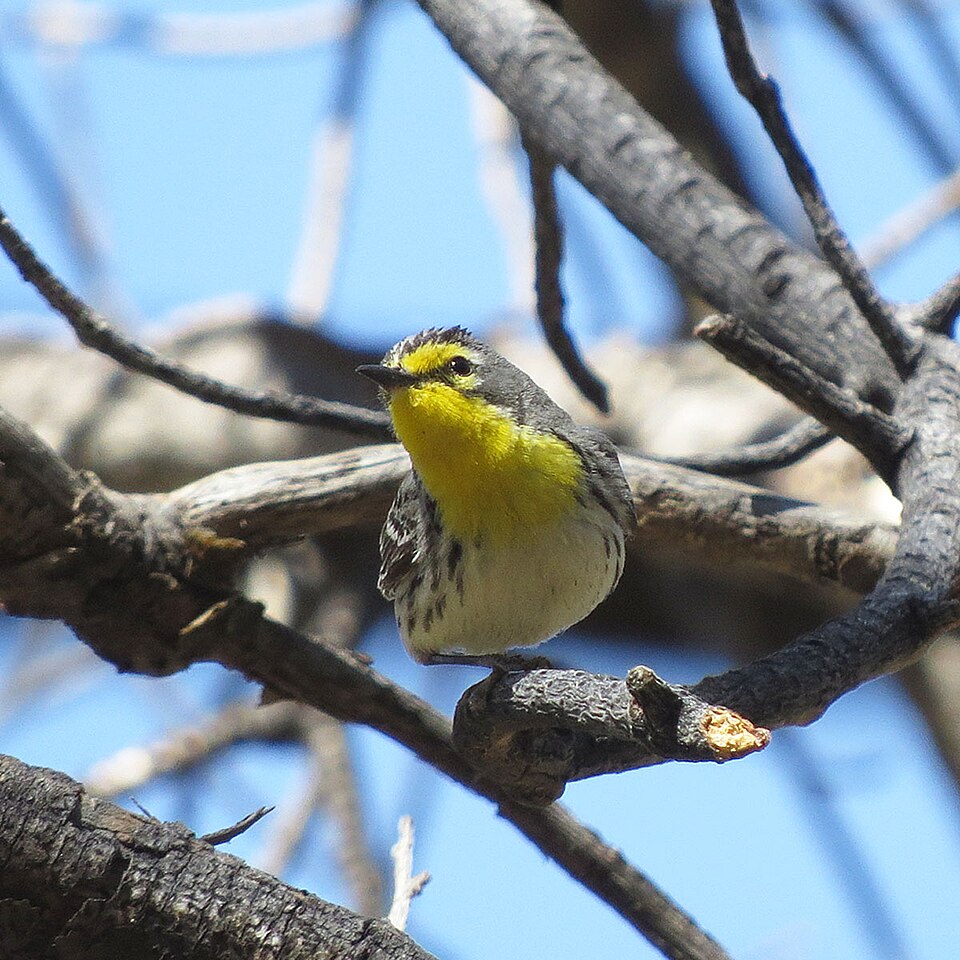
Grace's Warbler is the warbler of mature mountain pine forest in southwestern North America. It is grey above and yellow on throat and breast, and stays high in the canopy almost all day, among the needle clusters of ponderosa pine. The species was found in Arizona in 1864 and named after the sister of its discoverer.
Voice
The song is a series of clear, slightly buzzy notes that accelerate towards the end and run out into a short trill, roughly chee-chee-chee-cheecheechee. The pitch usually rises a little as it goes. A second, slower and lower variant exists. The call is a sharp, somewhat metallic chip; the flight note a thin high seet. Because the bird sits high, the song is often the first and for a long time the only sign of its presence.
Recording: Manuel Grosselet — CC BY-NC-SA 4.0 · Las Nubes, San Mateo Río Hondo, Oaxaca, Mexico · xeno-canto
Identification
The upperparts are grey with black streaks across back and flanks; throat and upper breast are yellow, the rest of the underparts white. The yellow eyebrow runs from the bill to above the eye and turns white behind it, with a yellow edge along the lower eyelid beneath. Two white wing bars are clear. The bill is short and fine. Females are duller with less black in the streaking. Foraging is restless and high, working the outside of needle clusters rather than probing bark.
Confusion species
Yellow-throated Warbler has the same grey back and yellow throat, but a longer bill, a white patch on the side of the neck and black on the face, and it does probe bark crevices. Townsend's and Hermit Warblers show yellow or black on the cheek and not yellow confined to a throat bib. Yellow-rumped Warbler has a yellow rump and yellow side patches instead of a yellow throat. Habitat helps: in mature mountain ponderosa forest, Grace's is usually the only grey-and-yellow warbler in the canopy.
Habitat
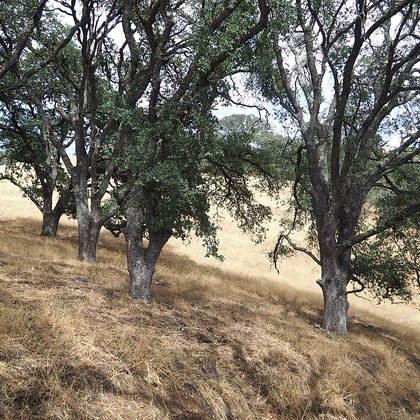
Mature, open mountain pine forest, chiefly ponderosa pine, and also Chihuahua and Apache pine and pine-oak woodland. In northern Arizona it favours stands with Gambel oak in the understorey; at the northern edge of its range it also occupies spruce-fir. In the United States and northern Mexico it sits roughly between 1800 and 2700 metres; farther south it reaches much lower. Young, dense plantation it hardly uses.
Where the bird is most often found, arranged by the USNVC — the vegetation classification of the United States and Canada — and CMECS for sea and coast.



Range and movements
The breeding range in the United States covers southern Nevada, southern Utah, southwestern Colorado, Arizona, New Mexico and West Texas. From the border it continues south through the Sierra Madre Occidental and Oriental and the mountains of southern Mexico and Central America to Nicaragua. Birds from the United States leave in September and winter in western Mexico, from northeastern Sinaloa and northwestern Durango southward; Mexican and Central American populations stay year-round in the same forest.
- Resident
- Breeding (summer)
- Winter
- Passage
- dark = core range, pale = thinly spread
Where and when to look
In May or June, go to mature ponderosa pine forest in the mountains of Arizona or New Mexico and listen for the accelerating song; the bird stays high, so look for it against the sky on the outside of the crown. A slope that lets you look into the canopy at eye level saves a stiff neck and gives the best chance of seeing the yellow throat.
Conservation
The species is globally assessed as Least Concern (LC), but numbers are falling and it sits on the yellow alert list of tipping point species. The cause is the loss of mature, open pine forest: a century of logging, fire suppression and thickening has greatly reduced that forest type. Management with periodic prescribed fire and the retention of large old trees produces the forest in which the species breeds.
Scientific name
Setophaga graciae | (Baird, 1865)
Baird described the species in 1865 as Dendroica graciae; because it was later moved to Setophaga, author and year stand in parentheses. The genus Setophaga was introduced in 1827 by William Swainson, from Greek sēs 'moth' and -phagos 'eating'. The species name graciae refers to Grace Darling Coues, sister of the discoverer Elliott Coues, whom Baird fixed in the name at his request. The specimen described came from Fort Whipple near Prescott, Arizona.