All species › Passerines › New World warblers › Black-throated Green Warbler
Black-throated Green Warbler | Setophaga virens
Gele zwartkeelzanger | Reinita dorsiverde
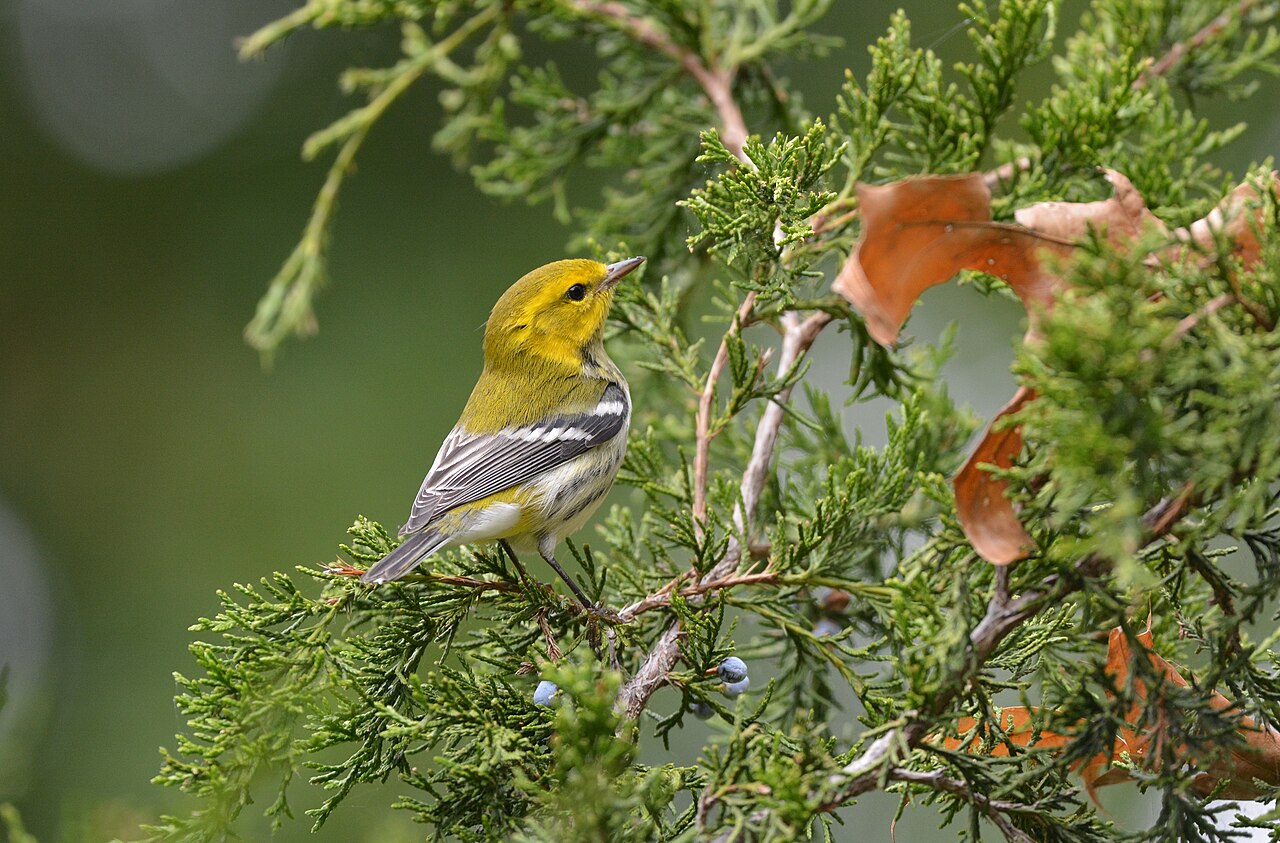
The Black-throated Green Warbler is the eastern member of the black-throated group: a yellow face, an olive-green back and, in the male, a black throat and upper breast. It breeds in coniferous and mixed forest from the boreal zone to the Appalachians and stays almost always high in the canopy.
Voice
The song is a short buzzy series of five notes, usually written zee-zee-zee-zoo-zee, with a low fourth note; a second type runs zoo-zee-zoo-zoo-zee. The tone is nasal and breathy and carries far through closed forest. The male sings persistently: one bird was counted at 466 songs in an hour. The call is a sharp tsip, the flight note a high, thin seet.
Recording: Bobby Wilcox — CC BY-NC-SA 4.0 · Williamsburg, Hampshire County, Massachusetts, United States · xeno-canto
Identification
The face is yellow with an olive-green eye-line and olive-green crown; back and mantle are olive-green. The male has a black throat and upper breast running back into black streaks along the flank; the belly is white with a yellow wash on the undertail. Two broad white wing bars and white outer tail feathers are clear. Females and young males have a pale throat with black spotting on the breast rather than a solid black field. The yellow face is present in all plumages and at all ages and keeps the species recognisable in autumn dress too.
Confusion species
Townsend's Warbler has a black cheek patch within the yellow face and more yellow on the breast, and the ranges meet only on migration in the West. Hermit Warbler has an entirely yellow face without a green eye-line and a grey back. Golden-cheeked Warbler of central Texas has a black crown and a black eye-line through a bright yellow face. In autumn the plumage of young birds resembles that of other Setophaga closely, but the combination of yellow face, olive-green back and yellow wash on the undertail coverts remains usable.
Habitat
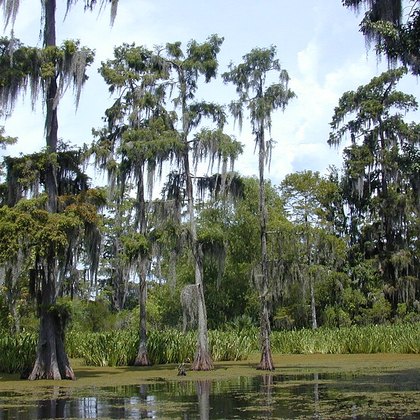
Coniferous and mixed forest: spruce-fir in the boreal zone, hemlock and white pine in the Northeast, and hemlock ravines in the Appalachians. It seeks dense conifer stands and forages at the tips of high branches. A separate population, cut off from the main range, breeds on the coast of Virginia and the Carolinas in bald cypress swamp and wet pine flatwoods. In winter quarters it uses montane conifer forest, pine-oak woodland, shade-grown coffee plantations and mangrove.
Where the bird is most often found, arranged by the USNVC — the vegetation classification of the United States and Canada — and CMECS for sea and coast.



Range and movements
It breeds from northeastern British Columbia and Alberta east across boreal Canada to Newfoundland, and south through the Great Lakes and New England into the Appalachians, where the range reaches northern Georgia. Migration runs broadly across the eastern United States and the Gulf coast; it winters from northeastern Mexico and Yucatán south through Central America, with small numbers in southern Florida and the Greater Antilles. Part of the population reaches Colombia and Ecuador, outside the guide area.
- Breeding (summer)
- Winter
- Passage
- dark = core range, pale = thinly spread
Where and when to look
Look for it in May in mixed forest with hemlock or spruce and let the ear do the work: the buzzy five-note series carries tens of metres while the bird itself sits unseen in the canopy. Wait at a clearing or a woodland edge until it comes out to the outer branches; the yellow face then comes into view.
Conservation
The species is assessed as Least Concern (LC) and is numerous over most of its range; the Breeding Bird Survey shows a slightly declining to stable trend over the past half-century. The coastal population of Virginia and the Carolinas is small and depends on old bald cypress swamp, of which little remains. In the northeastern part of the range the hemlock woolly adelgid, an introduced insect pest, is removing much of the hemlock forest the species uses there.
Scientific name
Setophaga virens | (Gmelin, 1789)
Gmelin described the species in 1789 as Motacilla virens; because it was later moved to Setophaga, author and year stand in parentheses. The genus Setophaga was introduced in 1827 by William Swainson, from Greek sēs 'moth' and -phagos 'eating'. The species name virens is Latin for 'being green, growing green' and refers to the olive-green upperparts. The type locality was restricted to Philadelphia, Pennsylvania, in 1910.