All species › Passerines › New World warblers › Golden-cheeked Warbler
Golden-cheeked Warbler | Setophaga chrysoparia
Geelwangzanger | Reinita caridorada
The Golden-cheeked Warbler is the only bird species whose entire breeding range lies within a single state: the juniper-oak woodlands of the Edwards Plateau in central Texas. It breeds there from March to July and winters in the montane forests of southern Mexico and Central America. It has been on the federal endangered species list since 1990.
Voice
The song is a short buzzy series of four or five syllables, usually written chee-chee-choo-wee, with the last note swinging up or down. Two song types can be told apart: the male uses one at the edge of his territory towards neighbours, the other deeper inside the territory near the female. The call is a short sharp chip, the same note both sexes give at disturbance. Singing is concentrated in the first hour after sunrise, from a perch halfway up the canopy.
Recording: Nathan Wahler — CC BY-NC-SA 4.0 · Madla Park, Grey Forest, Bexar County, Texas, United States · xeno-canto
Identification
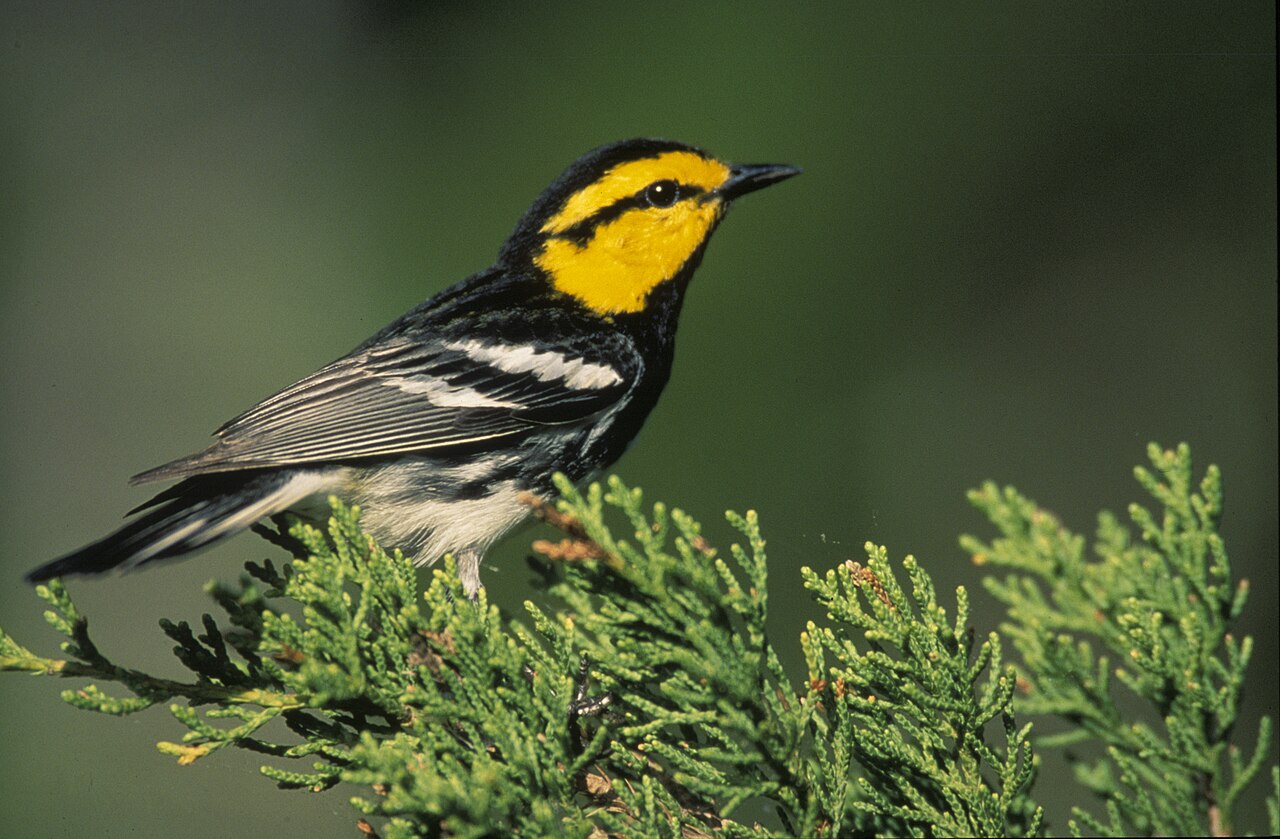
The male has a yellow face with a black line straight through the eye, a black throat and breast, and a solid black back. The underparts are white with black streaks on the flanks; the grey wing carries two white bars and the outer tail feathers are largely white. The female shows the same pattern in muted form: the back is greyish olive with faint streaking and the throat is pale with at most a few black feathers. The black eyeline on the yellow face is present in both sexes.
Confusion species
Four species share the black-yellow-white pattern. Black-throated Green Warbler has an olive-green back rather than a black one, a yellow wash on the face without a sharp black eyeline, and yellow on the vent. Hermit Warbler has an entirely yellow face without an eyeline and a grey back. Townsend's Warbler has a black cheek patch dividing the yellow face in two. Range helps: in the hills of central Texas only the Golden-cheeked of these four occurs as a breeder.
Habitat
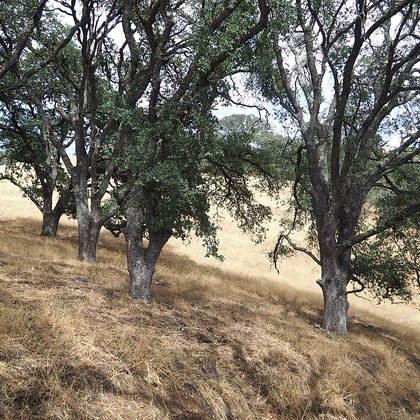
Mature, closed stands of Ashe juniper on limestone slopes and canyon heads, mixed with live oak, Texas oak and maple, roughly between 180 and 520 metres. The nest is built from the fine bark strips of junipers at least twenty years old; young plantings do not supply that material. In winter it occupies pine-oak woodland and cloud forest between 1500 and 3000 metres, usually in mixed flocks with other warblers and chickadees.
Where the bird is most often found, arranged by the USNVC — the vegetation classification of the United States and Canada — and CMECS for sea and coast.




Range and movements
The breeding range covers thirty-three counties in central Texas, from Palo Pinto County southwestward along the eastern and southern rim of the Edwards Plateau to Kinney County. The birds arrive in the first half of March and leave as early as July. Migration follows the Sierra Madre Oriental southward. The wintering range lies in southern Mexico, Guatemala, Honduras and northern Nicaragua; the birds are spread far more thinly there than on the breeding grounds.
- Resident
- Breeding (summer)
- Winter
- Passage
- dark = core range, pale = thinly spread
Where and when to look
Late March and April are the best period, when males sing all morning and the oak leaves are not yet fully out. Balcones Canyonlands National Wildlife Refuge, Lost Maples State Natural Area and Pedernales Falls State Park have designated trails. Go to a canyon head at sunrise and wait for the buzzy song; after mid-June the chance drops sharply because singing largely stops.
Conservation
The species has been federally listed as endangered since May 1990 and is Endangered (EN) on the IUCN Red List. Partners in Flight puts the breeding population at about 110,000 birds. The main pressure is loss of old juniper-oak woodland to urban expansion around Austin and San Antonio, to conversion to pasture, and to fragmentation; on the wintering grounds forest is lost to logging and farming. Brood parasitism by Brown-headed Cowbird lowers breeding success in fragmented woodland. The 2025 State of the Birds report lists it as a red-alert tipping point species.
Scientific name
Setophaga chrysoparia | (Sclater; Salvin, 1860)
Philip Lutley Sclater and Osbert Salvin described the species in 1860 as Dendroeca chrysoparia; because it was later moved to the genus Setophaga, authors and year stand in parentheses. The species name comes from Greek khrusos 'gold' and pareia 'cheek' — 'with the golden cheek'. The genus Setophaga was introduced in 1827 by William Swainson, from Greek sēs 'moth' and -phagos 'eating'. The specimen described came from Verapaz in Guatemala, and so from the wintering range rather than the breeding range.