All species › Passerines › New World warblers › Hermit Warbler
Hermit Warbler | Setophaga occidentalis
Heremietzanger | Reinita cabecigualda
The Hermit Warbler breeds in the tall conifer forests of the American West Coast, from Washington to the Sierra Nevada. It forages high in the crowns of Douglas-firs and pines and is therefore heard far more often than seen. Where its range meets that of Townsend's Warbler in Washington and northern Oregon, a narrow hybrid zone occurs.
Voice
The song is a series of three to five thin, high seely-seely-seely notes followed by two or three lower, rapidly delivered end notes. The whole is thinner and less buzzy than the song of Townsend's Warbler. The call is a flat, dry tup, often all you catch from a bird in the canopy; in flight it gives a thin tsee. Males sing from the top of a tall conifer, usually out of sight from the trail.
Recording: Paul Marvin — CC BY-NC-SA 4.0 · Chapman Saddle Rd, Sierra County, California, United States · xeno-canto
Identification
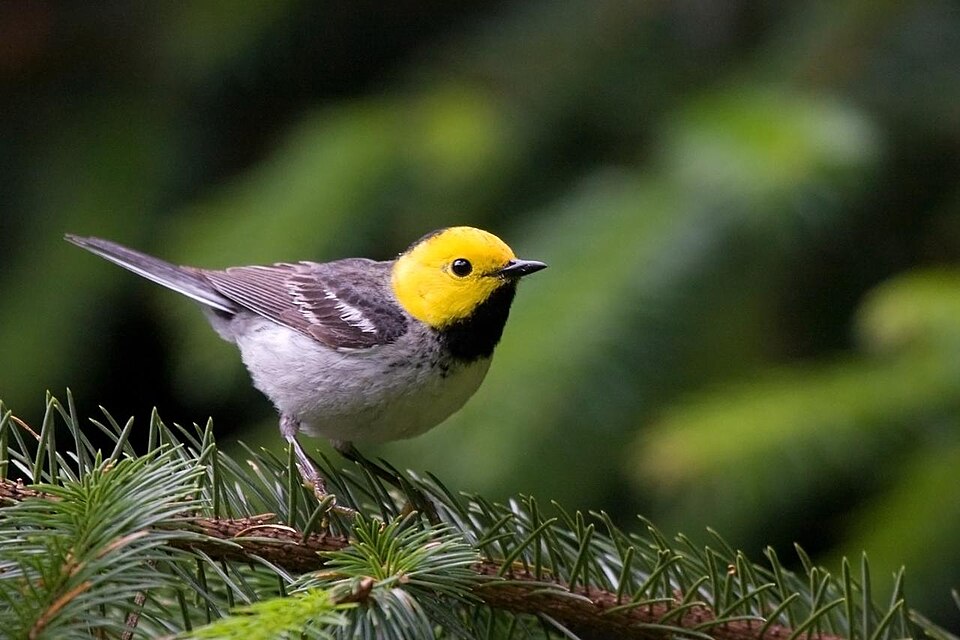
The breeding male has an entirely yellow head without markings, a black throat extending onto the breast, and a black band across crown and nape. The back is grey with faint black streaking, the underparts white with grey flank streaks, and the wing carries two white bars. The female has a pale yellow face with a dusky cheek and a yellow eye-ring, and at most some dark on the throat. Young birds in autumn have a dull yellow face without black; the grey, not olive, back remains the anchor.
Confusion species
Townsend's Warbler has a black or dark cheek patch cutting the yellow face in two, and yellow on breast and flanks; the Hermit has a plain yellow head and a white breast. Hybrids between the two combine these features in every intermediate form and cannot be reliably named within the hybrid zone. Golden-cheeked Warbler has a black eyeline on the yellow face and breeds only in Texas. Black-throated Green Warbler has an olive back and a yellow-green wash across the head.
Habitat
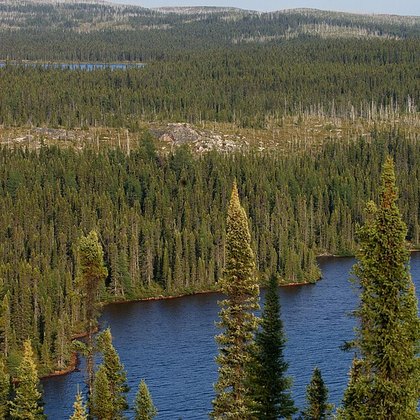
Tall, closed conifer forest of the mountains and the West Coast: Douglas-fir, grand fir, Sitka spruce, redwood and, higher up, sugar pine, lodgepole pine and Jeffrey pine. It favours old stands with high crowns and barely uses young plantations. On migration it is less selective and turns up in oak woodland, desert oases, city parks and gardens. In winter it occupies pine-oak forest in the Mexican and Central American mountains, roughly between 1200 and 3300 metres.
Where the bird is most often found, arranged by the USNVC — the vegetation classification of the United States and Canada — and CMECS for sea and coast.




Range and movements
The breeding range runs from western Washington through Oregon into California, with an arm southward along the Sierra Nevada and the coast ranges; in extreme southwestern British Columbia the species is scarce. Birds arrive in April and May and leave again from July to September, partly through the mountains of Arizona and New Mexico. The wintering range lies in the highlands of western and southern Mexico and in Guatemala, El Salvador, Honduras and Nicaragua. A small number stay through the winter on the coast of southern California.
- Resident
- Breeding (summer)
- Winter
- Passage
- dark = core range, pale = thinly spread
Where and when to look
Look for it in May and June on mountain trails in the Cascades, the Siskiyou Mountains or the western Sierra Nevada, and go by the song: without that thin, high series you will rarely find a bird in a forty-metre Douglas-fir. Migrants in August can also be seen at eye level in low-lying oases and gardens. On every sighting check the back colour — grey in Hermit, olive in Black-throated Green.
Conservation
The IUCN places the species in the Least Concern (LC) category and Partners in Flight puts the breeding population at about 2.5 million birds, with a broadly stable trend. The main pressure is logging of old conifer forest at both ends of the migration route, and loss of pine-oak woodland on the wintering grounds. In the hybrid zone Townsend's Warbler, less tied to old forest, is expanding; some researchers take this to mean ground is being lost that was formerly held by Hermit Warbler alone.
Scientific name
Setophaga occidentalis | (Townsend, 1837)
John Kirk Townsend described the species in 1837 as Sylvia occidentalis; because it was later placed in Setophaga, author and year stand in parentheses. The species name occidentalis is Latin for 'western', after the range on the western side of the continent. The type specimen came from the forests along the Columbia, near present-day Fort Vancouver in Washington. The English and Dutch names refer to the hidden life high in the canopy; the genus Setophaga means 'moth-eating'.