All species › Passerines › New World warblers › Townsend's Warbler
Townsend's Warbler | Setophaga townsendi
Townsends zanger | Reinita de Townsend
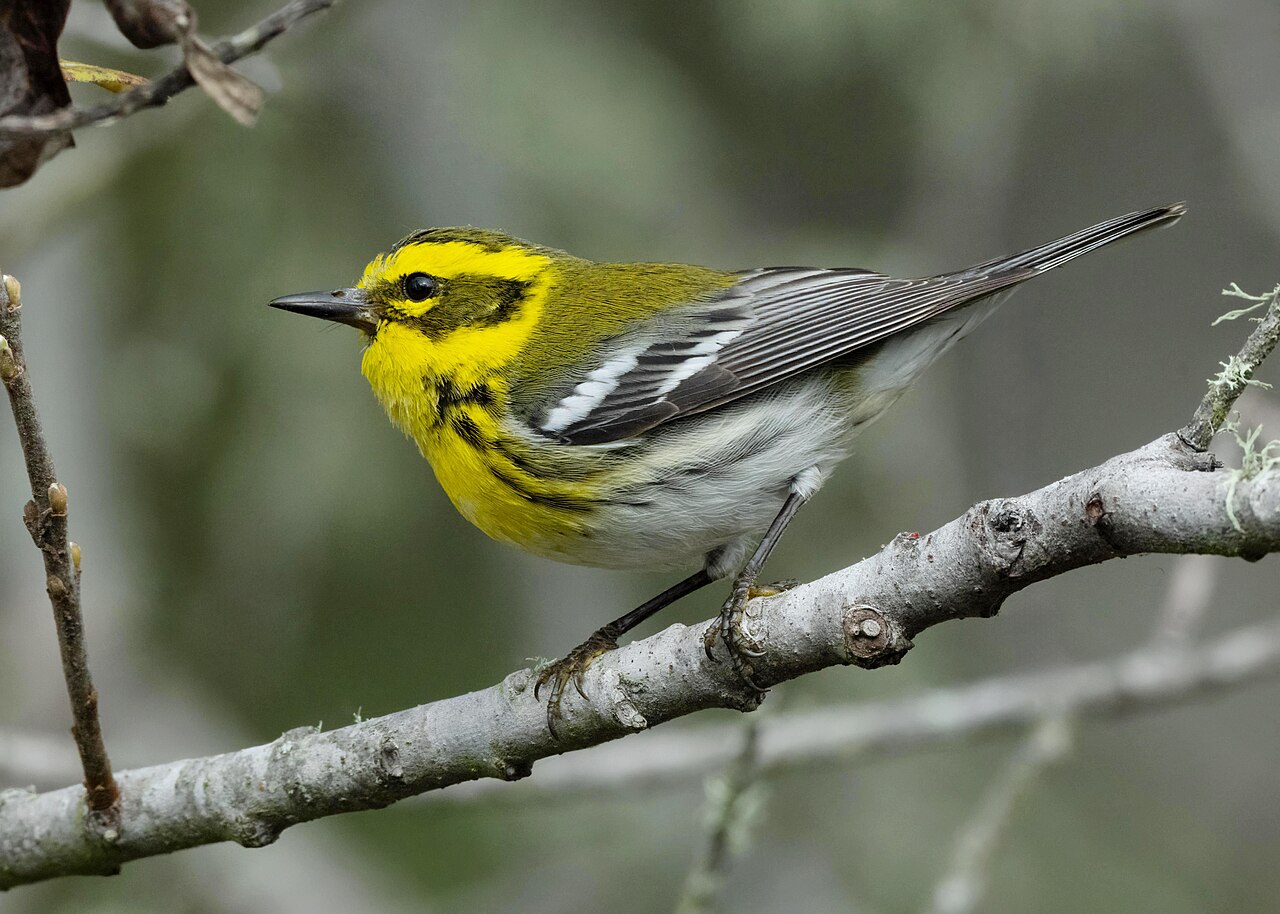
Townsend's Warbler breeds in the conifer forest of northwestern North America, from southeastern Alaska and Yukon to Montana. It is told by the black cheek patch on a yellow face. Part of the population migrates to the mountains of Mexico and Central America, while another part winters along the coast of California and Oregon, where it also visits gardens.
Voice
The song is a buzzy series, usually four or five even zee-zee-zee notes followed by one or two higher end notes: weazy-weazy-weazy-tswee. It resembles the song of Black-throated Green Warbler but is fuller and more emphatic than the thin song of Hermit Warbler. The call is a sharp, flat tup; in flight a high, short tsip. Singing males sit high in the crown of an old conifer.
Recording: Paul Marvin — CC BY-NC-SA 4.0 · Madera Canyon, Santa Cruz Co., Arizona, United States · xeno-canto
Identification
The male has a yellow face divided in two by a black ear patch, with a yellow crescent below it, and a black crown and throat. The breast is yellow, the flanks white with heavy black streaking; the back is olive with black streaks and the wing carries two white bars. The female shows the same pattern in muted form: the cheek patch is olive-grey rather than black and the throat is yellow with at most a few dark flecks. Young birds in autumn also keep the dark cheek patch, so that this feature also applies in autumn plumage.
Confusion species
Hermit Warbler has a plain yellow head without a cheek patch, a grey back and a white breast; Townsend's has an olive back and a yellow breast. Where the two meet in Washington and northern Oregon, hybrids occur with intermediate cheek patches and breast colour. Black-throated Green Warbler has a yellow face without a dark cheek patch and white underparts. The autumn plumage of females and young birds closely resembles that of other species in this group; the dark triangle on the cheek then remains the most reliable feature.
Habitat
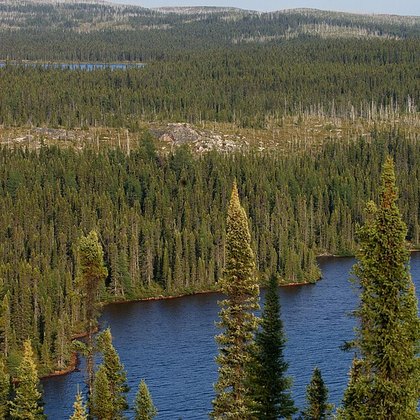
Mature coniferous and mixed woodland, especially old stands of Douglas-fir, grand fir and Sitka spruce on mountain slopes and along the coast. It forages in the upper branches for caterpillars, aphids and sawflies; outside the breeding season it also takes nectar and berries. In winter it occupies montane pine and oak forest in Mexico and Central America, and in the north coastal woodland, oak groves, parks and gardens into built-up areas.
Where the bird is most often found, arranged by the USNVC — the vegetation classification of the United States and Canada — and CMECS for sea and coast.




Range and movements
The breeding range runs from southeastern Alaska and southern Yukon and the Northwest Territories through British Columbia and western Alberta to Washington, Oregon, Idaho, Montana and northwestern Wyoming. Migration passes through the Great Basin and the mountains of Nevada, Utah, Colorado, Arizona and New Mexico. Wintering takes place in two separate areas: the coastal strip of California, and the montane forests of western and southern Mexico south to Nicaragua. There it appears in mixed flocks through the winter months.
- Resident
- Breeding (summer)
- Winter
- Passage
- dark = core range, pale = thinly spread
Where and when to look
In May and June the song is the quickest way in, in the Cascades and the Rocky Mountains of British Columbia. Between November and March the coast of central California gives the best chance at eye level: it visits eucalyptus, cypress and feeders there. On every bird look at the face pattern rather than the intensity of the colour, since females and young birds are far duller than breeding males.
Conservation
The IUCN lists the species as Least Concern (LC). Partners in Flight puts the world population at about 21 million birds and scores it 12 out of 20 on the Continental Concern Score, which counts as low concern; between 1968 and 2015 the trend was stable to slightly declining. Logging of old conifer forest reduces the breeding habitat, and fragmentation raises the risk of nest predation. Because the species migrates at night, birds are lost in collisions with buildings and masts.
Scientific name
Setophaga townsendi | (Townsend, 1837)
John Kirk Townsend described the species in 1837 as Sylvia townsendi; because it was later placed in Setophaga, author and year stand in parentheses. The name honours Townsend himself: Thomas Nuttall proposed it, so that Townsend did not have to name the species after himself. The type specimen came from the forests along the Columbia, near present-day Fort Vancouver in Washington. The genus Setophaga, introduced in 1827 by William Swainson, is from Greek sēs 'moth' and -phagos 'eating'.