All species › Waders, gulls and terns › Sandpipers and allies › Greater Yellowlegs
Greater Yellowlegs | Tringa melanoleuca
Grote Geelpootruiter | Archibebe patigualdo grande
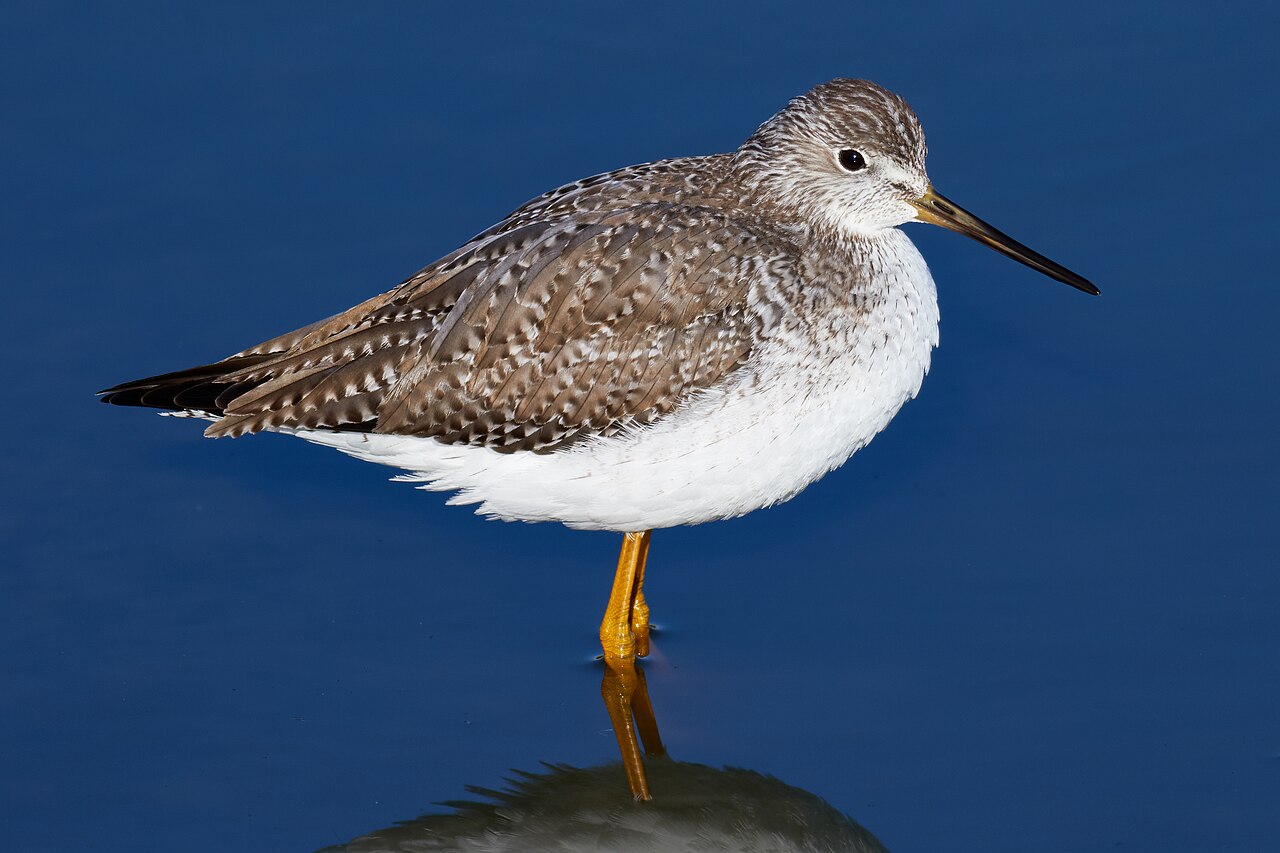
Greater Yellowlegs is the noisiest wader of the marsh: long in the leg, long in the neck, with yolk-yellow legs and a long bill, thick at the base and slightly upturned. It usually takes off before you have seen it, calling three or four ringing notes by which it can be named at a great distance. It breeds thinly across thousands of kilometres of peatland in the boreal forest, and that alone makes it one of the hardest North American waders to count.
Voice
The alarm call is a series of three or four clear, penetrating notes, tew-tew-tew, thrown out with force and falling slightly; it is the sound that puts a whole marsh on notice. Against Lesser Yellowlegs there are more notes, they are louder and they fall further — that species gives one or two flat notes. On the breeding grounds the male sings a steady too-whee too-whee in a long undulating display flight, sometimes for minutes on end. At the nest there is also a short hard kip, repeated from the top of a small spruce. Anyone who flushes a mixed flock of waders hears this species first.
Recording: Don Profota — CC BY-NC-SA 4.0 · South Bozeman, Gallatin County, Montana, United States · xeno-canto
Identification
In breeding plumage the upperparts are dark grey spotted with black and white, the neck and breast are closely streaked black, and the flanks are heavily barred far towards the rear. In winter plumage it is plainer grey with white speckling on the back and only a fine streaking on neck and breast. In every plumage a narrow white eye-ring shows and the legs are bright yellow, in spring orange-yellow on some birds. The bill is about one and a half times the length of the head, thick and grey at the base, and bends slightly upward over its last part. In flight the wing is plain dark without a bar, the rump is white and the tail finely barred, and the toes project beyond the tail. On the ground it walks through shallow water with raised knees and a high, staccato step.
Confusion species
Lesser Yellowlegs (Tringa flavipes) forms the classic confusion pair with this species: it is a good third smaller, and its bill is straight, wholly dark and about as long as the head, where that of Greater Yellowlegs is longer, paler at the base and slightly upturned at the tip. Only the call is reliable at every range: three or four loud falling notes against one or two flat ones. Short-billed Dowitcher (Limnodromus griseus) has shorter, greenish legs, a long straight bill and a white wedge up the back. Common Greenshank (T. nebularia), an Asian visitor in Alaska, has dull green legs and the same white wedge up the back. Willet (T. semipalmata) is greyer and heavier and shows a broad black-and-white wing pattern in flight.
Compare sandpipers, snipes and allies: bill, legs, wing bar and rump
Habitat
It breeds in muskeg: the wet peatland of the boreal forest, with many small pools, sedge flats and scattered low spruces, the nest set in the moss at the foot of a sapling. Outside the breeding season it uses almost any shallow water: tidal flats and saltmarsh along the coast, the margins of salt lagoons, flooded fields, rice paddies, sewage lagoons and the drying shores of reservoirs. Unlike most waders it often feeds belly-deep or even swimming, with sideways sweeps through the water, and takes small fish and shrimps alongside the usual bottom life. What it avoids is dry land and sandy beach without shallows beside it.
Where the bird is most often found, arranged by the USNVC — the vegetation classification of the United States and Canada — and CMECS for sea and coast.





Range and movements
It breeds in a broad band of peat and muskeg from southern Alaska and southern Yukon and the Northwest Territories east through the boreal forest to Newfoundland and Labrador. From July it moves south in small parties, across the whole continent at once rather than along a single coastal route, and the last birds leave Canada only in November. It winters from Washington and New Jersey south along both coasts, through the whole of Mexico and the Caribbean, and on to Tierra del Fuego; that winter range spans two continents. Inland in the United States it is chiefly a migrant, and the small numbers that stay are in the south. Its range has not shifted clearly over the past century; what changed is the number of birds.
- Resident
- Breeding (summer)
- Winter
- Passage
- dark = core range, pale = thinly spread
Where and when to look
Stand beside a flooded field or a sewage lagoon in April or September and wait for something to get up: the first bird to call is nearly always this species, and the number of notes tells you at once whether it is the Greater or the Lesser. If both stand together, measure the bill against the head: on the Greater it projects a good half head beyond it, on the Lesser it does not. If a bird's legs turn orange in spring, that is not another species.
Conservation
The Red List holds the species as Near Threatened (NT), the step below the threatened categories, and Partners in Flight puts the breeding population at about 140,000 birds. Counts point to a loss of more than half in fifty years, with an acceleration in recent years, and the species accordingly stands on the American list of birds at a tipping point. The causes lie mainly outside the breeding range: loss of marsh and saltmarsh in the wintering areas, and shorebird hunting in parts of the Caribbean. Because it breeds thinly across the muskeg, every trend estimate rests on counts of migrants and not on the breeding range itself.
Scientific name
Tringa melanoleuca | (Gmelin, 1789)
Gmelin described the species in 1789 as Scolopax melanoleuca, among the snipes; since it was placed in the genus Tringa, author and year stand in parentheses. Tringa goes back to the Greek trungas, in Aristotle the name of a white-rumped bird of the waterside. melanoleuca is made from the Greek melas, 'black', and leukos, 'white', after the black-and-white spotting of the upperparts. The type locality is the sandy shore of Labrador, later restricted to Chateau Bay. The description appeared in the thirteenth edition of the Systema Naturae, which Gmelin saw through the press.