All species › Waders, gulls and terns › Sandpipers and allies › Black Turnstone
Black Turnstone | Arenaria melanocephala
Zwarte Steenloper | Vuelvepiedras Negro
Black Turnstone is the dark wader of the Pacific rocks: nearly black above, white below, with short red-brown legs and a short pointed bill with which it turns over stones and weed. It breeds almost entirely on the coastal plain of western Alaska and winters on the surf-washed rocks of the west coast. Of all the waders of the continent it has the smallest range.
Voice
The call is a high rattling trill, skirrr, dry and slightly crackling, which from a flock on the rocks sounds like a steady rustle. On taking off it becomes shorter and sharper, chik-chik-chik, usually in series of three or four. Over the breeding grounds the male circles on shivering wings with a drawn-out buzzing trrrrrreee that carries across the sedge flats. At the nest there is a hard short chek as soon as a jaeger passes over. The call resembles that of Ruddy Turnstone but is higher and drier, and on a rocky coast holding both species that difference is the quickest way to a name.
Recording: Paul Marvin — CC BY-NC-SA 3.0 · Fiesta Island, San Diego, California, United States · xeno-canto
Identification
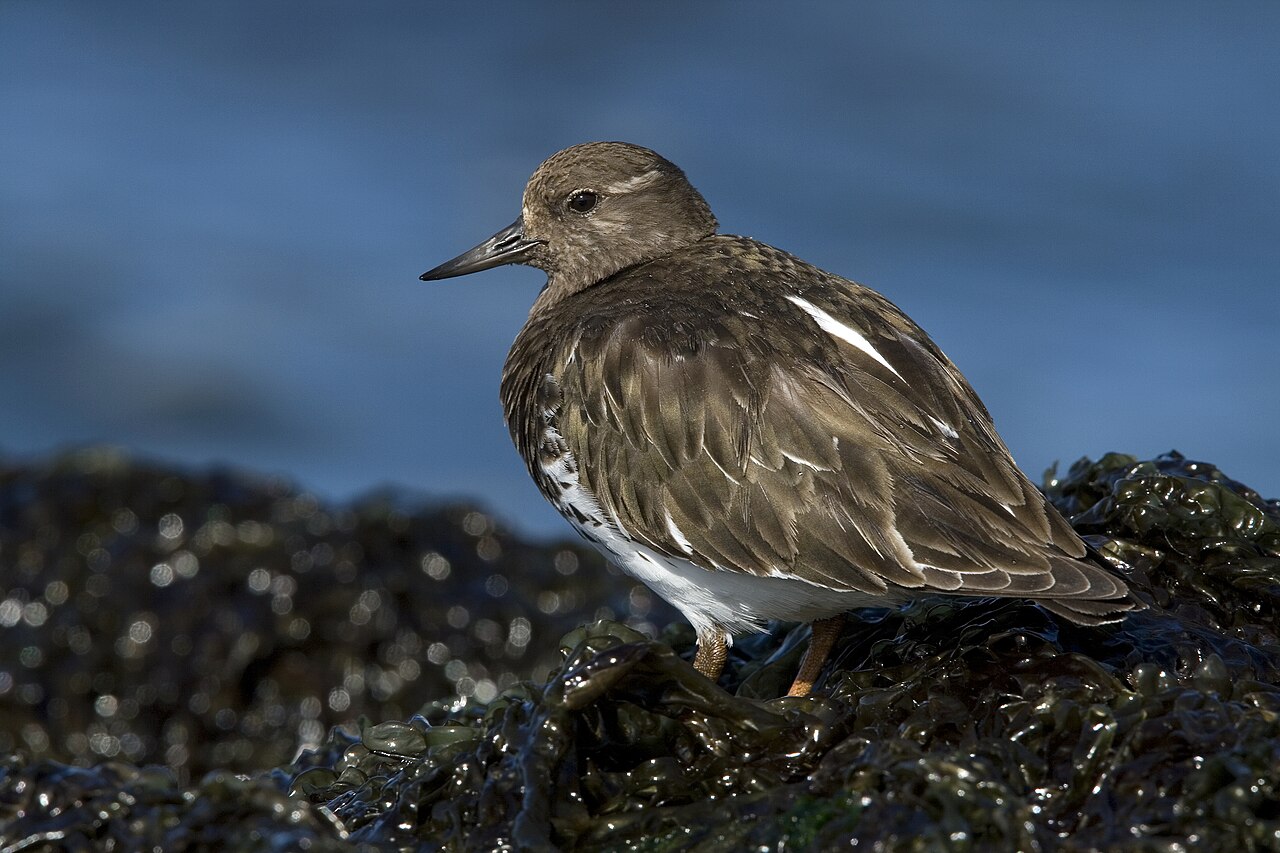
In breeding plumage the bird is slate black on head, breast and upperparts, with a white spot between eye and bill, a white eyebrow and white speckling across the sides of the breast. In winter plumage those white markings drop away and it is plain blackish brown, with a sharp border against the white belly. The bill is short, straight, pointed and wholly black; the legs are short and dull red to red-brown, never bright orange. In flight the pattern is pronounced: two white stripes across each wing, a white wedge up the back, and a white tail with a broad black band at the end. The sexes look alike; juveniles are duller brownish black with narrow pale feather edges. On the rock it walks low and thickset, and levers stones and strands of weed aside with a sideways push of the bill.
Confusion species
Ruddy Turnstone (Arenaria interpres) stands on the same rocks: in winter plumage it is browner and paler, with a patterned head, a dark breast band that leaves a pale wedge in the middle, and bright orange legs. Surfbird (Calidris virgata) is greyer and heavier, with a thicker bill with a yellow base and yellow legs, and its white tail carries one black band but no white wedge up the back. Wandering Tattler (Tringa incana) is plain grey, longer in leg and bill, and shows no white at all in flight. If a flock is waiting on a rock for the water to drop, look at the legs: dull red against bright orange usually settles it.
Compare sandpipers, snipes and allies: bill, legs, wing bar and rump
Habitat
Outside the breeding season this is a bird of the intertidal zone on hard ground: weed-covered rock platforms, cobble beaches, piers, jetties and breakwaters, where it turns stones and weed amid the surf. At high water it waits in tight parties on a dry rock, standing on one leg, until the water falls again. It uses adjoining mud and sandy beach as well, but only where there are stones nearby to rest on. It breeds on the coastal plain: wet sedge meadows and tussocks of beach rye beside brackish pools, the nest set in a tussock on a small island. Open sea and forest it avoids entirely.
Where the bird is most often found, arranged by the USNVC — the vegetation classification of the United States and Canada — and CMECS for sea and coast.




Range and movements
The breeding range is small and lies almost wholly in western Alaska, with by far the most birds on the delta of the Yukon and the Kuskokwim; beyond it only small numbers breed along the coast to north and south. From July onward it moves south, and part of the population then cuts straight across the Gulf of Alaska instead of following the coastline; in spring it follows that coastline closely. It winters on the rocky coasts from southeastern Alaska to Baja California, the Gulf of California and Sonora, and rarely touches the interior. Because breeding and wintering areas are both narrow strips, nearly the whole species sits along a single coastline the year round.
- Resident
- Breeding (summer)
- Winter
- Passage
- dark = core range, pale = thinly spread
Where and when to look
Look for it between September and April on a breakwater or a weed-covered rock platform, a couple of hours either side of low water; it often sits in one flock with Surfbirds and Ruddy Turnstones and is the darkest bird among them. Stand still and wait: against wet black rock the birds are nearly invisible until one moves, and then the flock proves three times the size you thought. When they get up, the black-and-white pattern of back, wing and tail names the species at once.
Conservation
Partners in Flight puts the world population at about 95,000 breeding birds and places the species on the list of birds with a restricted range. The Red List holds it as Least Concern (LC), but counts in the northwestern United States point to a decline. The vulnerability lies in the concentration: nearly the whole species breeds on one delta and winters along one coastline, so an oil spill or a change on that delta reaches many birds at once. The Exxon Valdez disaster of 1989 hit wintering birds in Prince William Sound; ingested plastic and lead from shot are named as threats as well.
Scientific name
Arenaria melanocephala | (Vigors, 1829)
Vigors described the species in 1829 as Strepsilas melanocephalus; since it was placed in the genus Arenaria, author and year stand in parentheses. Arenaria derives from the Latin arena, 'sand', and so means something like 'the one of the sand'. melanocephala is made from the Greek melas, 'black', and kephale, 'head', after the black head of the breeding bird. The type locality is given no more exactly than the northwest coast of North America. The description appeared in the fourth volume of The Zoological Journal.