All species › Waders, gulls and terns › Sandpipers and allies › Ruddy Turnstone
Ruddy Turnstone | Arenaria interpres
Steenloper | Vuelvepiedras común
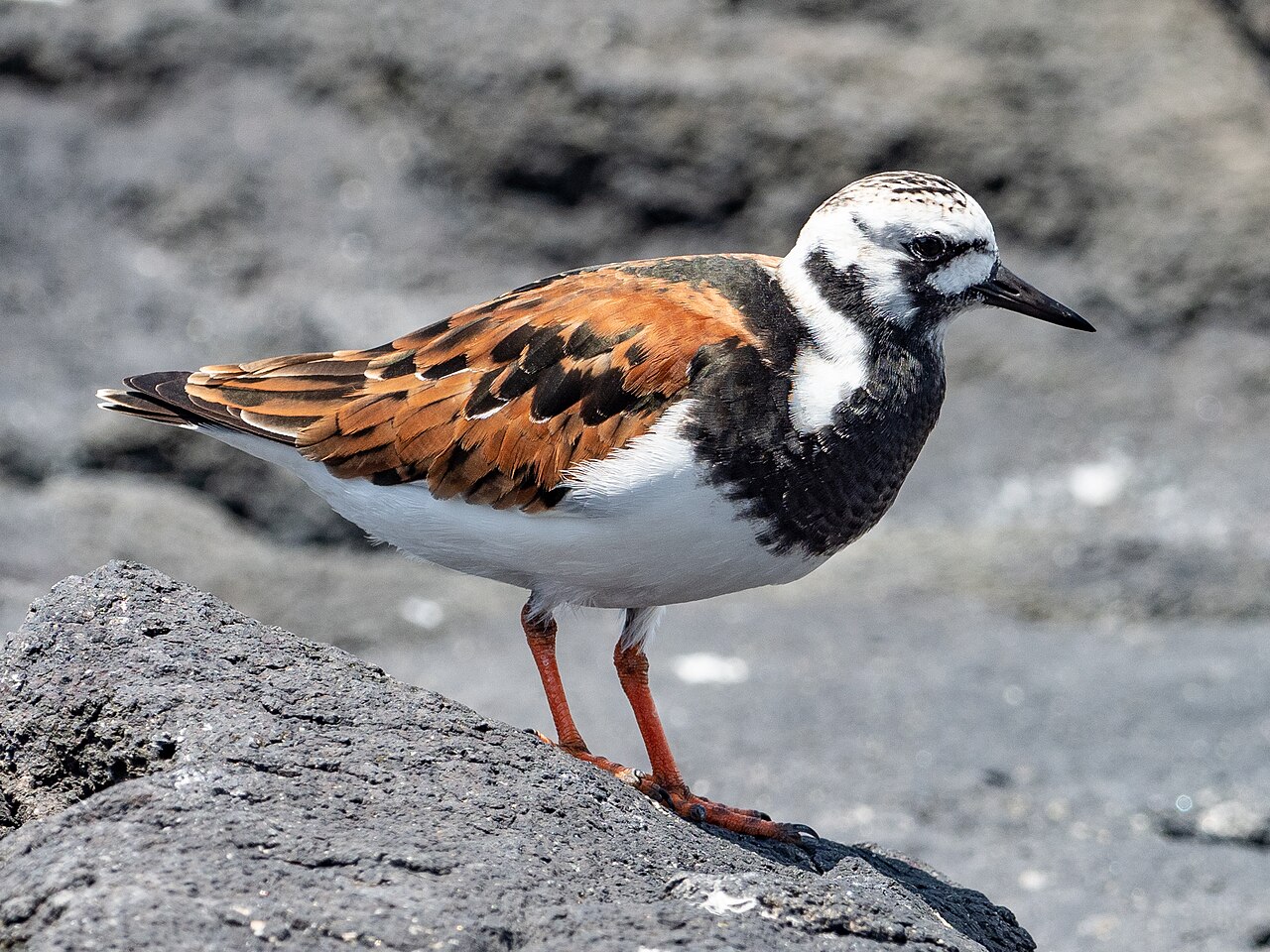
Ruddy Turnstone is the thickset wader found on almost every tideline in the world: short in the leg, orange in the leg, with a short pointed bill with which it turns over weed, stones and stranded rubbish. In breeding plumage it carries a variegated pattern of chestnut, black and white that no other shorebird of the continent has. It breeds on the bare tundra of the high north and winters along almost every coast between Massachusetts and Tierra del Fuego.
Voice
The flight call is a low rattling tuk-a-tuk-tuk, hard and dry, which from a rising flock sounds like a volley. There is also a sharp, staccato kwit-it-it, repeated when the birds are uneasy on the tideline. On the tundra the display flight carries a slow purring trill, repeated at short intervals, and at the nest a hard chek when a jaeger goes over. The call is lower and fuller than that of Black Turnstone, and on a shared rocky coast that difference is more usable than the plumage. Away from the breeding grounds what you mostly hear is the rattle of a flock shifting from one stony edge to the next.
Recording: David Darrell-Lambert — CC BY-NC-SA 4.0 · Spurn Bird Observatory, Kilnsea, United Kingdom · xeno-canto
Identification
In breeding plumage the upperparts are a variegated mixture of chestnut, black and white, the head is white with a black pattern across forehead, cheek and breast, and the underside from the breast down is white. In winter plumage the chestnut goes and the bird becomes dark grey-brown above, with a dark breast band that leaves a pale wedge in the middle. The legs are bright orange in every plumage, the bill short, black, pointed and slightly upturned at the tip. In summer the male has a whiter head than the female, which keeps more brown on crown and cheek; juveniles are duller, with neat pale feather edges. In flight the pattern is distinctive: a white stripe across each wing, a white wedge up the back and a white tail with a black band. On the ground it walks low and thickset, with short quick steps, levering stones and strands of weed over with a sideways push of the bill.
Confusion species
Black Turnstone (Arenaria melanocephala) of the west coast is plain blackish brown in winter plumage, without a head pattern, and has dull red rather than orange legs. Surfbird (Calidris virgata) is greyer and heavier, with a thicker bill with a yellow base and without the white wedge up the back. Dunlin (C. alpina) is slimmer, longer-billed and black-legged, and probes the mud rather than levering. If a mixed flock in winter plumage leaves you in doubt, the orange legs and the dark breast band broken in the middle are enough together.
Compare sandpipers, snipes and allies: bill, legs, wing bar and rump
Habitat
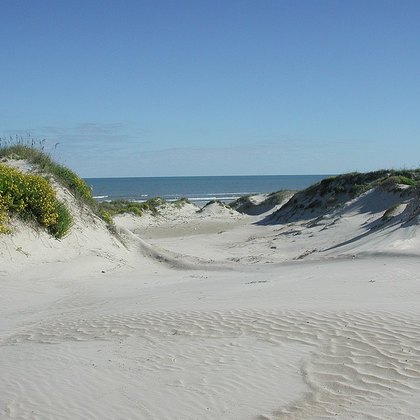
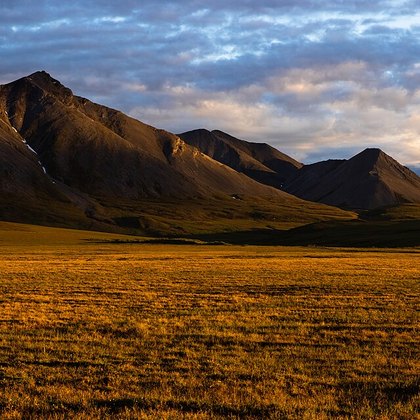
Outside the breeding season it uses almost any coast with something to turn over: weed-covered rock platforms and cobble beaches, sandy beaches with a strandline, the tidal flats of estuaries, piers, jetties and the concrete edges of harbours. It walks over saltmarsh and along the margins of salt pans as well, and on passage it appears on the shores of the great inland lakes. What it wants is an edge with cover under it — stone, weed, shell grit or driftwood — and not the open, smooth mud the sandpipers probe. It breeds on the bare stony tundra of the high north, usually near the coast or a pool, the nest set in a shallow scrape among moss and broken rock.
Where the bird is most often found, arranged by the USNVC — the vegetation classification of the United States and Canada — and CMECS for sea and coast.



Range and movements
In North America it breeds on the Arctic islands and along the north coast, from western Alaska east through Nunavut to Greenland, with two forms that change over roughly at the Mackenzie. Migration runs on a broad front: part of the population follows the Atlantic coast, part crosses the Great Lakes and the prairies, and the Alaskan birds follow the Pacific or carry on to the islands of the South Pacific. It winters along both coasts from Massachusetts and Washington south, through Mexico and the whole of the Caribbean into South America, and in Hawaii it is a common winter visitor. In spring large numbers gather around Delaware Bay, where like Red Knot they feed on horseshoe crab eggs. Its range has not changed over the past century; its numbers have.
- Resident
- Breeding (summer)
- Winter
- Passage
- dark = core range, pale = thinly spread
Where and when to look
Look for it all year round on the edge of a pier or a breakwater at low water: it walks about calmly and lets people come closer than any other wader. In May the birds are in full breeding plumage and the males can be told from the females by their whiter heads. Watch how it feeds: no other shorebird pushes stones and strands of weed aside with its bill.
Conservation
The Red List holds the species as Near Threatened (NT), the step below the threatened categories, and the world population is put at about 600,000 breeding birds. In North America more than half the birds have gone in fifty years, and the species accordingly stands on the list of birds at a tipping point. The threats lie more on the flyway than on the breeding grounds: loss of coast and saltmarsh, the decline of the horseshoe crab in Delaware Bay, and ingested plastic on the tideline. Because it concentrates heavily at a few sites, every change at such a site counts for a large part of the population.
Scientific name
Arenaria interpres | (Linnaeus, 1758)
Linnaeus described the species in 1758 as Tringa interpres; since it was placed in the genus Arenaria, author and year stand in parentheses. Arenaria derives from the Latin arena, 'sand', and so means something like 'the one of the sand'. interpres is Latin for 'interpreter' or 'messenger'; Linnaeus took the word from a Swedish account in which the bird's call was read as a warning to the other birds on the shore. The type locality was originally given as Europe and North America and was later restricted to Gotland in Sweden. The description stands in the first volume of the tenth edition of the Systema Naturae.