All species › Waders, gulls and terns › Sandpipers and allies › Red Knot
Red Knot | Calidris canutus
Kanoet | Correlimos gordo
Red Knot is a thickset, short-legged sandpiper, orange-red below in spring and plain grey in winter; on the tidal flats of both coasts it then stands out chiefly by its compact build and its short straight bill. It flies in a few long stages from the High Arctic tundra to the far south of South America, stopping at places where a great deal of food can be taken in a short time. That dependence on a handful of places has brought one of its three North American forms into trouble.
Voice
The flight call is a soft, low knut or kwet, often barely audible; a flock getting up makes more sound with its wings than with its voices. While feeding there is also a short nasal kek-kek passed between the birds. On the breeding grounds the male sings a mournful, far-carrying poo-mee... poo-mee in a high, slow display flight, at long intervals, hanging on raised wings above the bare tundra. In the south it is seldom heard: on the tidal flats this is one of the quietest waders.
Recording: Arend Wassink — CC BY-NC-SA 4.0 · De Cocksdorp, Texel, Noord-Holland, Netherlands · xeno-canto
Identification
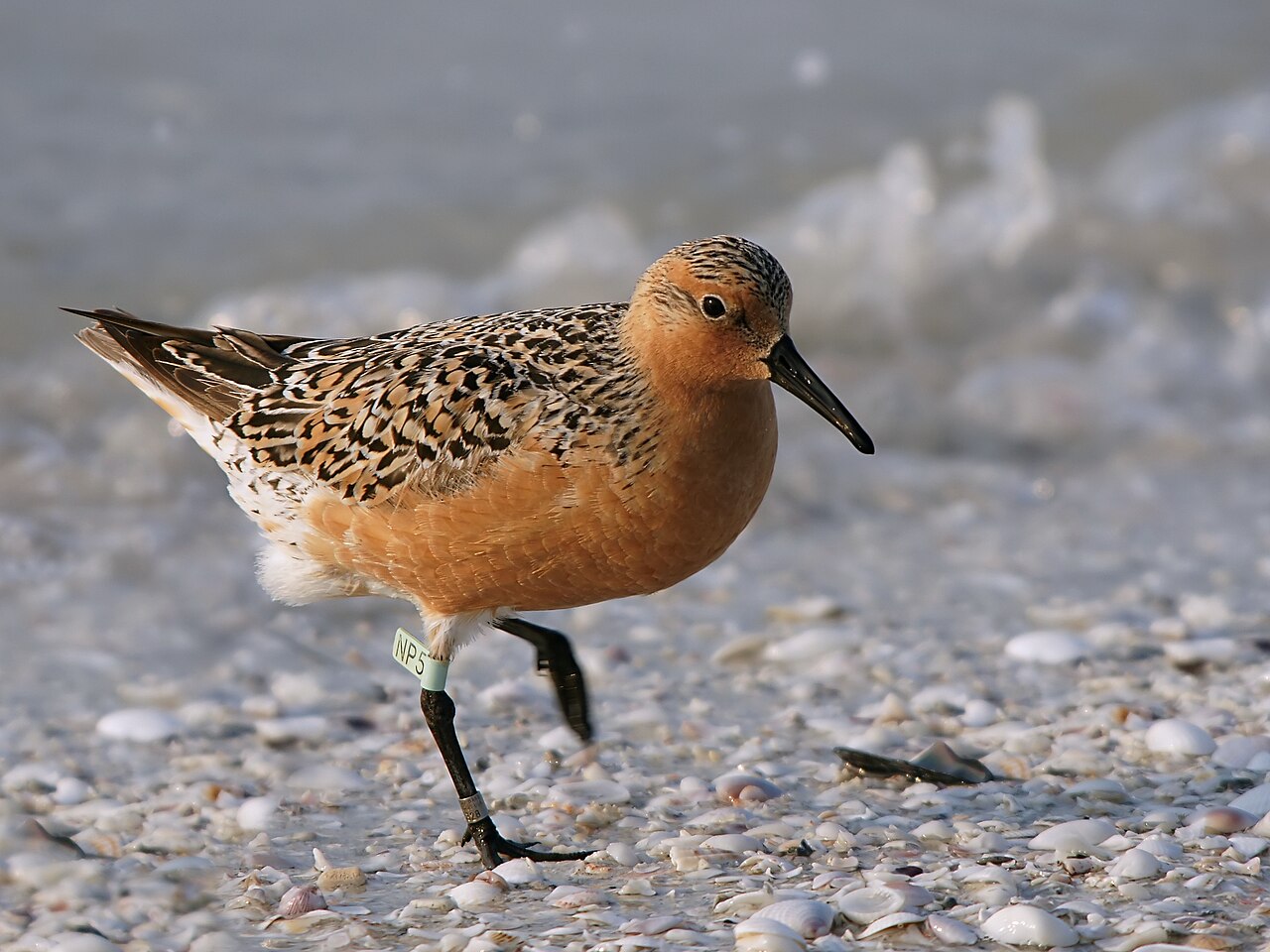
In breeding plumage the face, neck, breast and belly are warm orange-red, and the upperparts are a fine pattern of black, golden brown and grey with rufous feather edges. In winter plumage the bird is plain pale grey above and white below, with a fine grey wash across the breast and a pale eyebrow. The bill is straight, black, about as long as the head and clearly thicker at the base than in the smaller sandpipers; the legs are short and dark grey to olive green. The silhouette is that of a heavy, short-necked bird that walks low over the mud and probes in short, quick jabs. Juveniles have neat, dark-edged feather margins that give the back a scaly look, and often a hint of yellow on the legs. In flight the wingbar is narrow and rump and tail are pale grey, without sharp contrast.
Confusion species
Great Knot (Calidris tenuirostris), an Asian visitor in western Alaska, is larger and longer-billed and in breeding plumage has black spotting on the breast and white rather than red underparts. Dunlin (C. alpina) is smaller and slimmer, with a longer bill that bends down at the tip. Short-billed Dowitcher (Limnodromus griseus) has a far longer straight bill and a white wedge up the back, which Red Knot lacks. In winter plumage the plain pale grey upperparts without markings, together with the short bill and the thickset build, are the quickest mark.
Compare sandpipers, snipes and allies: bill, legs, wing bar and rump
Habitat
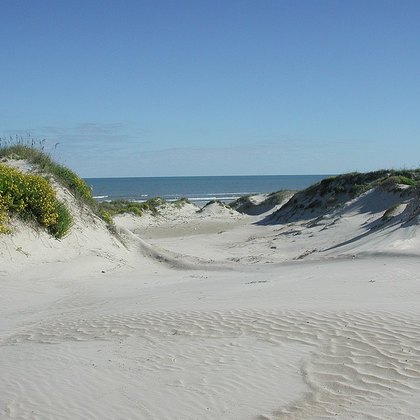
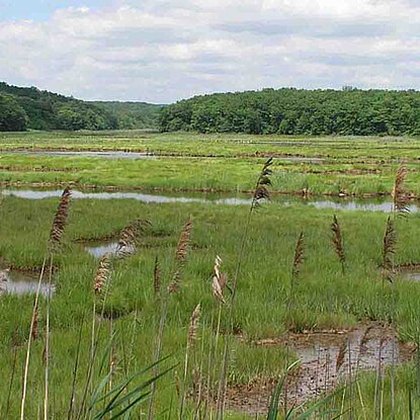
Outside the breeding season this is a bird of wide tidal flats: the mud of estuaries and bays, broad sandy beaches at low water, the margins of lagoons and salt pans, and along some tropical coasts the mud in front of the mangrove. It eats mainly small bivalves, which it feels for with the bill tip in the mud and swallows whole; the shells are ground up in a heavy gizzard. At a few places it lives in spring almost entirely on eggs — of the horseshoe crab in Delaware Bay, of the grunion on the west coast — because it has to double its weight in a short time. It breeds on dry, sparsely vegetated High Arctic tundra: gravel ridges and slopes with lichen and dwarf willow, usually some way back from the coast.
Where the bird is most often found, arranged by the USNVC — the vegetation classification of the United States and Canada — and CMECS for sea and coast.



Range and movements
Three subspecies occur in North America, each with its own route. Calidris canutus subsp. rufa breeds in the central Canadian Arctic, from the islands of northern Hudson Bay by way of Prince Charles Island to Victoria Island, and winters from the southeastern United States and the Caribbean to the coast of Argentina and Tierra del Fuego. Subsp. islandica breeds on the High Arctic islands of Canada and in northern Greenland and leaves the continent: those birds winter in western Europe. Subsp. roselaari breeds on the Seward Peninsula in western Alaska and on Wrangel, and moves down the Pacific to Baja California and beyond. The same species can therefore stand on three coasts at once in May without the birds having anything to do with one another.
- Resident
- Breeding (summer)
- Winter
- Passage
- dark = core range, pale = thinly spread
Where and when to look
The best time is the second half of May on Delaware Bay: on a rising tide the birds stand packed together on the beach in orange-red breeding plumage and feed without pause. Outside that season look for it on a wide tidal flat at low water, in a flock of its own that looks slower and heavier than the sandpipers beside it. With a grey bird, watch three things at once: short straight bill, short neck and plain upperparts without markings.
Conservation
The Red List holds the species as Near Threatened (NT), the step below the threatened categories; the world breeding population is put at about a million birds and more than half has gone in fifty years. The form rufa collapsed around the turn of the century when horseshoe crabs were taken from Delaware Bay on a large scale and too few eggs were left in spring; since 2014 that subspecies has been federally listed as threatened in the United States. The crab harvest has been regulated since, and numbers on the bay have not fallen further, but there is no recovery to the old level. Sea-level rise on the wintering coasts and hunting in parts of the Caribbean and South America count as well.
Scientific name
Calidris canutus | (Linnaeus, 1758)
Linnaeus described the species in 1758 as Tringa canutus; since it was placed in the genus Calidris, author and year stand in parentheses. Calidris goes back to the Greek kalidris, in Aristotle the name of a grey speckled bird of the waterside; the genus was introduced by Merrem in 1804. Explanations of canutus differ: it is linked to the Danish king Canute, and it has also been read as an imitation of the soft call knut. The type locality was given as Europe and later restricted to Sweden. The description stands in the first volume of the tenth edition of the Systema Naturae.