All species › Waders, gulls and terns › Sandpipers and allies › Surfbird
Surfbird | Calidris virgata
Brandingloper | Playero de Rompientes
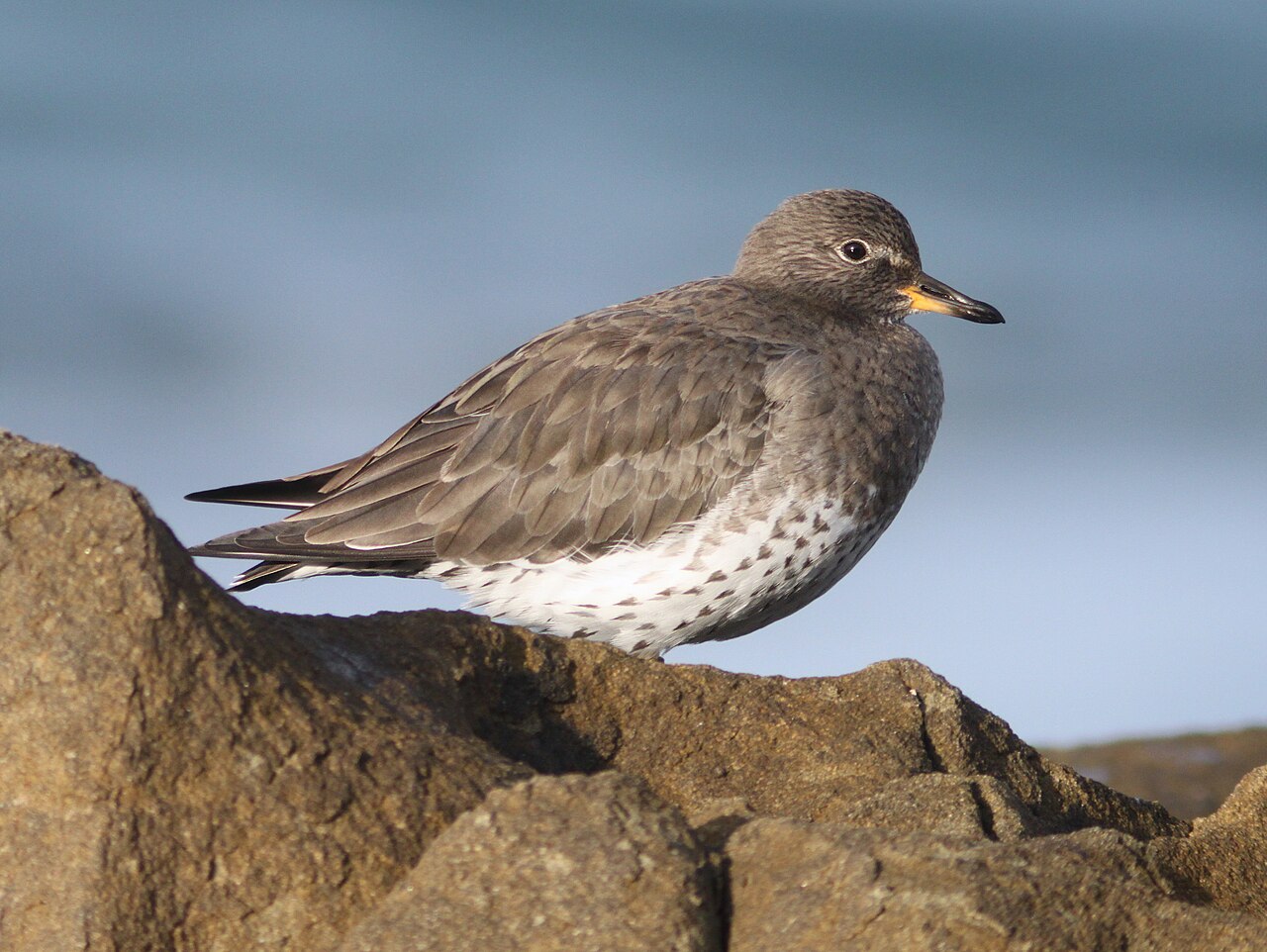
Surfbird is a thickset grey wader of rocks in the swell, with a short thick bill with a yellow base and short greenish-yellow legs. It breeds high in the mountains of Alaska and Yukon, on bare slopes just below the summits, and spends the rest of the year on wet rock platforms along the Pacific. Few waders set their two half-years so far apart: rubble above the treeline against the surf.
Voice
On the breeding grounds the male sings a see-sawing series of scratchy, tern-like dee-derr phrases that rises at the end. There is also a nasal laughing run of notes climbing in pitch, with short clucking ticks and a high screech among them. On the wintering coast this is a quiet bird: a flock waiting on a rock for the water to fall often says nothing at all. Come close and the most you hear between feeding bouts is a soft, high kip. When the flock gets up, the rush of the wings carries further than the voice.
Recording: Davyd Betchkal — CC BY-NC-SA 4.0 · Fang Mountain, United States · xeno-canto
Identification
In breeding plumage the upperparts are a stippled mixture of light, dark and rufous, with large rufous scapulars, and head and underparts are white with black streaks and arrowheads across breast, flanks and belly. In winter plumage that pattern drops away: the bird is then muddy grey-brown above and across the breast, with a white chin and a white belly with some streaking. The bill is short, straight and thick, black with a clearly yellow base; the legs are short, stout and greenish yellow. In flight the tail is white with a broad black terminal band, and a narrow white stripe runs along the wing. The sexes look alike; juveniles are paler than winter adults, with fine pale feather edges on back and wing. On the rock it looks short-necked and heavy, and levers barnacles and snails free with the blunt bill tip.
Confusion species
Black Turnstone (Arenaria melanocephala) sits on the same rocks but is darker, has dull red legs and shows a white wedge up the back in flight, which Surfbird lacks. Rock Sandpiper (Calidris ptilocnemis) is smaller and slimmer, with a longer bill that bends down a little at the tip, and without the heavy head and thick bill base. Wandering Tattler (Tringa incana) is plain grey, longer in leg and bill, and shows no white at all in flight. Ruddy Turnstone (Arenaria interpres) has bright orange legs and a patterned head. At a distance the silhouette settles it: no other bird on those rocks carries so short and thick a bill.
Compare sandpipers, snipes and allies: bill, legs, wing bar and rump
Habitat
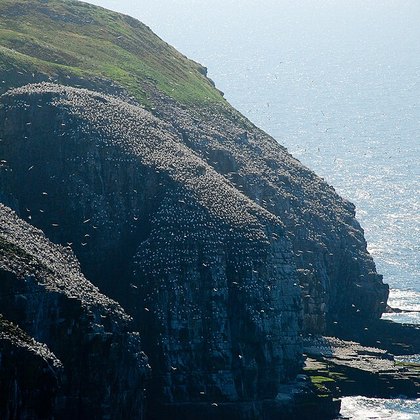
Outside the breeding season this is a bird of hard ground in the intertidal zone: surf-washed rock platforms, reefs, cobble beaches and the weedy rim of islets, and beyond that jetties, piers and breakwaters. It feeds there chiefly on barnacles, periwinkles and small bivalves, which it prises off the stone with the blunt bill and swallows whole. It uses adjoining sand and mud as well, but only within sight of rock to rest on. It breeds far from the sea, on alpine tundra between roughly 150 and 1,800 metres: steep slopes and ridges near the summit, with lichen, moss and dwarf shrubs among the rubble. It passes over open sea and forest.
Where the bird is most often found, arranged by the USNVC — the vegetation classification of the United States and Canada — and CMECS for sea and coast.



Range and movements
The breeding range lies in the mountains of mainland Alaska, all but the far north, and in northwestern Yukon; the first nest was not found until 1926, in the Alaskan interior. From July onward it moves to the coast, and in spring much of the species gathers in Prince William Sound and Kachemak Bay to feed on herring spawn. It winters on rocky coasts down the whole Pacific, from southeastern Alaska to Tierra del Fuego. By far the greater part of that wintering range lies along the coasts of Peru and Chile and so falls outside this map; what the map shows is the northern tip of a ribbon fifteen thousand kilometres long. Inland it is all but unknown.
- Resident
- Breeding (summer)
- Winter
- Passage
- dark = core range, pale = thinly spread
Where and when to look
Look for it between September and April on a breakwater or a weed-covered rock platform, a couple of hours either side of low water, usually in mixed company with Black Turnstones. Watch two things at once: the yellow base of the short thick bill and the greenish-yellow legs. When the flock gets up, the white tail with its broad black terminal band names the species at once.
Conservation
Partners in Flight puts the world population at about 70,000 breeding birds and holds the concern for the species low; the Red List has it as of Least Concern (LC). The vulnerability lies not in the number but in the crowding: in spring much of the species stands on a handful of bays in the Gulf of Alaska, where a single oil spill reaches many birds at once. Disturbance of rocky shores and the squeezing of the intertidal zone by rising sea level are named as threats as well. Because it breeds on inaccessible mountain tundra, the trend is hard to measure.
Scientific name
Calidris virgata | (Gmelin, 1789)
Johann Friedrich Gmelin described the species in 1789 as Tringa virgata, in the thirteenth edition of the Systema Naturae; since it was placed in the genus Calidris, author and year stand in parentheses. For a long time it stood in a genus of its own, Aphriza, made from the Greek aphros, 'sea foam', and zaō, 'to live': the bird that lives in the foam. virgata is Latin for 'striped', from virga, 'twig' or 'stripe', after the streaks and arrowheads on the underparts. The specimen described came from Prince William Sound in Alaska, the same bay where the species still gathers in thousands. The genus Calidris goes back to the Greek kalidris, in Aristotle the name of a grey speckled bird of the waterside.