All species › Waders, gulls and terns › Sandpipers and allies › Great Knot
Great Knot | Calidris tenuirostris
Grote Kanoet | Correlimos grande
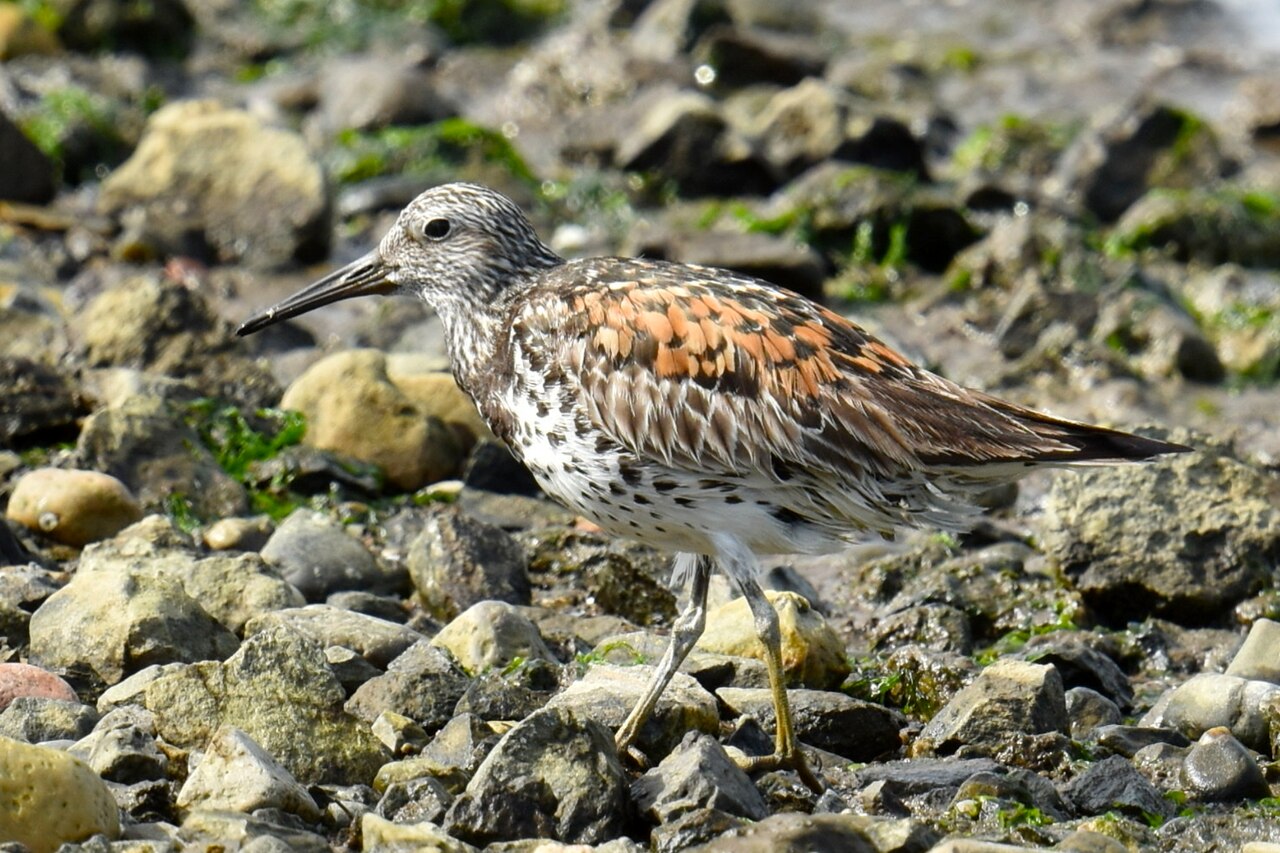
Great Knot is the heaviest sandpiper in the world: a big bird with a long, slightly downcurved bill, carrying a breast full of black spots and rufous scapular patches in breeding plumage. It breeds on mountain tundra in northeastern Siberia and winters on the tidal flats of Asia and Australia, with almost the whole species passing through the Yellow Sea. In North America it is a vagrant: some twenty records are known, nearly all from western Alaska.
Voice
Outside the breeding season this is a silent bird; large flocks on the mud often feed without a sound. The flight call is a soft, low, two-syllable note rendered as nyut-nyut, duller and shorter than the clear calling of most shanks beside it. While feeding, a short low grunt sometimes passes between the birds. On the breeding grounds the male performs a song flight with a drawn-out, plaintive whistle that carries across the bare ridge. A vagrant in Alaska is in practice seldom or never heard.
Recording: Sven Normant — CC BY-NC-SA 4.0 · Ash Sharqiyah South Governorate, Oman · xeno-canto
Identification
This is a large, long-bodied sandpiper with a long black bill that bends down slightly at the tip and is clearly longer than the head, and short dark grey to greenish-grey legs. In breeding plumage the breast is thickly set with black spots that pass into arrowheads on the flanks, the scapulars carry large rufous patches, and the rest of the underparts are white. In winter plumage the upperparts are plain grey-brown with fine dark shaft streaks, and the breast keeps a grey, streaked wash. Juveniles have neat dark feather centres with pale edges, which gives the back a scaly look, and a buff, spotted wash across the breast. In flight a narrow white wingbar shows, and above all the white rump and uppertail coverts, which stand out sharply against the grey tail. The sexes look alike; the female averages a little larger and longer-billed.
Confusion species
Red Knot (Calidris canutus) is the species it is first confused with: smaller and shorter-billed, with red rather than white underparts in breeding plumage and no black breast spotting. Dunlin (C. alpina) is far smaller and in breeding plumage has a black belly patch instead of a spotted breast. Surfbird (C. virgata) has a shorter, thicker bill and a white tail with a black terminal band, where Great Knot shows a white rump and a grey tail. Bar-tailed Godwit (Limosa lapponica), among which it often stands in Alaska, is longer in the leg and has a long, slightly upturned bill.
Habitat
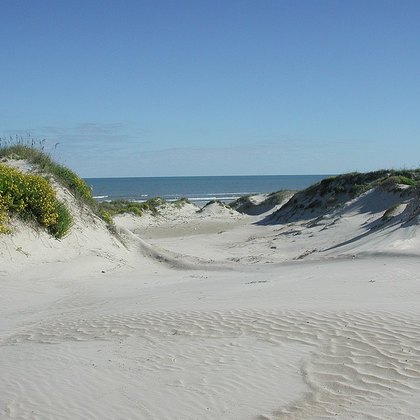
Outside the breeding season it keeps almost entirely to broad tidal flats: the mud and sand of estuaries, bays and lagoons, with a preference for flats holding many small bivalves. It feels for those shellfish with the bill tip in the bottom and swallows them whole; the shells are ground up in a heavy gizzard. At high water it waits in tight flocks on sandbanks, salt marsh and salt pans. It breeds far from the sea, on dry mountain tundra of stone, gravel and lichen in northeastern Siberia. The few birds that reach Alaska stand on muddy coastal flats and along the edges of lagoons.
Where the bird is most often found, arranged by the USNVC — the vegetation classification of the United States and Canada — and CMECS for sea and coast.



Range and movements
The breeding range lies in the mountains of northeastern Siberia, from the country around Yakutsk eastward to the Anadyr Peninsula. It winters on coasts from the northeastern Arabian Peninsula eastward to Taiwan and the Philippines and south to Australia, which holds most of the species; on the way out and back almost every bird uses the tidal flats of the Yellow Sea. North America lies outside that: here the species is a vagrant, with most records in western Alaska — St. Lawrence Island, the Seward Peninsula and the Pribilofs — and scattered sightings further south along the Pacific and on the eastern side of the continent. Most birds appear in late May and June, in full breeding plumage, among other waders arriving from the same quarter.
Where and when to look
The best chance of this species is late May and June on the coast of western Alaska, in a flock of Red Knots or Bar-tailed Godwits. Look for a bird that seems larger than a Red Knot and longer in the bill, then check the breast: thickly spotted with black, without a trace of the knot's red. When the flock gets up, the white rump against the grey tail is the final proof.
Conservation
The Red List holds the species as Endangered (EN). The world population is put at a few hundred thousand birds and has fallen sharply in thirty years, chiefly because the tidal flats of the Yellow Sea have been reclaimed on a large scale; after the closing of Saemangeum in South Korea in 2006 an estimated fifth to a quarter of the world population disappeared within a few years. Recent counts suggest the decline has flattened, but there is no recovery yet. Because nearly every bird needs the same narrow strip of coast on the way out and the way back, the species hangs on a small number of places.
Scientific name
Calidris tenuirostris | (Horsfield, 1821)
Thomas Horsfield described the species in 1821 as Totanus tenuirostris, from a bird wintering on Java, thousands of kilometres from the breeding grounds; since it was placed in the genus Calidris, author and year stand in parentheses. tenuirostris is made from the Latin tenuis, 'thin' or 'slender', and rostrum, 'bill', after the long narrow bill that separates the species from Red Knot. The type locality is given no more exactly than Java. The description appeared in the thirteenth volume of the Transactions of the Linnean Society of London. The genus Calidris goes back to the Greek kalidris, in Aristotle the name of a grey speckled bird of the waterside.