All species › Swifts › Hummingbirds › Green-breasted Mango
Green-breasted Mango | Anthracothorax prevostii
Groenborstmango | Mango pechiverde
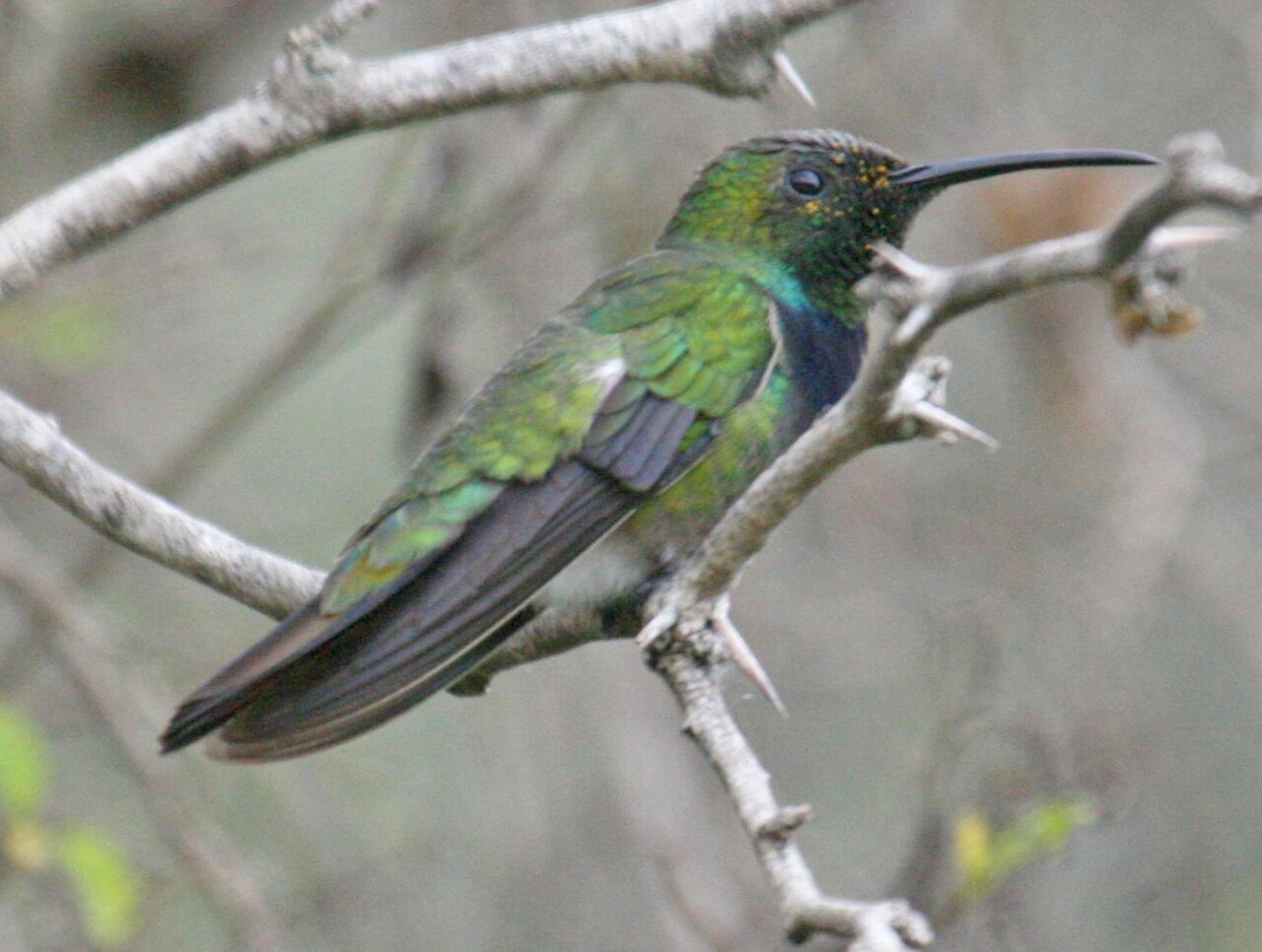
The Green-breasted Mango is a large, brilliant green hummingbird of the lowlands around the Gulf of Mexico, with a velvety black throat stripe edged in metallic blue-green on the male. It turns up only rarely in southern Texas, usually recognisable by that same dark stripe, which no other hummingbird there shows.
Voice
The song is a buzzy, repeated tsi-sisisi-sisisi of up to seventeen notes in a row, sung from an open perch. In flight and while feeding it gives a short, high, sharp sip, which rises to a shrill, high-pitched twitter during aggressive encounters with other mangos at a flowering shrub.
Recording: Paul Driver — CC BY-NC-SA 4.0 · Rancho Naturalista, Cartago, Costa Rica · xeno-canto
Identification
The male has a metallic bronze-green crown, back and upperparts, with a velvety black stripe down the centre of the throat edged in metallic blue-green. The tail runs from bronze-green on the inner feathers to purple on the outer pair. The female is duller, with the same dark throat stripe but less bronze in the plumage and blue-black outer tail feathers tipped white. Young birds resemble the female but are often even duller.
Confusion species
In southern Texas it is most often confused with the Buff-bellied Hummingbird, likewise large and green but with a red, yellow-based bill and plain buffy underparts lacking any dark throat stripe. No other hummingbird regularly found there carries that broad, velvety black stripe down the centre of throat and breast, which alone separates females and young Green-breasted Mangos from every other species in the area. Confusion with Rivoli's Hummingbird or the Blue-throated Mountain-gem is rare, since both of those stay in the mountains far to the west.
Habitat
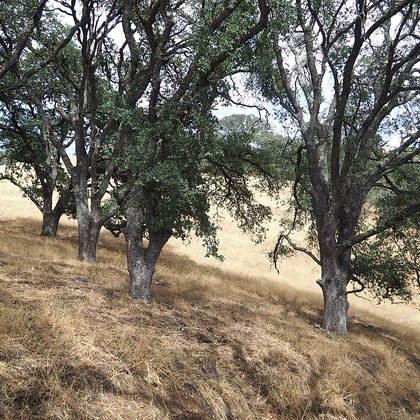
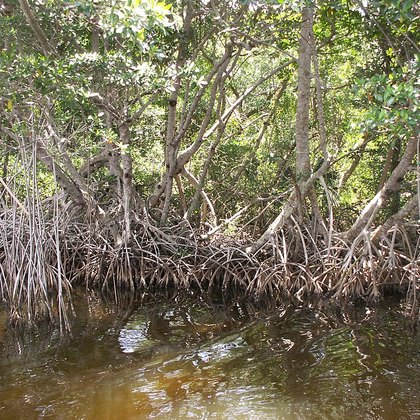
It occupies semi-open to open lowland country: scrub, savanna, secondary forest, mangrove and forest edge, and is also found in planted landscapes such as orchards, parks, gardens and the edges of towns. It is at home from sea level to a few hundred metres; only unbroken, gapless high forest is avoided.
Where the bird is most often found, arranged by the USNVC — the vegetation classification of the United States and Canada — and CMECS for sea and coast.



Range and movements
It is a resident of the Gulf coastal strip and Caribbean lowlands of Mexico, through Central America to Colombia and Venezuela. Northern breeders from southern Mexico withdraw south for a time after breeding, but most populations stay in the same place year-round. Since 1988 there have been at least twenty-five records in Texas, with occasional reports as far as Louisiana, Georgia, Wisconsin and North Carolina.
- Resident
- Breeding (summer)
- Winter
- Passage
- dark = core range, pale = thinly spread
Where and when to look
In southern Texas the best chance is at a sugar-water feeder in a garden with flowering shrubs, where a Green-breasted Mango can hold its ground for days against the local Buff-bellied Hummingbirds. Watch above all for the dark stripe down the centre of the throat: it is always present, regardless of age or sex.
Conservation
Least Concern (LC), with a large range and an estimated population of more than five hundred thousand mature individuals. The trend is slightly declining, but elsewhere the species benefits from gardens, parks and farmland created by people.
Scientific name
Anthracothorax prevostii | (Lesson, 1832)
Lesson described the species in 1832 as Trochilus prevostii; it was placed in other genera before settling definitively in Anthracothorax in 1854, which is why author and year stand in parentheses. The genus was introduced by Boie in 1831, from Greek anthrax (coal, black) and thorax (chest), after the mangos' dark breast stripe. The species name honours the French naturalist Florent Prévost. The type locality is recorded only as 'South America, locality unknown', a vague designation that was later refined.